
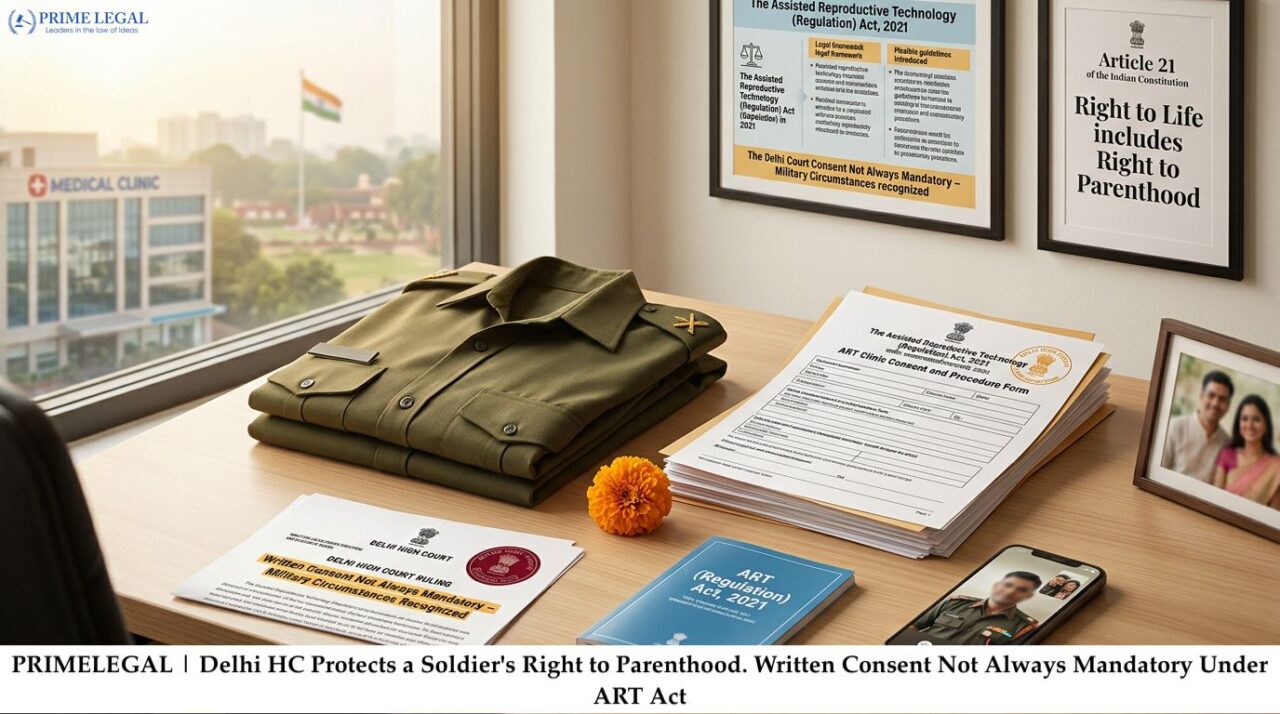
CASE NAME: Ms. X (Anonymised.) v. Union of India & Others
(CDJ 2026 DHC 259 | 2026 DHC 3086)
CASE NUMBER: W.P.(C) 4469 of 2026
COURT: High Court of Delhi
DATE: 13 April 2026
QUORUM: Hon’ble Mr. Justice Purushaindra Kumar Kaurav
FACTS
The petitioner is the wife of Mr – XX Kumar, who is a soldier in the Indian Army and whose name is hidden by the Court. In 2017 the couple married and in June 2023, they chose to use In Vitro Fertilization because they wanted to have a child.
On a day in July 2025, Mr Kumar fell while he was on patrol duty in Jammu and Kashmir. Because of this fall, he sustained a severe injury to his brain. After doctors performed multiple surgeries, he remained in a state where he is alive but cannot move or communicate. Doctors do not expect his nervous system to recover at any time soon.
Authorities in the Army allowed the medical process to continue, but the treatment stopped later because Mr. Kumar is not able to write his permission as Section 22 of the Assisted Reproductive Technology (Regulation) Act, 2021 requires.
To address this the petitioner asked the Delhi High Court to order that doctors collect and freeze the sperm of her husband. By this request she seeks to continue the medical process because the couple previously agreed to and participated in the treatment.
ISSUES
- Whether the husband’s prior consent and participation in IVF treatment could be treated as sufficient compliance under Section 22 of the ART Act
- Whether sperm retrieval and cryopreservation could be permitted despite the husband’s inability to provide fresh written consent.
- Whether strict procedural compliance could override reproductive autonomy protected under Article 21 of the Constitution.
LEGAL PROVISIONS
- Article 21 of the Constitution of India
- Section 22 of the Assisted Reproductive Technology (Regulation) Act, 2021
- X v. Principal Secretary, Health and Family Welfare Department, (2023) 9 SCC 433
- Gurvinder Singh v. State (NCT of Delhi), 2024 SCC Online Del 6902
- Simi Rajan v. Union of India and Others
- Y v. A Healthcare NHS Trust, [2018] EWCOP 18
ARGUMENTS
PETITIONER
As stated by the petitioner, both spouses began the medical treatment of their own will before the accident happened. She stated that the fact that the husband participated earlier shows that he agreed to the reproductive treatment. In her view the only reason she cannot get new written permission is because the accident was not expected and caused him to lose his physical and mental capacities.
It was also argued that if the court denies the procedure, it will go against the right of a person to make their own reproductive choices, a right that is part of the personal liberty and honour that Article 21 of the Constitution protects.
RESPONDENT
As specified in Section 22(1)(a) of the Assisted Reproductive Technology Act, the respondents stated that all involved individuals must provide written informed consent before a medical professional performs any procedure. It is the position of the respondents that the husband of the petitioner has not provided a written document to indicate his current agreement.
For the medical board, the experts reported that it is possible for a doctor to retrieve sperm through surgical means, but the board noted that the probability is low for a doctor to find sperm that are capable of surviving and developing.
ANALYSIS
The Delhi High Court applied the Assisted Reproductive Technology Act looking at the specific goals of the law. It decided that rules about how to do things should not stop the rights of people to have children. In this case the husband and wife chose to start the medical process to conceive before the accident happened. There is no evidence that the husband changed his mind about this process.
By its decision the Court stated that the right to control one’s own body and reproduction is part of the right to life under Article 21. On that account the law must be used in a way that helps people exercise their reproductive rights. To support this view, the Court used previous legal cases like Simi Rajan v. Union of India besides Gurvinder Singh v. State (NCT of Delhi).
It also looked at a case from England called Y v. A Healthcare NHS Trust. All of those cases are about how individuals give permission for reproduction when medical situations are unusual. The Court also stated that a person cannot be refused a medical procedure just because it is not certain that doctors will be able to collect sperm.
JUDGEMENT
The Delhi High Court decided that the husband’s earlier actions in the IVF process satisfy the requirements in Section 22 of the ART Act.
To provide further direction, the Court stated that the petitioner’s consent is valid for later IVF procedures when they are required. By this order the respondents are prohibited from stopping the treatment if the only reason is that the husband cannot provide new written consent.
But the Court stated that the procedure is only allowed if it follows the law and if it is medically possible.
CONCLUSION
In its conclusion, the judgement explains the ART Act in a way that focuses on legal rights. It shows that rules about procedures are not so strict that they stop a person from having control over their body and being treated with respect under Article 21.
By treating the husband’s past participation as enough to follow Section 22, the Delhi High Court kept the legal protections in place while also protecting the constitutional right to make reproductive choices during unusual medical situations.
“PRIME LEGAL is a National Award-winning law firm with over two decades of experience across diverse legal sectors. We are dedicated to setting the standard for legal excellence in civil, criminal, and family law.”
WRITTEN BY: SAMANA
Read the judgment copy below:

