
INTRODUCTION
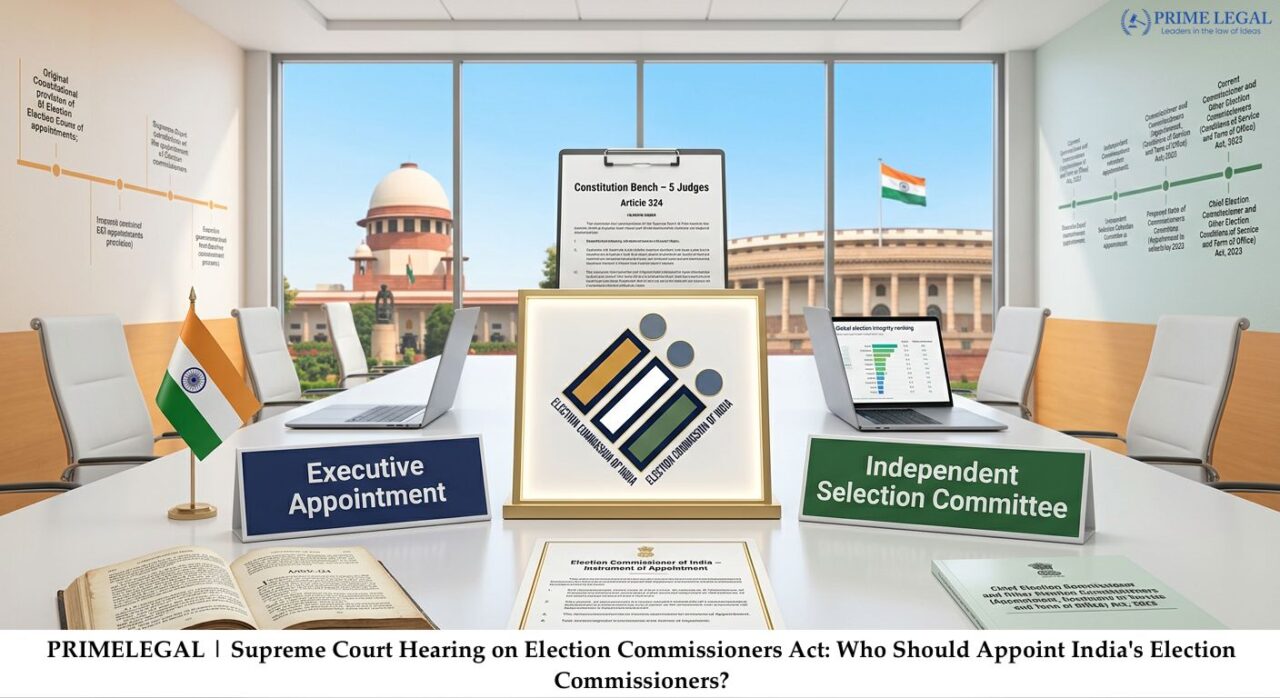
A hearing was conducted by a Division Bench comprising Justices Dipankar Datta and Satish Chandra Sharma of the Supreme Court on 6th May 2026 regarding the Chief Election Commissioner and Other Election Commissioners Act, 2023. This particular law is under review due to its potential effect on the independence of India’s election commission. The said act took away the power of appointment from a Supreme Court-created committee consisting of the Chief Justice of India (CJI). Instead, it gave power to another committee with members dominated by the executive branch. Article 324(2) of the Constitution states that the President will appoint the CEC and ECs as per the law made by the Parliament. For the last seventy years, there has been no such law made by the Parliament, so they have been appointed by the President on the recommendation of the Prime Minister. In March 2023, the Supreme Court filled this lacuna and passed an order that to maintain their utter independence, the selection committee for the appointment of Chief Election Commissioner shall consist of the Prime Minister, the leader of the opposition and the Chief Justice of India.
BACKGROUND
The question about the independence of the Election Commission was first raised in the PIL, Anoop Baranwal v. Union of India [2023] 9 S.C.R. 1. It was claimed that, for 73 years after 1950, Election Commissioners had been appointed by the executive (specifically the office of the Prime Minister) alone. That, according to the petitioners, contravened Article 324, which provided for Parliament to legislate specifically regarding appointments, which had yet to happen. This created a legislative void. Consequently, until such legislation was made, an umpire in the democratic process could not be appointed by any of the sides. In what became an iconic move, the Court established a “stopgap arrangement,” namely, a committee made up of the Prime Minister, the Leader of the Opposition, and the Chief Justice of India (CJI). There was now some sort of “neutralising” judicial authority, which counterbalanced the two other political figures. The Chief Election Commissioner and Other Election Commissioners Act, 2023, was enacted precisely to fill this 73-year-long legislative vacuum. The Act has mostly adhered to the organisational scheme of the Court, except that the post of Chief Justice has been replaced by a Union Minister appointed by the Prime Minister. Consequently, the Executive regained its majority (of two out of three members). Hence, this issue kept getting raised in the case of Dr Jaya Thakur v. Union of India (2026 INSC 97 ).
KEY POINTS
- Justice Datta observed that the decision in 2023 was more about filling the “constitutional vacuum” until the law was enacted. In his opinion, the judgment does not specifically make any provision regarding whether the Parliament should make it compulsory for the CJI to be included in the statutory body.
- The main legal contention here is that fair and free elections are one of the elements in the Constitution’s Basic Structure. As a result, any law that vests the appointment powers completely in the executive is automatically unconstitutional, irrespective of Parliamentary competence to enact it.
- The court questioned the process by which the law was created and whether there was any “proper debate” around its “ethos”.
- The Court has called this matter the “most important of all issues” and refuses to adjourn despite some mistakes in filing the petition.
RECENT DEVELOPMENTS
A Division Bench of Justice Dipankar Datta and Justice Satish Chandra Sharma has been hearing arguments regarding this issue in the Supreme Court for the case Dr Jaya Thakur v. Union of India (2026 INSC 97 ). Wherein the counsel on behalf of the petitioner argued that by having both the PM and a Cabinet Minister on a three-member panel, the government has a permanent 2:1 majority. The ruling party will be able to choose its own “referee” or “Prime Minister’s man,” rendering the Leader of the Opposition a mathematical irrelevance. The petitioners argued that whereas Article 324(2) of the Indian Constitution enables Parliament to enact legislation, such legislation has to be in consonance with the “Basic Structure” of the Constitution, which includes the need for free and fair elections. According to them, an Election Commission “controlled by the Executive” runs counter to this basic tenet of the Constitution. The counsel argued that the 2023 judgment wasn’t just a “stop-gap” for a vacuum; it established a Constitutional Principle that the Executive cannot have exclusive control over ECI appointments. They argue Parliament cannot bypass this principle without a Constitutional Amendment, and a non-independent Commission violates the Right to Equality and the Voter’s Right to Know.
While the Solicitor General, on behalf of the Union Government, argued that the Supreme Court’s 2023 ruling was explicitly meant to last only until Parliament makes a law. Now that a law exists, the vacuum is filled, and the Court cannot issue a mandamus to Parliament to include specific individuals like the CJI in a selection committee. The Union contends that selecting Election Commissioners is a purely executive function. Including a judge (the CJI) in the committee would actually violate the Separation of Powers by involving the Judiciary in a political/administrative selection process. The Court is currently weighing whether “independence” is a procedural requirement (requiring a neutral member) or if any law passed by Parliament fulfils the constitutional mandate regardless of its composition.
CONCLUSION
The Supreme Court’s hearings held in May 2026 ended with the bench reserving judgment after several rigorous rounds of hearings wherein the sovereignty of Parliament as a legislative institution clashed with the constitutional requirement of having a neutral “umpire” in a democratic set-up. Despite the Supreme Court’s doubts about the applicability of the Anoop Baranwal judgment with regard to the structure of the committee, the Court is strongly opposed to the “unprecedented rapidity” with which appointments were made recently, as well as the lack of substantial discussion in the parliament regarding the Act. The decision ultimately comes down to how the Supreme Court feels about institutional independence being a matter of procedure rather than an element of the Basic Structure of the Constitution.
“PRIME LEGAL is a National Award-winning law firm with over two decades of experience across diverse legal sectors. We are dedicated to setting the standard for legal excellence in civil, criminal, and family law.”
WRITTEN BY: B LOUKIKA

