
INTRODUCTION
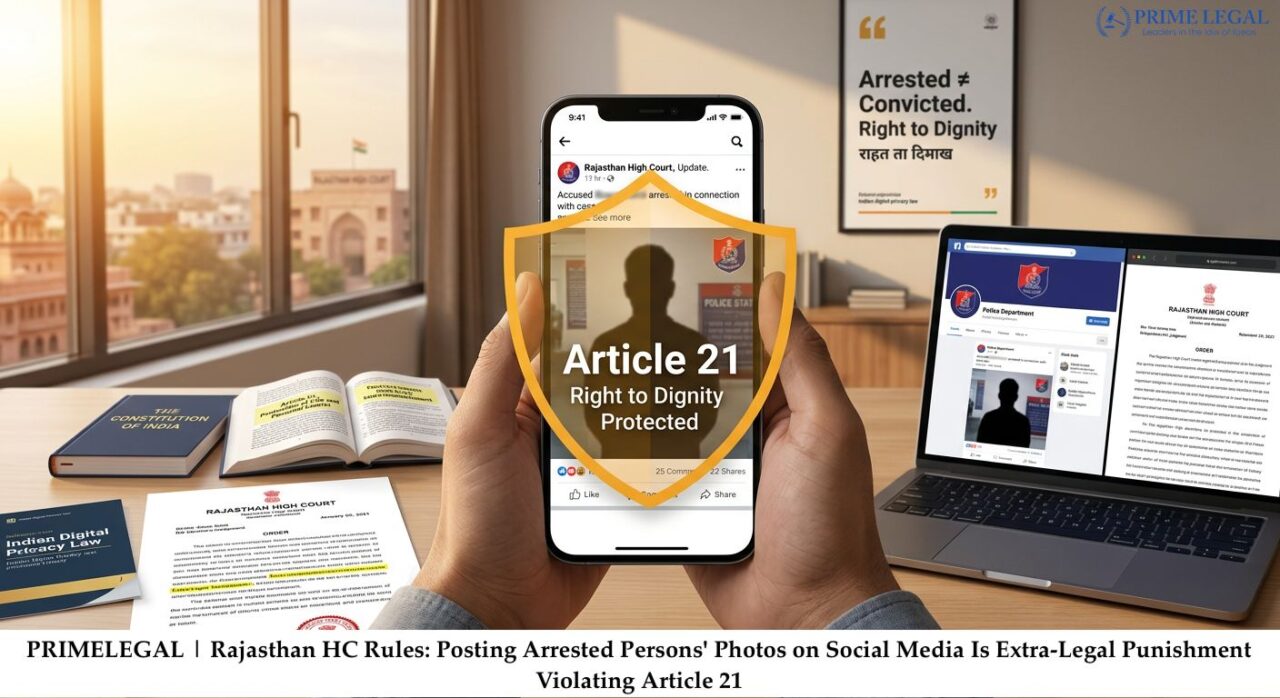
The Rajasthan High Court has taken a very strong view against the rising trend of “digital media trials” conducted by law enforcement agencies. The Court observed that an accused person is entitled to the presumption of innocence until proven guilty by a competent court. By circulating images of arrestees on digital platforms like X (formerly Twitter), Facebook, or Instagram, the police effectively take up on themselves the role of judge, subjecting individuals to social condemnation and permanent stigma before even the trial begins.
BACKGROUND
The ruling arose from a Criminal Writ Petition Islam Khan & Ors. v. State of Rajasthan 2026:RJ-JD:17927 filed by ten residents of Jaisalmer. The petitioners alleged that they were arrested during a protest in a village in July 2025 and the police officials made them sit in humiliating conditions outside the station and took photographs and videos of the same. These visuals were uploaded on the official social media accounts of the police portraying them as hardened criminals.
The petitioners argued that such treatment and its digital dissemination caused irreparable damage to their reputation and mental health. They further contended that such practices have no legitimate investigative purpose and are done only to humiliate the accused, thereby violating their right to fair trial and personal liberty under Article 21.
KEY POINTS
- The Rajasthan HC once again has held that the Article 21 includes the right to life with dignity and it remains intact even if the person is taken to the police custody. The Court held that the arrest is only a procedural step and it doesn’t permit the police officers to harm the mental health of the person being held in custody.
- One of the Judges on the Bench said that once a photo is uploaded and circulated on social media it becomes a ‘digital footprint’ and a stigma is attached to the person’s personality which remains for the rest of their life
- The judgement criticized these practices as a reflection of “colonial consciousness of control and subordination,” which is incompatible with a modern constitutional democracy governed by the rule of law.
- The Court found that neither the Bharatiya Nagarik Suraksha Sanhita, 2023 (BNSS) nor the Police Act, 1861 empowers the police to publicly parade or digitally shame an accused person. Therefore, such acts are “extra-legal” and lack legal authority.
RECENT DEVELOPMENT
On May 5, 2026, the Rajasthan High Court issued binding “Do’s and Don’ts” for the state police force. The Court directed:
- A complete prohibition on sharing photographs or videos of arrested persons on social media or with the press, unless specifically required for investigation (e.g., absconders).
- Police departments were ordered to scan and remove existing “shaming” posts from their official handles.
- Any violation of these guidelines will now be construed as a form of “punishment” not recognized by law, inviting strict disciplinary and legal action against the erring officers.
- These instructions must be prominently displayed in every police station across Rajasthan to ensure both police accountability and public awareness.
CONCLUSION
The Rajasthan High Court’s ruling is a landmark step in curbing the “obstacle to justice” that has become a routine in the era of social media. By framing digital shaming as a form of illegal punishment, the Court has reinforced the boundary between investigation and adjudication. This judgement serves as a reminder that law and order cannot come at the expense of constitutional morality and human dignity that the law is mandated to protect.
“PRIME LEGAL is a National Award-winning law firm with over two decades of experience across diverse legal sectors. We are dedicated to setting the standard for legal excellence in civil, criminal, and family law.”
WRITTEN BY: LISHIKA BATRA

