
ABSTRACT
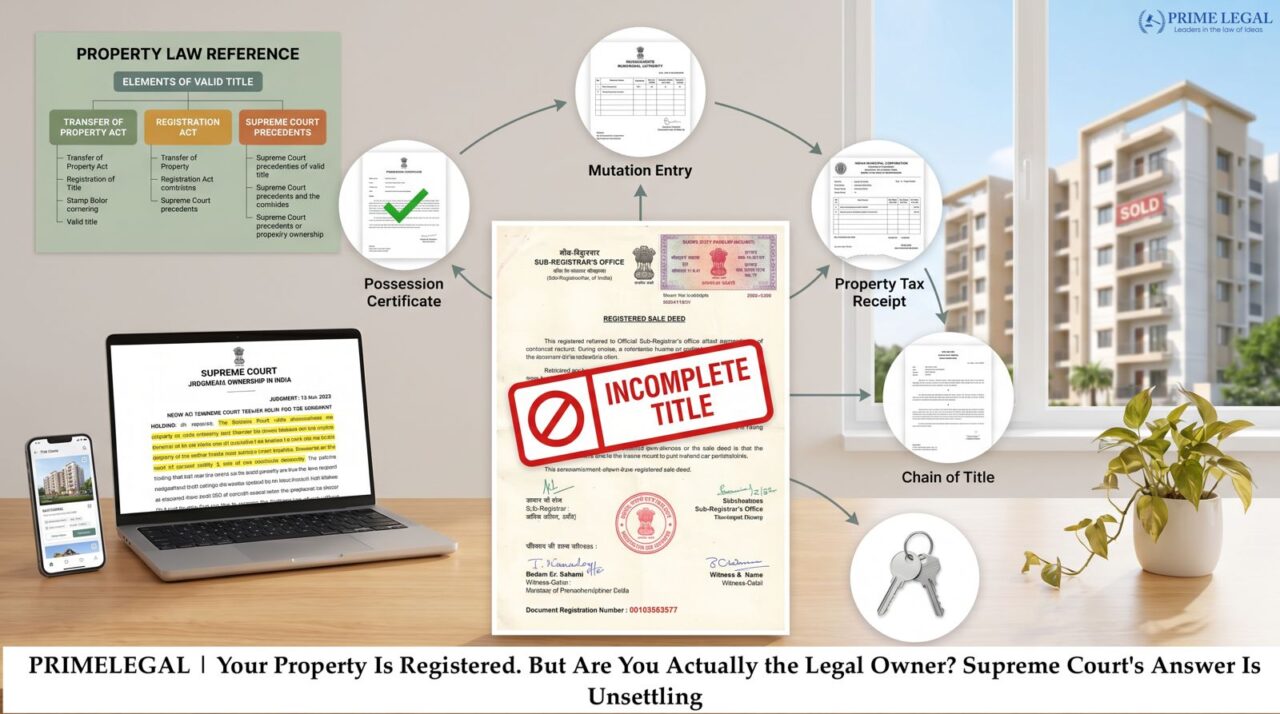
Registration of a sale deed is often mistaken for final proof of ownership. However, in K. Gopi v. Sub-Registrar & Ors. (2025 INSC 462), the Supreme Court ruled that a registered sale deed is only a legal document showing transaction and does not prove ownership. This article discusses the reasoning and relevant statutory provisions to support the judgment’s legal position.
KEYWORDS: Registered Sale Deed, Ownership, Title, Registration Act, Transfer of Property
INTRODUCTION
In India, immovable property is transferred through a registered sale deed. But the common assumption is that a registered sale deed means a conclusive proof of ownership, which is incorrect.
When a person intends to transfer property, it is necessary for them to have the legal right to that property – this rule is a result of the principle of nemo dat quod non habet, which describes how a person is unable to give what they do not have. By the decision in K. Gopi v. Sub Registrar, the Supreme Court of India confirmed that registration is not the cause of ownership.
CORE LEGAL ISSUE
To determine if a registered sale deed is sufficient to prove that a person owns an immovable property.
LEGAL POSITION
It is the rule that ownership relies on if the title of the seller is valid and the transfer is legal. With registration, there is evidence only that a transaction happened.
NATURE OF A SALE DEED
A sale deed is a legal document which records transfer of property and establishes its ownership. It, however, does not confirm whether the seller had ownership rights. If the seller does not have the title, the buyer does not get ownership rights.
REGISTRATION vs. TITLE
The difference between the two terms is that title is the factor that defines who owns a property, whereas registration is the process that ensures that the transfer of property is in a formal record. When a court determines ownership, it is common for judges to examine the sequence of previous owners and if the transfer follows the law.
RELEVANT STATUTORY PROVISIONS
The Registration Act, 1908 and the Transfer of Property Act, 1882 are the primary laws for this matter. Under Section 17 of the Registration Act, it is mandatory that parties register sale deeds for immovable property, but the Sub-Registrar has a restricted function during this process. For this task the official only verifies that the parties sign the document correctly and follow the established steps. It is not within the power of the official to investigate who possesses the legal right to the property. By Section 49, the law specifies that the act of registration allows a person to use the document as evidence in court. It does not mean that an illegal transfer becomes legal.
As stated in Section 54 of the Transfer of Property Act, a sale occurs when a person transfers the right of possession for a specific amount of money. If the person who sells the property does not have a legal right to it, the person who buys it does not receive ownership through a registered deed. In a related manner, the Indian Contract Act, 1872 is applicable here. To be valid an agreement must exist because parties agree freely and the purpose is lawful. If a person uses deceit or the transfer violates the law, an interested party can still dispute the document in court after the registration is complete. On a similar note, the Specific Relief Act, 1963 gives power to courts so that they can void documents which are not valid. Due to those rules, a registered document does not correct a transaction that contains legal flaws.
CASE ANALYSIS
In this legal matter, the parties disputed a situation where a person presented a sale deed for registration – but the Sub Registrar did not register the document because the title of the seller was not clear. Due to specific rules, the authority believed they could investigate who owned the property before they finished the registration. If the petitioner challenged this act, it was because they believed the Sub Registrar is not authorized to examine a title. To resolve the disagreement, the case moved to the Supreme Court.
As the Court considered the facts, the primary question is if a Sub-Registrar is able to deny registration – asking questions about the title. And the Court also asked if the act of registration is what provides ownership to a person.
By its ruling the Supreme Court determined that the duties of the Sub Registrar are narrow and are for the purpose of administration. It is not possible for the authority to investigate matters that involve title or ownership. Registration is only a way to confirm that people signed a document in a manner that follows the law. It is not a process that makes the ownership of the property valid.
For those reasons, the Court stated that a person must prove ownership through a title that is legally sufficient. If a sale deed is registered, it is still not a way to give ownership automatically when the seller is without a proper title. When there is a dispute about ownership, it is necessary for a civil court with the correct authority to decide the outcome.
CONCLUSION
As the court held in K. Gopi v. Sub-Registrar & Ors., ownership is dependent on a valid title rather than only on registration. And it is certain that a Sub Registrar is not authorised to decide questions that relate to title.
“PRIME LEGAL is a National Award-winning law firm with over two decades of experience across diverse legal sectors. We are dedicated to setting the standard for legal excellence in civil, criminal, and family law.”
WRITTEN BY: SAMANA

