
ABSTRACT
As generative artificial intelligence grows quickly, it changes how people produce art, literature, music and journalism across the world. In this context technology companies describe those systems as tools that change processes plus introduce new methods but creators state that developers build AI models using copyrighted material that they collect without permission, credit or payment. Due to lawsuits like The New York Times v. OpenAI besides Getty Images v. Stability AI, there are more global discussions about copyright infringement, fair use and the use of human work. This article examines the ways that generative AI tests traditional copyright rules. It argues that current legal systems are not enough to manage how machine learning systems collect human creative work on a large scale.
KEYWORDS: Generative AI, Copyright Law, Creative Labour, Fair Use, Machine Learning.
INTRODUCTION
In the modern environment, generative artificial intelligence has changed how people create digital content. To produce essays, artwork, music but also code, systems like ChatGPT, Midjourney or Stable Diffusion process large sets of data from the internet – those datasets frequently contain books, articles, photographs and art that millions of individuals created as well as own the rights to.
For those who support generative AI, those systems are acceptable because they “learn” from existing material in the same way that humans learn from books, films and art. On this side of the debate, people believe that AI training is a transformative process or is necessary for technology to advance. However, artists, writers, journalists and musicians are challenging this narrative with the argument that AI companies are commercially profiting from copyrighted works without permission or compensation.
The debate surrounding generative AI has therefore evolved beyond simple questions of copying. It now raises broader concerns regarding labour, ownership and exploitation in digital economies driven by machine learning.
GENERATIVE AI AND COPYRIGHTED TRAINING DATA
Generative AI systems function when machine learning models process large amounts of material from the internet. During this training, those systems identify patterns, structures of language, styles of art and connections between images or text so that they can produce new results.
But many people state that works which have legal protections are necessary for the systems to be profitable. If models did not have access to content that humans create, they would not be able to copy artistic styles, make images that look like real objects or write complex text. Because of this situation, many legal disagreements about copyright exist around the world.
One of those instances is The New York Times v OpenAI, in which the newspaper stated that OpenAI besides Microsoft used millions of articles without legal consent to train AI systems. In a similar way, Getty Images stated in Getty Images v. Stability AI that Stability AI took photographs protected by law, including with visible watermarks, to train models that make images. In Andersen v. Stability AI, artists argued that AI image generators copied and imitated their art in a way that is not legal.
As those cases show, courts now check copyright law against technologies that can take in and copy patterns of human creativity at a speed and volume that was not possible before.
FAIR USE AND THE LIMITS OF COPYRIGHT LAW
In many cases companies that develop artificial intelligence use the fair use doctrine in United States copyright law when they justify how they train models. By this doctrine people can use copyrighted materials in a limited way if they use them for research, criticism or transformative purposes. For those technology companies, the argument is that artificial intelligence systems do not make direct copies of original works. To the companies, the systems change data into results that are different in form and function.
As a basis for this position, supporters point to legal decisions like Authors Guild v. Google. In that case the court decided that Google acted in a transformative way when it turned books into digital data for search tools – but generative artificial intelligence is not the same as a search engine or a technology used for archives. With traditional digital tools, the output does not replace the original source. If a person uses an artificial intelligence system, the system can create content that competes for money against artists, journalists and writers.
On a historical level, legislators created copyright laws during a time when infringement required a person to make a copy that others could identify. Due to the way generative artificial intelligence works, this legal structure is now difficult to apply. It is possible for harm to happen even when the system does not make a direct copy. And because of this, content from artificial intelligence can copy the style of an artist or fill markets with options made by machines. By doing this the technology lowers the price of work done by humans without making an exact reproduction of a specific piece.
When we look at the results, the current copyright rules are not sufficient to control this type of use. For those systems, the process of taking material is based on statistics and happens on a large scale across many sources.
THE EXTRACTION OF CREATIVE LABOUR
When people discuss generative AI, they do not only focus on technology because the conversation is also about jobs and money. It is a fact that AI systems require the gathered work of many artists, photographers, musicians, journalists and writers. To build those systems, companies collect and process the creative works in very large quantities.
Due to those methods, many scholars and creators say that generative AI is a form of “extractive creativity”. In this view the expressions of people are the basic materials that companies use to make a profit through machines. As a contrast to how humans find inspiration, machine learning systems are able to take in patterns from billions of works at the same time.
There are effects of this technology that are now easy to see in many businesses. As an example, illustrations that an AI creates are in competition with artists who work independently. And synthetic music is a threat to composers and musicians who play for recording sessions. By using automated journalism, companies also create uncertainty about how news media will function in the future. If AI outputs are not a direct legal violation of copyright, they are still able to make creative markets weaker – this happens because machines produce many low cost alternatives at a high speed.
On a fundamental level, this situation shows that copyright law has limits. It is true that current legal rules mostly protect authors against others who copy their work – but generative AI causes a different type of financial damage that comes from taking data, imitating styles and replacing workers in the market.
THE INDIAN POSITION ON AI AND COPYRIGHT
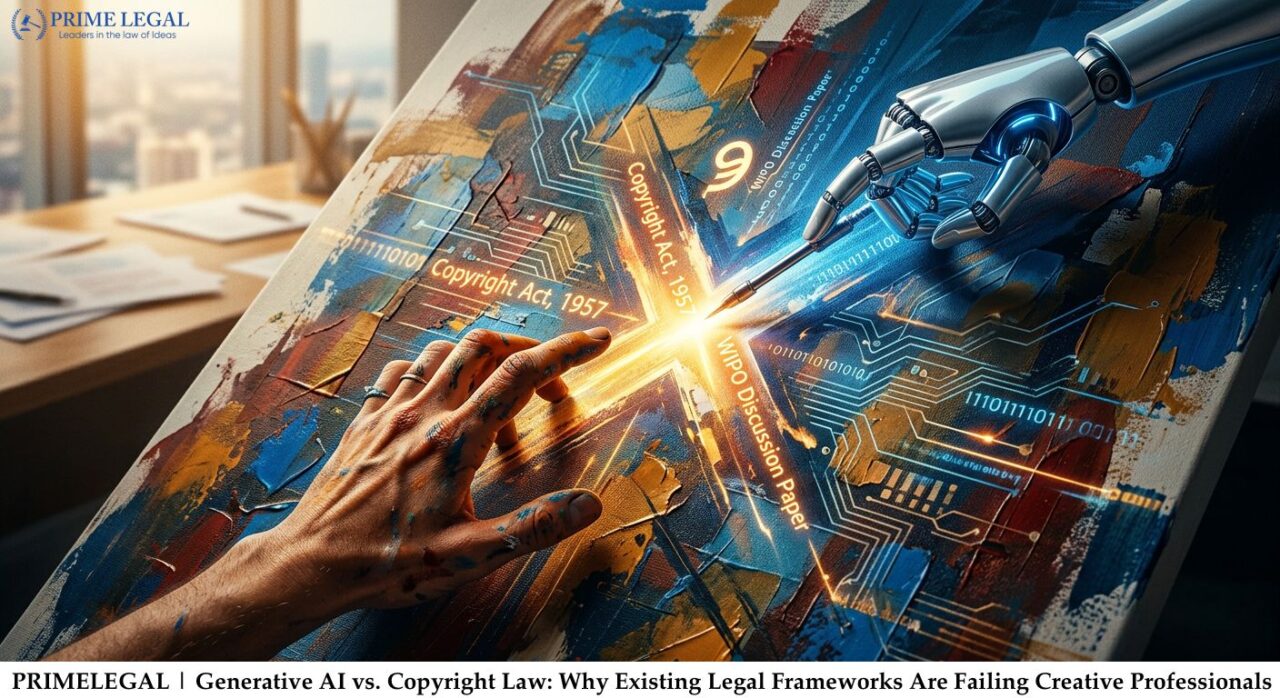
In India, there is no single law that regulates generative AI or the data that developers use to train it. By the terms of the Copyright Act, 1957, the law does not mention machine learning, which means that judges must apply old rules to new digital systems.
On the legal front, the Delhi High Court is now hearing the case of ANI Media Pvt. Ltd. v. OpenAI. To support its claims, ANI stated that OpenAI took news articles without permission to train ChatGPT. And the company argued that the AI produced fake news that it wrongly linked to ANI.
As this case continues, it asks if using copyrighted data to train AI is a legal violation or if it is allowed as fair dealing. To address those questions, the Delhi High Court noted that the problems are new and come from recent changes in technology. For help with those issues, the court chose legal experts to provide advice.
It is likely that this case will set a first example for how India handles AI and the responsibilities of platforms. If AI continues to grow in Indian media and art then courts will have to decide if current rules are enough to keep original works safe.
REIMAGINING COPYRIGHT IN THE AGE OF MACHINE LEARNING
As generative AI grows more common, it shows that people must change copyright law so it stays useful in economies that use machine learning. If officials apply old rules to new technologies, they might not protect creators when systems collect their work in large amounts.
By looking at global proposals, one can see multiple possible changes, which include systems for licensing where AI companies must pay creators when they use their work to train models. There are also rules that make training materials visible and systems where creators choose if a machine can use their work.
On this topic some researchers say that copyright law should not only focus on when a machine makes a copy. They say the law should address when technology replaces workers or treats them unfairly. For lawmakers the difficult task is to make sure that new technology does not harm the people who produce the work that machines use.
CONCLUSION
In the current legal environment, generative AI shows that copyright laws contain many missing parts – this happens because those systems change how people think about who creates, owns and produces work. It is possible for AI to create complex content only because the systems learn from many items that people made and put on the internet.
To technology companies, machine learning is a tool that changes how individuals innovate – but for people who create work, the systems are tools that collect data in large amounts based on work that people did without payment. Existing laws are not sufficient to control technologies that can take, copy and sell human expression in a mass produced way.
The future of copyright law is dependent on if legal systems can change to match how machine learning works. At the same time those systems must protect the money that creators earn and the control they have over their work. As courts in many countries face legal disagreements about generative AI, it is certain that copyright law will change. For many individuals the only remaining question is the total distance of that change.
“PRIME LEGAL is a National Award-winning law firm with over two decades of experience across diverse legal sectors. We are dedicated to setting the standard for legal excellence in civil, criminal and family law.”
WRITTEN BY: SAMANA

