
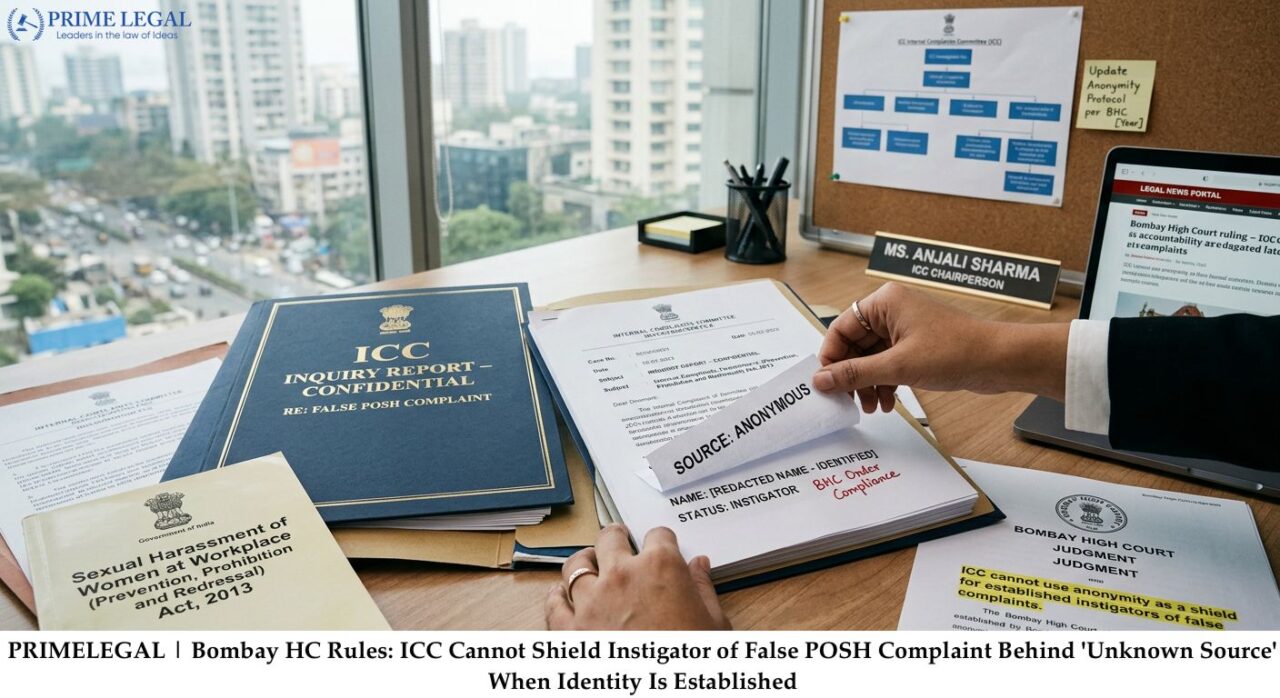
CASE NAME: Shrinivas Shinde v. Directorate of Skill Development & entrepreneurship & Others CDJ 2026 BHC 786
CASE NUMBER: Writ Petition No. 15 of 2026
COURT: High Court of Bombay at Goa
DATE: April 20, 2026
QUORUM: Hon’ble Dr Justice Neela Gokhale
FACTS
The Petitioner in the present case is a Group ‘A’ Gazetted Officer, who has been accused of sexual harassment by Respondent No. 4 (a contract employee). The Internal Complaint Committee (ICC) investigated the given case and found out the allegations to be false and malicious. Further, the ICC concluded that Respondent No. 3 (a colleague) has instigated Respondent No. 4 to file the false complaint against the petitioner but while concluding the case omitted the name of the person who instigated Respondent No.3 and wrote in the report “Unknown Source” which aggrieved the Petitioner.
The Petitioner in furtherance of this sought to have the ICC’s finding regarding the instigation aspect to formally be recorded to clear his name. However, his appeal in this regard was dismissed by the Industrial Dispute Tribunal, stating that it lacked jurisdiction in this case as the petitioner is a Central Government Employee and the “Appellate Authority” for his service is not defined under the POSH Act.
ISSUES
- Whether the Industrial Tribunal had the jurisdiction to entertain an appeal against the ICC’s findings when the service rules (Industrial Employment Standing Orders) were applicable.
- Whether the court can direct the recording of a specific finding that a false complaint was “instigated” by a third party.
- Whether disciplinary action can be directed against the instigator under the POSH Act, 2013.
LEGAL PROVISIONS
- Sexual Harassment of Women at Workplace (Prevention, Prohibition, Redressal) Act, 2013 (POSH Act): Section 11 (Inquiry), Section 14 (Punishment for False Complaint), and Section 18 (Appeals).
- Industrial Employment (Standing Orders) Act, 1946: Defining the “Appellate Authority”.
- Central Civil Services (Classification, Control and Appeal) Rules, 1965: Governing disciplinary proceedings for government servants.
ARGUMENTS
PETITIONER
Argued that since the ICC found the complaint to be false and specifically noted the instigation by Respondent No. 3, this finding must be preserved and recorded. The Industrial Tribunal made an error in dismissing the appeal on technical jurisdictional grounds, leaving the Petitioner without a remedy to save his reputation.
RESPONDENT
Respondent No. 3 argued that the ICC had no power to make findings with respect to a third person who was neither a “complainant” nor a “respondent” in the given case. The State argued that the Industrial Tribunal was not the correct forum for a Group ‘A’ officer.
ANALYSIS
The Court observed that the Industrial Tribunal’s refusal to exercise jurisdiction on hyper-technical grounds was “perverse.” Since the Standing Orders were applicable to the establishment, the Tribunal was indeed the Appellate Authority.
Regarding the merits, the court found clear evidence that Respondent No. 3 has “instigated” the false complaint. While the POSH Act, 2013 primarily focuses on the employer-employee-complainant relationship, the court emphasized that a person who instigates a false/malicious litigation cannot be shielded. However, the Court clarified that while it can record the fact of instigation, it cannot bypass the service rules to order immediate disciplinary action against the instigator without the due process being followed.
JUDGEMENT
The High Court quashed the Order of the Industrial Tribunal. Instead of remanding the case back (which would cause further delay), the Court exercised its extraordinary jurisdiction to modify the ICC’s conclusion. It directed that the final record specifically state:
“The Respondent No. 3 instigated the Respondent No. 4 to file a false sexual harassment case against the Petitioner.”
The Court allowed the Petitioner the liberty to initiate separate appropriate legal proceedings against the instigator.
CONCLUSION
The judgement serves as a vital precedent in protecting the reputation of the individuals who are wrongfully accused of sexual harassment. It establishes that courts will look beyond the immediate parties to address the root cause of false complaints that are the “instigators” while ensuring that jurisdictional technicalities do not obstruct the very path of justice.
“PRIME LEGAL is a National Award-winning law firm with over two decades of experience across diverse legal sectors. We are dedicated to setting the standard for legal excellence in civil, criminal, and family law.”
WRITTEN BY: LISHIKA BATRA
Read the judgement copy below:
Shrinivas Shinde Versus Directorate of Skill Development & Entrepreneurship, Through its Director, Goa & Others

