
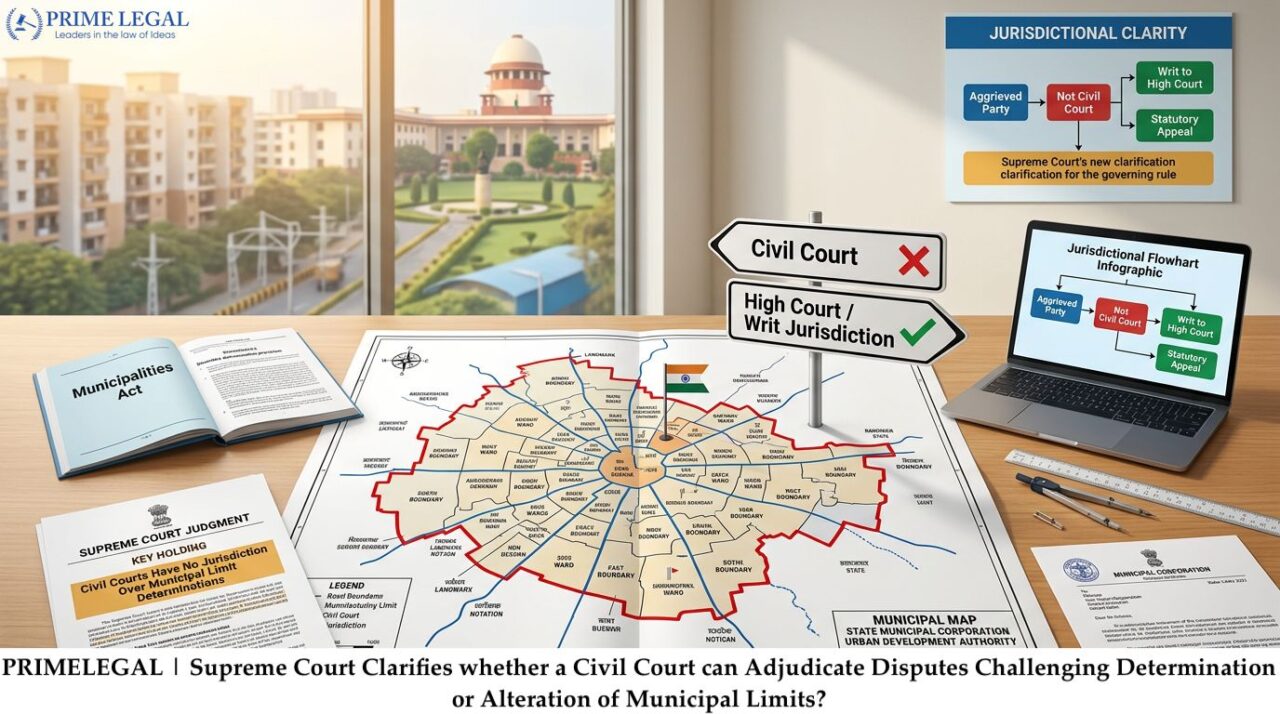
CASE NAME: Unchgaon Village Panchayat v. Kolhapur Municipal Corporation & Another
CASE NUMBER: Civil Appeal Nos. 4684, 4685 of 2026 [Arising out of SLP (Civil) Nos. 10001, 10532 of 2018] & Contempt Petition (Civil) Diary No. 3208 of 2025
COURT: Supreme Court of India
DATE: 22 April, 2026
QUORUM: Hon’ble Mr. Justice Prashant Kumar Mishra and Hon’ble Mr. Justice K.V. Viswanathan
FACTS
The Unchgaon Village Panchayat and the Kolhapur Municipal Corporation disagreed about which authority holds jurisdiction and control over specific lands in Village Unchgaon. As the Panchayat stated, the lands are inside its territorial boundaries, but the Corporation stated that the lands are inside the municipal boundaries of the Kolhapur Municipal Corporation.
On 29 January 2013, the Corporation published a public notice to inform the public that many survey lands in Village Unchgaon are inside municipal limits and that they were affected by development plans, including lands for a truck terminus and dumping ground. With this notice the Corporation also stated that people built structures on the lands without receiving permission from the municipal office, and that they were subject to demolition.
The Panchayat argued that the Corporation never followed the legal process to include the lands in the municipal limits. The Panchayat issued the construction permissions and commencement certificates under the Bombay Village Panchayats Act. They stated that the Corporation intends to destroy structures without following the legal steps that the law requires to extend municipal boundaries.
The Panchayat filed a Civil Suit, requesting a ruling that the lands in question exist outside the municipal boundaries of the Corporation. They also filed an application for temporary injunction under Order XXXIX Rules 1 and 2 of the Code of Civil Procedure, 1908. It requested that the court prevent the Corporation from destroying any structures or using legal authority over the property.
On the initial hearing, the Civil Court decided that it possessed the power to decide the case and granted interim protection, but the High Court of Bombay changed this decision later, stating that the Civil Court does not have the power to hear the dispute as any disagreement about the expansion of boundaries under Section 3 of the Maharashtra Municipal Corporations Act is a matter of making laws. For these reasons, the Panchayat took the case to the Supreme Court.
ISSUES
- Whether a Civil Court can entertain a suit challenging inclusion of lands within municipal limits.
- Whether disputes concerning municipal boundaries and planning control fall within public law rather than private civil rights.
- Whether the suit was barred under Section 149 of the Maharashtra Regional and Town Planning Act, 1966.
LEGAL PROVISIONS
- Section 3 of the Maharashtra Municipal Corporations Act, 1949 – specification and alteration of municipal limits.
- Section 149 of the Maharashtra Regional and Town Planning Act, 1966 – bar on Civil Court jurisdiction.
- Section 9A CPC – determination of preliminary jurisdictional issues.
- Order XXXIX Rules 1 and 2 CPC – temporary injunctions.
ARGUMENTS
APPELLANT
The Panchayat stated that the lands in question are not inside the boundaries of the Corporation because the Corporation is not able to show official documents that prove the inclusion. It claimed that the disagreement involves details about events and legal rules which make a full trial necessary. By the view of the Panchayat, the Civil Court is the correct place for this case and the rules in the MRTP Act do not stop the court from acting.
RESPONDENTS
The Corporation stated that the process to define or change municipal boundaries under Section 3 of the Maharashtra Municipal Corporations Act is a task of the legislature. Because of this status, a person is not able to challenge the boundaries in a civil court. It also stated that the notice for the public is part of its work as a planning authority under the MRTP Act. On that account Section 149 of that Act is a rule that prevents the Civil Court from having power over the matter.
ANALYSIS
In its decision the Supreme Court stated that the actual disagreement is about how municipal boundaries are set and if the Corporation has the power to control the lands. To explain this the Court noted that the actions under Section 3 of the Maharashtra Municipal Corporations Act are legislative. Because those actions are legislative, it is not common for a Civil Court to change them or to give a judgment that declares them invalid.
In the ruling the Court stated that the Corporation functioned in the capacity of a planning authority under the MRTP Act when it issued the notice. Because Section 149 explicitly prevents Civil Courts from exercising authority over matters that arise under this Act, the suit was not capable of being heard.
To clarify the law, the Supreme Court explained that the presence of facts that parties disagree upon does not give authority to a Civil Court if the law places the subject matter outside the power of that court. The Court observed that the municipal records and official notices were from the 1940s. Due to the passage of multiple decades, the court could not consider a legal challenge made through indirect civil actions.
JUDGMENT
By this decision the Supreme Court rejected the appeals and confirmed that the judgment of the Bombay High Court is correct. It found that the Civil Court was without power to hear the suit of the Panchayat because the disagreement involved duties related to the making of laws and the following of statutes regarding town limits and planning rules. The court removed the interim status quo order, and also ended the related legal actions for contempt.
CONCLUSION
The judgment demonstrates that disagreements about how municipal borders are set or changed are matters of public law and the work of the legislature. As a result those issues are usually outside the power of Civil Courts. If a special law includes a prohibition on the authority of a court, that rule must be followed closely, even when the parties do not agree on the facts.
“PRIME LEGAL is a National Award-winning law firm with over two decades of experience across diverse legal sectors. We are dedicated to setting the standard for legal excellence in civil, criminal and family law.”
WRITTEN BY: SAMANA
Read the judgement copy below:
Unchgaon Village Panchayat Versus Kolhapur Municipal Corporation & Another

