
CASE NAME: P. Vijayan v. George & Company Thrissur, Rep By K.M. Unni & Another (CDJ 2026 Ker HC 271)
CASE NUMBER: Crl. Rev. Pet No. 776 of 2020
COURT: High Court of Kerala
DATE: February 17, 2026
QUORUM: Hon’ble Mr. Justice Johnson John
FACTS
The revision petitioner who is the accused was involved in a transaction with the respondent company involving two cheques (totaling Rs. 7,23, 500/-) issued to discharge the debt. When the cheques were deposited, they were dishonored due to “fund insufficiency”. The complainant followed the statutory safeguards provided under Negotiable Instrument Act, 1881, but the accused still failed to make payment.
The Trial Court convicted the accused, sentencing him to seven months of simple imprisonment and compensation. The Appellate Court subsequently confirmed the said conviction but modified the sentence to imprisonment “till the rising of the court” while maintaining the compensation amount as it is. The accused then moved to the High Court in a revision petition.
ISSUES
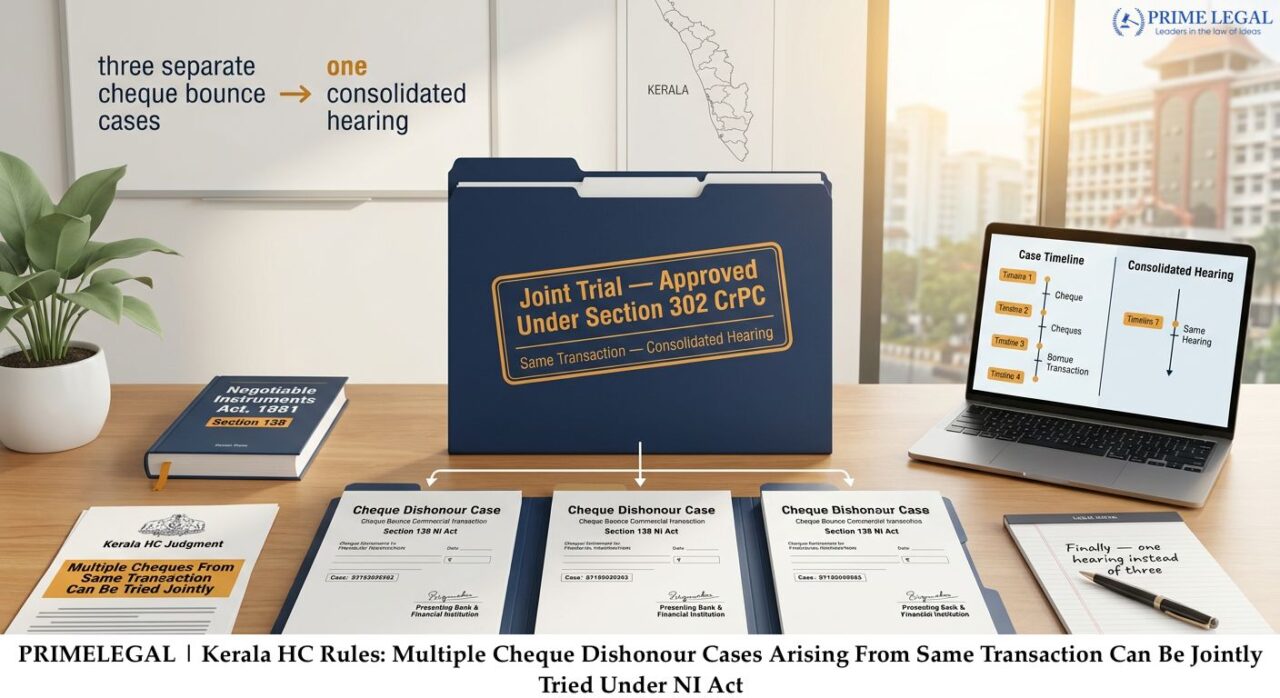
- Whether the joint trial of two cheques issued in a single transaction is legally sustainable under Section 219 of the Cr.P.C (Section 233 BNSS, 2023).
- Whether the Revisional Court can re-appreciate evidence when the Trial and Appellate Courts have reached the same findings of fact.
- Whether there was any illegality or infirmity in the lower courts’ judgements necessitating interference of the revisional court.
LEGAL PROVISIONS
- Negotiable Instruments Act, 1881: Section 138 (Dishonour of cheque) and Section 139 (Presumption in favour of holder).
- Code of Criminal Procedure (Cr.P.C.)/ BNSS: Section 219 (Three offences of the same kind within a year may be charged together)
- Section 233 BNSS, 2023 and Sections 397/401 (Revisional Jurisdiction)/ Section 467 BNSS, 2023.
ARGUMENTS
APPELLANT (REVISIONAL PETITIONER)
The petitioner argued that the courts below failed to appreciate the evidence correctly. A major procedural objection was raised regarding the joint trial of the two different cheques under Section 219 Cr.P.C., suggesting it was not allowed.
RESPONDENT
The respondent asserted that the cheques were issued for the fulfillment of legally enforceable duty of paying debt and that the accused failed to rebut the statutory presumptions under the N.I. Act, 1881. They argued that a joint trial is permissible when offences of the same kind occur within the same year.
ANALYSIS
The Court focused on the narrow scope of Revisional Jurisdiction. It stated that a Revisional Court is not a second court of appeal; it cannot re-appreciate evidence unless there is “an indication of grave injustice” or a “prime facie violation of law.”
On the procedural point, the Court clarified Section 219 of the Cr.P.C. / Section 235 BNSS, which allows for the joint trial of up to three offences of the same kind committed within a span of twelve months. Since both the cheques were part of the same transaction and occurred within the statutory framework of twelve months, the joint trial was deemed to be legal. The court found that the accused failed to provide any evidence to rebut the presumption that the cheques were issued for debt.
JUDGEMENT
The High Court held that there was no illegality, perversity, or infirmity in the findings of the lower courts. The Court upheld the modified sentence passed by the Appellate Court (imprisonment till the rising of the court and compensation).
The revision petition was dismissed.
CONCLUSION
The judgement reaffirms that same findings of fact by Trial and Appellate Courts are generally not interfered by revisional courts unless a jurisdictional error is present. It also provides clarity on the efficiency of joint trials under N.I. Act litigation, preventing unnecessary multiplication of proceedings for cheques issued in a single transaction.
“PRIME LEGAL is a National Award-winning law firm with over two decades of experience across diverse legal sectors. We are dedicated to setting the standard for legal excellence in civil, criminal, and family law.”
WRITTEN BY: LISHIKA BATRA
Read the judgement copy below:
P. Vijayan Versus George & Company, Thrissur, Rep By K. M. Unni & Another

