
CASE NAME: Manjula & Others V. D.A. Srinivas (CDJ 2026 SC 717)
CASE NUMBER: Civil Appeal No. 7370 of 2026 (Arising out of SLP (C) No. 7924 of 2024)
COURT: Supreme Court of India
DATE: May 8, 2026
QUORUM: Hon’ble Mr. Justice J.B. Pardiwala and Hon’ble Mr. Justice R. Mahadevan
FACTS
The dispute concerned several properties purchased in the name of the Respondent (D.A. Srinivas). The Appellants (legal heirs of the late D.A. Lakshmana) filed a suit claiming that while the properties were in the Respondent’s name, the consideration for the same was paid by Lakshmana. They claimed beneficial ownership based on Will and alleged the Respondent held the properties in fiduciary relationship. The Trial Court rejected the plaint, stating it was barred by the Prohibition of Benami Property Transactions Act, 1988. However, the High Court reversed it, restoring the suit for trial. The Appellants then approached the Supreme Court.
ISSUES
- Whether the suit was barred by Section 4 of the Benami Act, which prohibits the right to recover property held benami.
- Whether the “fiduciary capacity” exception under the Act could be invoked based on averments in the plaint.
- Whether the Trial Court was correct in rejecting the plaint under Order VII Rue 11 of CPC at the threshold.
LEGAL PROVISIONS
- Code of Civil Procedure, 1908: Order VII Rule 11 (Rejection of Plaint).
- Prohibition of Benami Property Transactions Act, 1988 Section 2(9): Definition of Benami Transaction.
- Section 4 Prohibition of the right to recover property held benami.
- Section 6 Prohibition on re-transfer of property by benamidar.
ARGUMENTS
APPELLANT (REPRESENTED BY LEGAL HEIRS)
Argued that the suit was a classic attempt to enforce a benami transaction. They contended that a “meaningful reading” of the plaint clearly showed the properties were purchased by one person in the name of the other, which is what exactly the Act forbids.
RESPONDENT
Argued that the matter required a full trial to determine the “intent” of the parties and whether a fiduciary relationship existed between the brothers, which would exempt the transaction from the Benami Act’s prohibition.
ANALYSIS
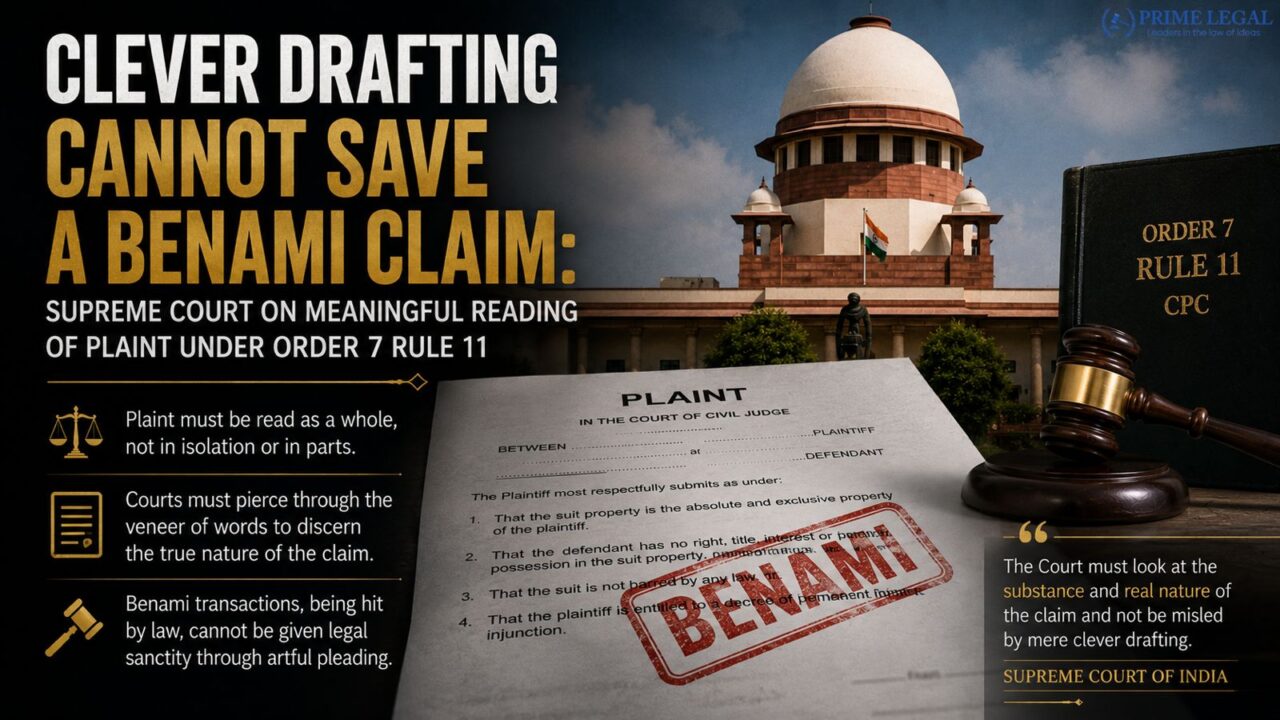
The Supreme Court applied the “meaningful reading” test for Order VII Rule 11. It observed that the Appellants’ own pleadings admitted that the consideration was paid by the father/brother but the title was held by the Respondent. The Court held that the Benami Act is a piece of “prohibitory legislation” intended to kill the source of such transactions.
Crucially, the Court ruled that “fiduciary capacity” cannot be a mere plea to bypass the Act; there must be a pre-existing legal relationship (like a trustee or partner). A brother holding property purchased by another brother does not automatically create a “fiduciary” exception. The Court emphasized that allowing such suits to go to trial would defeat the very purpose of the 1988 Act.
JUDGEMENT
The Supreme Court allowed the appeal and set aside the High Court’s judgement.
The Trial Court’s order rejecting the plaint was restored.
Further, the Court took a stern view of the illegal nature of the transaction. It directed the Central Government to appoint an Administrator and take over the suit properties as per the law within eight weeks, noting that benami transactions should not receive judicial approval
CONCLUSION
This judgement reinforces the strict enforcement of the Benami Act. It clarifies that when a plaint explicitly describes a transaction that falls within the definition of “Benami”, the courts must reject the suit at the outset rather than making it to the trial stage. The Court’s directive to confiscate the property highlights that the law is not just punitive but serves a larger public purpose of preserving the sanctity of lawful ownership.
“PRIME LEGAL is a National Award-winning law firm with over two decades of experience across diverse legal sectors. We are dedicated to setting the standard for legal excellence in civil, criminal, and family law.”
WRITTEN BY: LISHIKA BATRA
Read the judgement copy below:

