
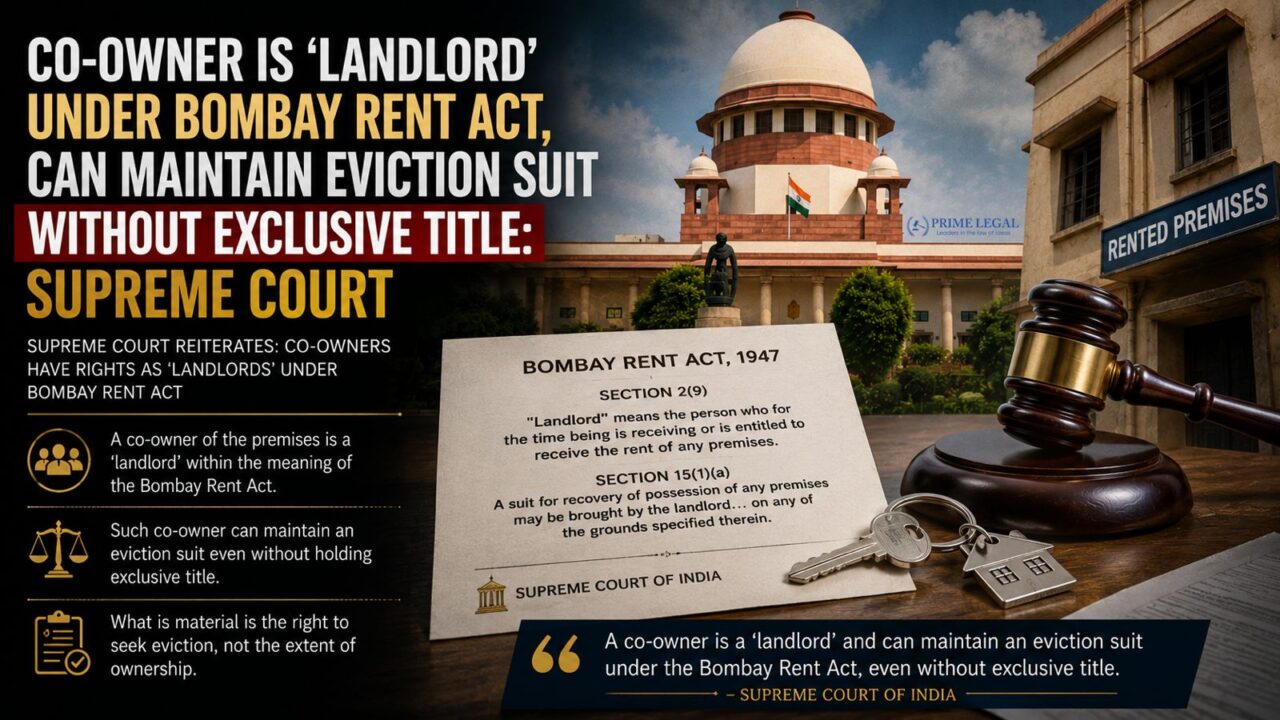
CASE NAME: Marietta D’ Silva v. Rudolf Clothan Lacerda & Ors.
CITATION: CDJ 2026 SC 771 | 2026 INSC 496
CASE NUMBER: Civil Appeal No. ___ of 2026 (Arising out of SLP(C) No. 31012 of 2025)
COURT: Supreme Court of India
DATE: 15 May, 2026
QUORUM: Hon’ble Mr. Justice Manoj Misra and Hon’ble Mr. Justice Manmohan
FACTS
The dispute arose from Flat No. 2 situated in the “Memorare Building” at Chembur, Mumbai. On the land where the building exists, St. Anthony’s Homes Cooperative Society Ltd. had provided a lease for 99 years to the parents of the appellant, Marietta D’ Silva. The appellant’s parents later constructed a building with six flats. On 6 June 1959, the society issued five share certificates.
On 6 June 1962, the father of the appellant signed an agreement for a sub tenancy regarding Flat No. 2 with Augustine/Cyprian O, who is the father of Defendant Nos. 1 – 3. When he died on 7 December 1969, the tenancy passed to his widow, Virginia Lacerda. On 5 July 1987, the share certificates were jointly transferred in names of the appellant, her sister and other members of the family.
In March 1993, Virginia Lacerda died. For the purpose of removing the legal heirs, the appellant filed an eviction suit in July 1993 under Sections 13(1)(g), 13(1)(l), 13(1)(k) and 13(2) of the Bombay Rents, Hotel and Lodging House Rates Control Act, 1947. She claimed a genuine need for the space, bona fide requirement, acquisition of alternative accommodation, change of user and comparative hardship.
At the time when the appellant started the suit, her parents lived in Flats 5 and 6, but the father of the appellant died on 24 February 1994. The appellant moved to Mumbai for a limited duration and stayed with her mother in those flats.
The family members made an oral agreement that the brothers have the right to use Flats 5 and 6 exclusively. Upon eviction of the tenants, Flat No. 2 was for the appellant.
The Small Causes Court ordered the tenants’ eviction on 14 September 2007. It held that the appellant needs the property for a legitimate reason and that the tenants have other places where they can live. On 25 July 2017, the Appellate Bench affirmed this.
The Bombay High Court, however, changed this result on 23 June 2025 in Civil Revision Application No. 308 of 2019. The court set aside the previous decisions and gave an instruction that the tenant must receive the property back.
ISSUES
- Whether the appellant had sufficiently pleaded and proved her status as landlord/co-landlord of the suit premises?
- Whether evidence regarding share certificates and oral family arrangement could be relied upon despite not being specifically elaborated in the plaint?
- Whether the appellant had established a bona fide requirement and comparative hardship under the Rent Act?
- Whether courts may consider subsequent developments arising after the institution of the suit?
LEGAL PROVISIONS
- Order VI Rules 1 and 2 of the Code of Civil Procedure, 1908 – relating to pleadings and material facts.
- Section 13(1)(g) of the Bombay Rents, Hotel and Lodging House Rates Control Act, 1947 – eviction on the ground of bona fide requirement of the landlord.
- Section 13(1)(l) of the Bombay Rents, Hotel and Lodging House Rates Control Act, 1947 – eviction where the tenant has acquired alternative suitable accommodation.
- Section 13(1)(k) of the Bombay Rents, Hotel and Lodging House Rates Control Act, 1947 – change of user of the premises.
- Section 13(2) of the Bombay Rents, Hotel and Lodging House Rates Control Act, 1947 – comparative hardship between landlord and tenant.
- Section 5(3) of the Bombay Rents, Hotel and Lodging House Rates Control Act, 1947 – definition of “landlord”.
- Sections 3 and 8 of the Transfer of Property Act, 1882.
Important precedents:
- Bachhaj Nahar v. Nilima Mandal (2008) 17 SCC 491
- Virender Nath Gautam v. Satpal Singh (2007) 3 SCC 617
- Ram Sarup Gupta v. Bishun Narain Inter College (1987) 2 SCC 555
- Pasupuleti Venkateswarlu v. Motor & General Traders (1975) 1 SCC 770
- Kale v. Deputy Director of Consolidation (1976) 3 SCC 119.
APPELLANT
The appellant stated that she was a co-landlord when the suit was filed. She pointed to the share certificates from 1987, where her name was present with others. She claimed that the details about the family agreement are only facts that show the truth of the main points in the case. By her further statements, the appellant did not have a house of her own in Mumbai, due to which, her requirement for the property was based on a true need.
RESPONDENTS
The respondents said that there was no specific description in the papers by which the appellant became the landlord of the property. According to them, the appellant attempted to improve her case through evidence by introducing an oral family arrangement and reliance on share certificates which had not been expressly pleaded in the plaint. Relying upon Bachhaj Nahar v. Nilima Mandal, they argued that no relief could be granted on the basis of unpleaded facts.
ANALYSIS
The Supreme Court talked about how pleadings differ from the proof provided in a case. It stated that pleadings must include only material facts rather than the evidence proving that those facts are true. The Court made a distinction between facta probanda (material facts requiring proof) and facta probantia (evidence used to establish those facts).
The Court held that the plaint sufficiently disclosed the appellant’s status as co-landlord and the statutory grounds for eviction. The affidavit evidence, family agreements and the share certificates only supported the facts in the pleadings. The documents did not create a new case. deficiency in pleadings cannot ordinarily be raised for the first time in appeal where parties clearly understood the dispute and led evidence accordingly. They also noted that oral agreements were legally enforceable.
JUDGEMENT
The Supreme Court permitted the appeal and set aside the judgment from the Bombay High Court on 23 June 2025. The eviction decree passed by the Small Causes Court on 14 September 2007 was restored. The Court held that the appellant had successfully proved her status as co-landlord, bona fide requirement and comparative hardship in her favour.
CONCLUSION
This judgement clarified the difference between pleadings and proof under civil procedure. The Court focused on the actual meaning of the case rather than its form. The Supreme Court adopted a substance-oriented approach and held that evidentiary details supporting already pleaded material facts need not themselves be specifically pleaded. The ruling also reaffirmed the validity of oral family arrangements and the power of courts to consider subsequent developments in eviction proceedings. Ultimately, the Court prioritised substantial justice over technical objections relating to drafting deficiencies in pleadings.
“PRIME LEGAL is a National Award-winning law firm with over two decades of experience across diverse legal sectors. We are dedicated to setting the standard for legal excellence in civil, criminal, and family law.”
WRITTEN BY: SAMANA.
Read the judgement copy below:

