
CASE NAME: Brijesh Kothia v. State NCT of Delhi
CASE NUMBER: BAIL APPLN. 439/2026
COURT: High Court of Delhi at New Delhi
DATE: 13 May 2026
QUORUM: Hon’ble Mr. Justice Anup Jairam Bhambhani
FACTS
On 02 October 2024, the police registered FIR No. 455/2024 at P.S. Special Cell, Delhi – this case involves Sections 8, 20, 21, 25 and 29 of the Narcotic Drugs besides Psychotropic Substances Act, 1985 (NDPS Act). In the chargesheet, the authorities added Sections 22 and 27A of the NDPS Act along with Sections 238B and 209 of the Bharatiya Nyaya Sanhita, 2023.
By 13 October 2024, officers arrested the petitioner, Brijesh Kothia, in Ankleshwar in District Bharuch, Gujarat. He filed a petition for regular bail under Section 483 of the Bharatiya Nagarik Suraksha Sanhita, 2023 (BNSS).
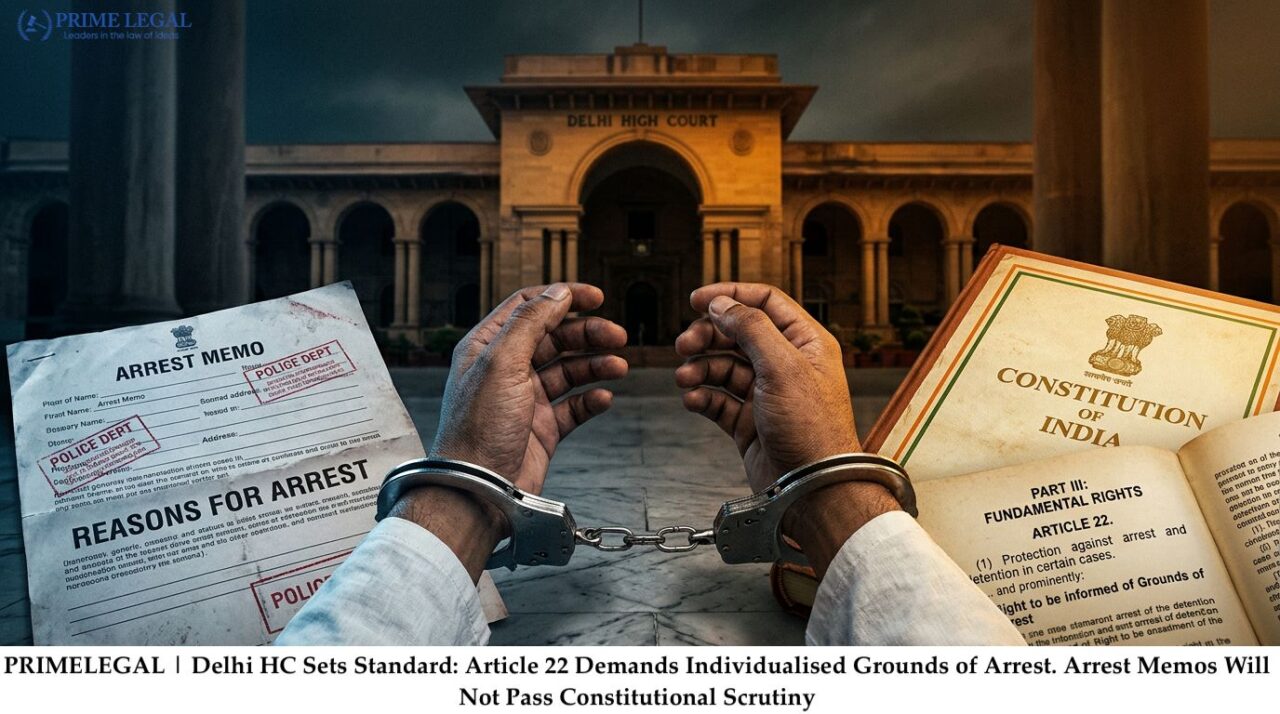
As part of his argument, the petitioner stated that the investigating agency did not provide him with the “grounds of arrest” in a written format. He claimed this failure occurred when the arrest happened and before he appeared before the Magistrate for transit remand. With this focus he argued that the arrest memo contained only broad and non-specific justifications for his detention rather than facts that applied specifically to his situation.
But the State opposed the petition and presented a different interpretation of the legal requirements. According to the State, the obligation to provide written grounds for arrest is a rule that became binding only after the Supreme Court delivered its judgment in Mihir Rajesh Shah v. State of Maharashtra & Anr. on 06 November 2025. Since the arrest of the petitioner was in October 2024, the State argued that the court cannot apply the judgment retrospectively.
ISSUES
- Whether failure to furnish written grounds of arrest violates Article 22(1) of the Constitution.
- Whether non-supply of written grounds of arrest renders the arrest and remand illegal.
- Whether the principles laid down in Mihir Rajesh Shah apply to arrests made before the judgment was delivered.
LEGAL PROVISIONS
- Article 21 and Article 22(1) of the Constitution of India.
- Section 47 of the Bharatiya Nagarik Suraksha Sanhita, 2023.
- Sections 8/20/21/22/25/27A/29 of the NDPS Act, 1985.
- Case Laws:
- Pankaj Bansal v. Union of India & Ors.
- Prabir Purkayastha v. State (NCT of Delhi)
- Vihaan Kumar v. State of Haryana & Anr.
- Mihir Rajesh Shah v. State of Maharashtra & Anr.
- Dr. Rajinder Rajan v. Union of India & Anr.
ARGUMENTS:
PETITIONER
To start the legal argument, the petitioner stated that Article 22(1) of the Constitution makes the delivery of written reasons for an arrest a required protection. For this position, the petitioner cited decisions from the Supreme Court like Pankaj Bansal, Prabir Purkayastha, Mihir Rajesh Shah besides Dr. Rajinder Rajan.
As part of the submission, the petitioner claimed that officials did not provide written reasons for the arrest before the transit remand in Gujarat or the remand proceedings in Delhi. If this information is missing, a person cannot talk to a lawyer in a useful way or resist the remand process. Because the petitioner lacked those details, he argued that his legal situation suffered harm.
RESPONDENT
By contrast the State argued that the rule for written reasons should only apply to future cases following the Mihir Rajesh Shah judgment. It is also the position of the State that the remand applications given to the courts contained enough information to explain the reasons for the arrest. The State argued that the failure to give written reasons is a minor error in process. In this view such an error does not make an arrest unlawful by itself.
ANALYSIS
When the Delhi High Court reviewed the case, it looked at the constitutional duty to tell a person why they are under arrest. There are multiple cases, including Pankaj Bansal, Prabir Purkayastha, Vihaan Kumar, Mihir Rajesh Shah or Dr. Rajinder Rajan, where the Supreme Court treated this duty as a fundamental and essential protection under Article 22(1).
On this point the Court separated general “reasons for arrest” from specific “grounds of arrest”. It is the final ruling of the Court that reasons for an arrest must relate directly to the individual person and must be in a written format.
In this case the Court did not agree with the claim from the State that the ruling in Mihir Rajesh Shah only applies to prospectively. It stated that the decision reaffirms the protections in the Constitution which earlier rulings had already identified.
When the Court examined the facts, it saw that officials did not provide written reasons for the arrest to the petitioner before the proceedings for transit remand in Gujarat or the remand for police custody in Delhi. It decided that this failure resulted in a clear disadvantage for the petitioner because he lacked a functional chance to argue against the remand.
JUDGEMENT
On 13 May 2026, the Delhi High Court allowed the petitioner to receive regular bail. To justify this the Court explained that the arrest and the later remand are legally unsound because the authorities did not deliver written reasons for the arrest during the period that the Constitution requires, but it also explained that the petitioner receives bail because the arrest is illegal, while the investigation and the trial remain valid.
For the bail to take effect, the petitioner must follow specific rules, that he must provide personal bonds and sureties, give up his passport, assist the people who investigate the case and not talk to witnesses or change any evidence.
CONCLUSION
By this judgment the Court shows that the act of telling a person the written reasons for their arrest is a requirement under Article 22(1) of the Constitution and is not just a small task in a process. And the Delhi High Court confirmed that the arrest and remand are against the Constitution if officials do not follow this rule, even if the person faces accusations of serious crimes under the NDPS Act.
The decision also clarifies that the principles recognised in Mihir Rajesh Shah are rooted in pre-existing constitutional protections and are not confined only to arrests made after that judgment.
“PRIME LEGAL is a National Award-winning law firm with over two decades of experience across diverse legal sectors. We are dedicated to setting the standard for legal excellence in civil, criminal, and family law.”
WRITTEN BY: SAMANA
Read the judgement copy below:

