
INTRODUCTION
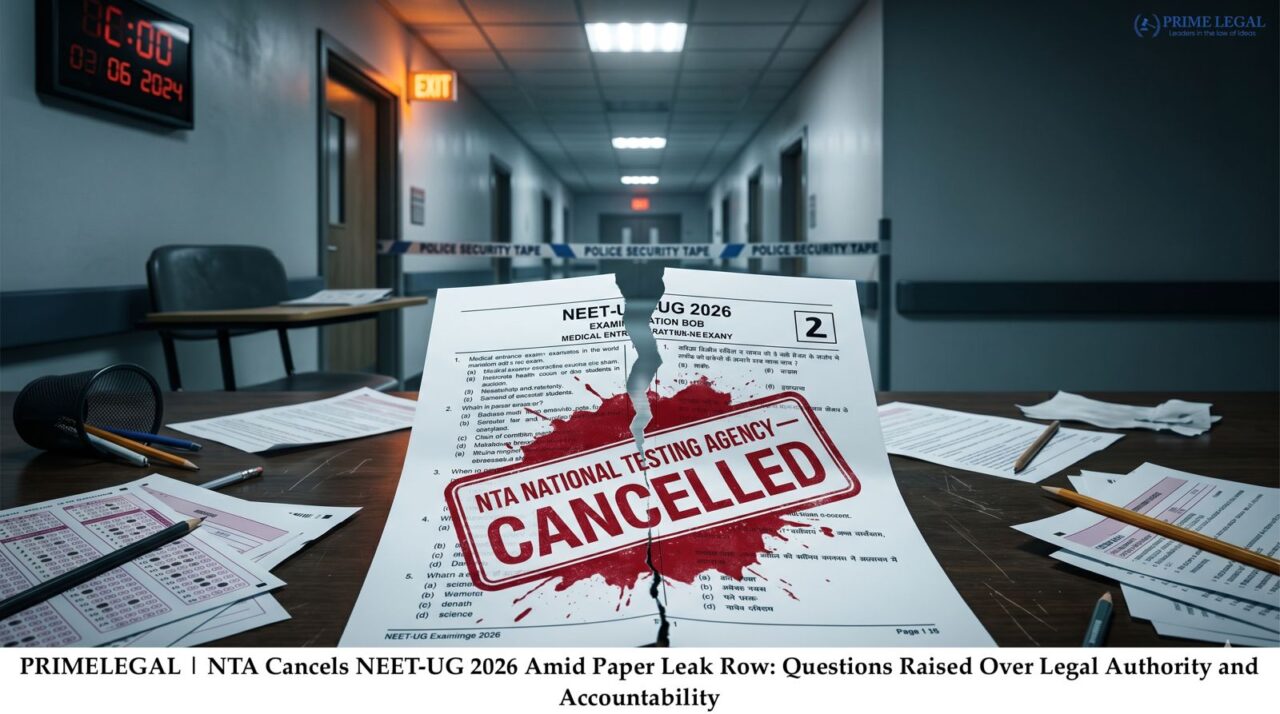
The National Testing Agency (NTA) nullified the NEET-UG 2026 examination which occurred on 3 May 2026, this action followed claims that individuals distributed the paper beforehand and that many people cheated during the test. Because of this decision, people are protesting across the country, politicians are expressing disapproval and many individuals are submitting legal requests to the Supreme Court.
Reports indicated that organised networks spanning multiple states shared private materials from the test for money. If we look at the results of the investigation, agencies claim they found that many questions on the official test are the same as those in a “guess paper” which individuals received before the date of the exam.
But this situation involves more than just a failure to follow rules during a test. It creates serious questions about the constitution and administrative law. People are questioning what powers the NTA can use and if it is legal to cancel examinations that happen nationwide. To assess the situation let’s focus on if the State is fulfilling its duty to provide a system for education where everyone is treated fairly but also processes are clear.
BACKGROUND
In November 2017, the Ministry of Education, which people formerly called the Ministry of Human Resource Development, created the National Testing Agency. It is an autonomous testing organisation that manages entrance examinations at the national level. In 2018 the NTA began its operations. To achieve its goals, the agency builds examination systems that are transparent and use technology to ensure all procedures are the same for everyone.
There are multiple major examinations that the NTA conducts at this time, such as NEET-UG, JEE Main, CUET, UGC-NET, etc.
As a legal entity, the NTA is not a statutory body because the Parliament did not create it through legislation. It is a registered society that follows the Societies Registration Act, 1860. It is under the administrative control of the Ministry of Education. For its authority, the agency relies on executive powers that the Union Government uses under Article 73 of the Constitution.
Due to its role the NTA performs public functions that are important. Those functions decide if hundreds of thousands of students can enter universities or access educational opportunities. Because those actions are significant, they are subject to judicial review under Articles 32 and 226 of the Constitution.
When the NEET-UG 2026 controversy grew, it happened because the Special Operations Group of the Rajasthan Police reportedly found a “guess paper”, this document had a large amount of content that was the same as the actual examination paper from 3 May 2026. On the basis of this evidence, investigators suspect that organised “paper leak mafias” are active in multiple states.
KEY POINTS
- The NTA is in a specific legal position. It is not an organisation that the legislature created but it uses broad powers to manage national tests. To perform its role, the NTA performs multiple actions
- It organises tests across the whole country.
- It writes the rules and the steps for how tests work.
- It gives out documents for entry and provides final scores.
- It stops tests if people do not follow the rules.
- If the NTA Is Able to Cancel NEET
The NTA has the power to cancel examinations because of rules in examination bulletins, agreements that candidates sign and instructions that the Ministry of Education issues. In many cases courts have decided that authorities have the power to protect the honesty of a test if someone interferes with the process.
- Violation of Article 14
To challenge the examination, petitioners said that the body violates Article 14 of the Constitution if it accepts a test where cheating occurred. By doing this the governmental body does not provide the same chance to candidates who followed the rules. On multiple occasions, the Supreme Court has stated that the government must keep public examinations fair to meet constitutional requirements for equality.
- Accountability of Autonomous Testing Agencies
Since there is no specific law that controls the NTA, the public debate has grown more intense. Since the NTA conducts examinations for millions of students, people argue that the Parliament should pass a law to define certain areas.
IMPORTANT CASE LAWS
- Bihar School Examination Board v. Subhas Chandra Sinha (1970)
The Supreme Court held that examination authorities possess broad powers to preserve examination discipline and integrity.
- Chairman, All India Railway Recruitment Board v. K. Shyam Kumar (2010)
The Court observed that cancellation of examinations may be justified where the selection process stands materially compromised.
- Ran Vijay Singh v. State of Uttar Pradesh (2018)
The Supreme Court held that courts should ordinarily avoid interfering in academic matters unless clear arbitrariness or illegality is established.
RECENT DEVELOPMENTS
Following allegations of a paper leak in the NEET-UG 2026 examination conducted on 3 May 2026, multiple petitions were filed before the Supreme Court seeking cancellation of the examination and a fresh re-test under judicial supervision. Reports suggested that leaked papers were circulated across several states through organised networks.
On 12 May 2026, the National Testing Agency officially cancelled the examination after mounting public outrage and investigative findings linking several questions in the actual paper with a previously circulated “guess paper.” The investigation was transferred to the Central Bureau of Investigation (CBI).
The Supreme Court is expected to examine whether the alleged leak was widespread enough to compromise the integrity of the entire examination process, whether the cancellation was proportionate, and whether the NTA adopted sufficient safeguards to maintain fairness and transparency in a national-level competitive examination affecting over 23 lakh students.
CONCLUSION
The National Testing Agency’s goal was to make sure that entry tests are open to view and follow professional rules. The situation is proof that agencies with the power to act on their own must still follow the rules in the constitution.
If the judges decide how to react to this, their choices will change how individuals manage national exams in the future. To prevent people from sharing papers illegally, new rules will change how authorities who conduct tests must answer for their mistakes. Under the new standards, the government will likely require better systems for security and oversight.
“PRIME LEGAL is a National Award-winning law firm with over two decades of experience across diverse legal sectors. We are dedicated to setting the standard for legal excellence in civil, criminal, and family law.”
WRITTEN BY: SAMANA

