
ABSTRACT
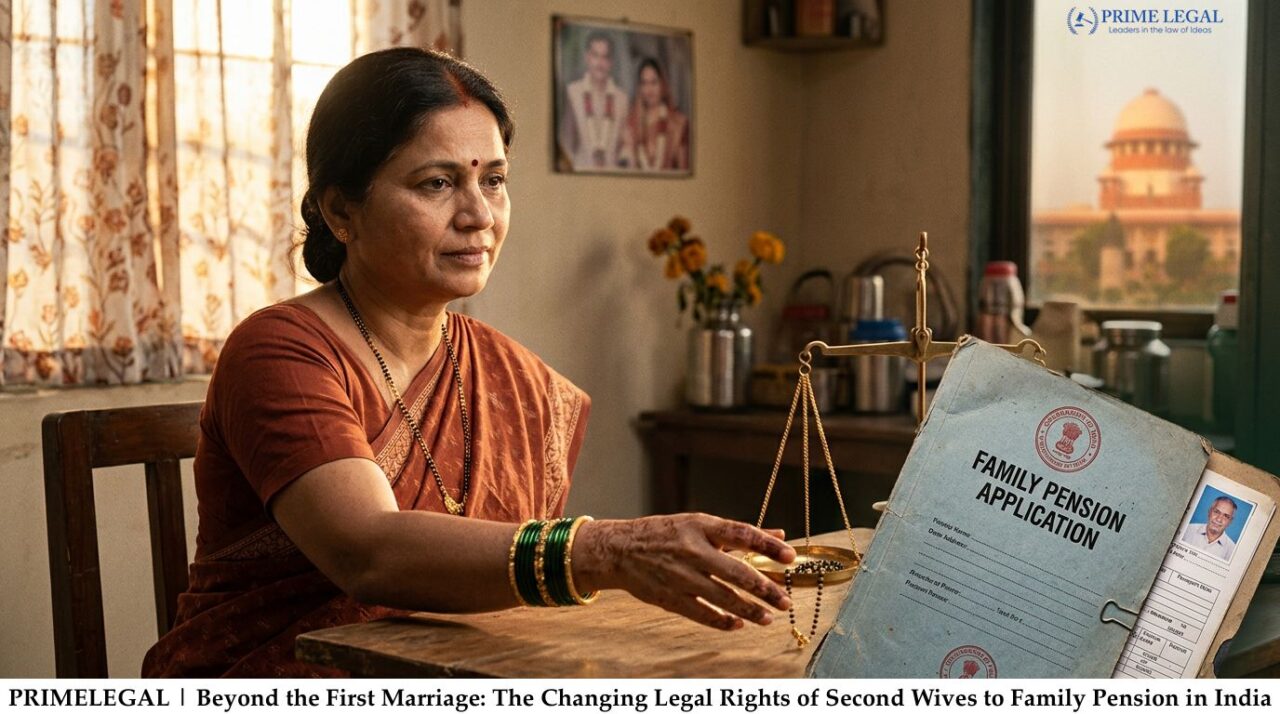
For many years, the Indian legal system followed a very strict rule: only the first, legally wedded wife was entitled to a government family pension. Any second marriage performed while the first was still active was considered “void” or legally non-existent. However, as we move through 2026, the judiciary is beginning to look at this issue through the lens of social justice rather than just cold statutes. While the law still prioritizes legal marriages, recent judgements from various High Courts have started to recognize the financial vulnerability of second wives. This article explores how the courts are balancing the strict marriage laws with the “Right to Life,” ensuring that long-term partners are not left in poverty after a husband’s death.
KEY WORDS
Second Wife, Family Pension, 2026 Legal Updates, Article 21, Void Marriage, Social Justice, Maintenance, High Court Rulings.
INTRODUCTION
The question of whether a “second wife” can claim a pension is one of the most complicated and emotional topics in the Indian Family law system. Usually, under laws like the Hindu Marriage Act, 1955, a second marriage is not legal if the first wife is still alive and not divorced. Because of this, government pension rules have historically refused to pay a single rupee to a second wife, even if she lived with a man for thirty years and raised his children. But in 2026, we are seeing a shift. Judges are increasingly asking: “Is it fair to let a woman starve just because her marriage certificate is technically invalid?” This article breaks down the old rules, the new humanitarian approach of the courts, and what the latest news says about these rights.
THE STRICT RULE: WHY SECOND MARRIAGES OFTEN FAIL THE PENSION TEST
To understand the change, we must first look at the old “gatekeeper” rule. According to most government service rules and personal laws in India, a second marriage is “void ab initio,” which is a fancy way of saying it never legally happened. Because the law doesn’t recognize the marriage, it doesn’t recognize the woman as a “widow” either. This was recently seen in a Madras High Court decision in January 2026 (The Accountant General V. M. Radhakrishnan) 2026:MHC:388. Where the court ruled that even if the first wife after the second marriage, it doesn’t suddenly make the second marriage valid. The court held that since the marriage started as an “illegal” act under service rules, the second wife cannot be a nominee for the pension. This remains the “hard” side of the law that many women still face today.
A NEW VOICE: “ILLEGAL BUT NOT IMMORAL” (THE 2026 SHIFT)
While some courts stat strict with regard to these issues, others are taking a kinder path. On May 8 2026, the Himachal Pradesh High Court delivered a landmark judgement in Umawati V. HPSEB And Others (LPA No. 545 of 2025) that has sparked nationwide debate. The court granted a family pension to a second wife, using a very powerful phrase: “Illegal but not Immoral.” The judges argued that even if the marriage violated a statute, the woman was economically dependent on her husband for years. Leaving her with no income after his death would violate her Right to Life (Article 21). This ruling shows that in 2026, “Social Justice” is starting to outweigh “Technical Legality.” The court essentially said that the state cannot ignore its duty to prevent a woman from becoming destitute.
THE MIDDLE PATH: SPLITTING THE PENSION AND CHILDREN’S RIGHTS
In cases where both the first and second wives are alive the law is evolving to find a middle ground. While the second wife might struggle for her own rights, the law is very clear about the children. Under Indian law, even if a marriage is void, the children born from it are considered “legitimate” for the purposes of inheritance and pension. In 2026, we are seeing more cases where the court orders the family pension to be divided between the first wife and children of the second wife. In some rare humanitarian cases, if the first wife proves a “No Objection Certificate” or if she has already passed away, the courts are more willing to allow the second wife to receive the funds to ensure the family survival.
THE IMPORTANCE OF NOMINATION AND LIVING TOGETHER
One major trend in recent 2026 cases is the focus on who the husband actually lived with. Courts have noticed that many government employees live exclusively with their second family while the first marriage exists only on paper. Recent rulings have suggested that if a man lived with his second wife until his death and officially nominated her in his pension papers, the government should not be too quick to reject the claim. While nomination doesn’t automatically “fix” an illegal marriage, it serves as strong evidence of who was actually dependent on the pensioner. This “Pragmatic Approach” is helping many women who would have otherwise been ignored by the system.
CONCLUSION
The legal journey for second wives in India is moving from a dark “No” to a hopeful “Maybe.” As of May 2026, the law is at a crossroads. On one hand, we have the strict rules of Madras High Court that protect the sanctity of the first marriage. On the other hand, we have the compassionate “Social Justice” approach of the Himachal Pradesh High Court that protects the right to survive. For an adoptive mother or a second wife, the 2026 landscape is finally acknowledging that family life is complicated and that law must be kind. While the battle for full legal status continues, the recognition that a “destitute spouse” deserves dignity after their partner’s death is a massive step forward for Indian Family Law.
“PRIME LEGAL is a National Award-winning law firm with over two decades of experience across diverse legal sectors. We are dedicated to setting the standard for legal excellence in civil, criminal, and family law.”
WRITTEN BY: LISHIKA BATRA

