
INTRODUCTION
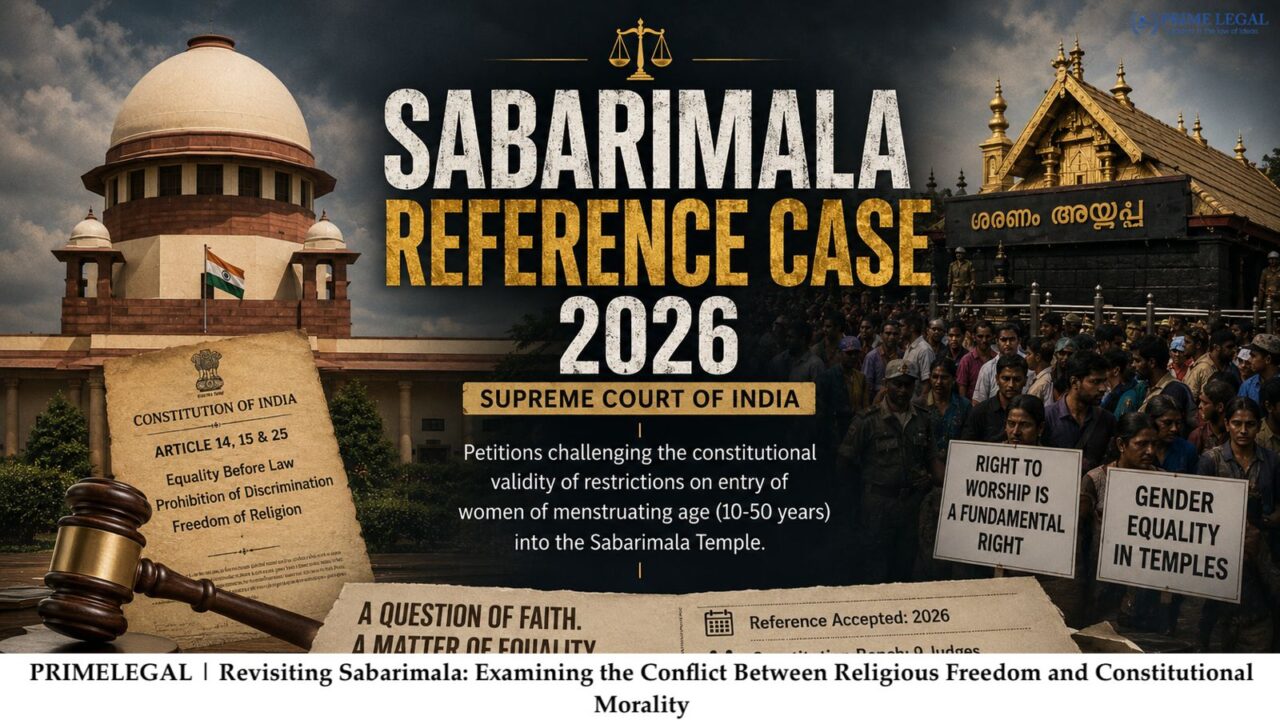
The Sabarimala Sree Dharma Sastha Temple dispute can be considered one of the most important cases of the country highlighting the dichotomy between religious freedom and constitutional rights of women. It is concerned with the entry of menstruating women inside the Sabarimala temple in Kerala.
By April 2026, a nine-judge bench in the Supreme Court commenced a 16-day marathon hearing of arguments involving the validity of the 2019 judgement. These proceedings are expected to define the scope of Indian courts’ jurisdiction when religious and constitutional rights are in conflict.
BACKGROUND
A five-judge constitutional bench of the supreme court in the case Indian Young Lawyers Association v. State of Kerala [(2019) 11 SCC 1], struck down an age-old practice of prohibiting women of menstruating ages from entering the Sabarimala temple.
By a 4:1 majority, the court held that this practice violated constitutional rights granting equality and freedom of religion to female devotees. The court observed that biological factors cannot be grounds for denying a group from accessing religious spaces.
Justice Indu Malhotra gave the only dissenting opinion and stated that courts should avoid interfering with religious practices of communities unless they perpetuate actual social injustice.
The present nine-judge Bench hearing commenced on 7 April 2026 and concluded after sixteen days of arguments on 14 May 2026, following which the Court reserved judgment.
KEY POINTS
- The present Constitution Bench is headed by Chief Justice of India Surya Kant and includes Justices B. V. Nagarathna, M. M. Sundresh, Ahsanuddin Amanullah, Aravind Kumar, Augustine George Masih, Prasanna B. Varale, R. Mahadevan, and Joymalya Bagchi.
- Review petitioners, devotees’ organisations, and the Travancore Devaswom Board argued that Sabarimala represents a separate religious denomination protected under Article 26 of the Constitution. They contended that the restriction is linked to the Naishtika Brahmacharya (eternal celibate) character of Lord Ayyappa and therefore constitutes an essential religious practice.
- Solicitor General Tushar Mehta appearing for the Union Government, said that Courts should act with caution when they handle religious issues. In his view the constitution protects the right of religious groups to govern themselves.
- Senior Advocate Rajeev Dhavan stated that religions continue to exist because of their organisations and their ability to manage themselves. By his reasoning, Article 26 protects the religious institutions that people need to maintain their traditions.
- For female devotees, senior advocates including Indira Jaising, Abhishek Manu Singhvi, Mukul Rohatgi besides Gopal Sankaranarayanan argued that rules which keep people out because of menstruation are inherently discriminatory and constitute a violation of women’s right to religion and freedom.
- The proceedings focused on the “essential religious practices” doctrine, from the case of Commissioner, Hindu Religious Endowments, Madras v. Sri Lakshmindra Thirtha Swamiar of Shirur Mutt [(1954) SCR 1005].
- The Court also discussed precedents such as Durgah Committee, Ajmer v. Syed Hussain Ali [(1961) 1 SCR 383], N. Adithayan v. Travancore Devaswom Board [(2002) 8 SCC 106], Shayara Bano v. Union of India [(2017) 9 SCC 1], Navtej Singh Johar v. Union of India [(2018) 10 SCC 1], and Joseph Shine v. Union of India [(2019) 3 SCC 39].
- Justice B. V. Nagarathna believed that women cannot be deemed as “untouchable” during their periods.
- But the Bench also discussed if courts are the right bodies to determine if a religious practice is essential, or if courts can act if these practices violate fundamental rights.
- Organisations such as the Nair Service Society (NSS) and SNDP Yogam reiterated their opposition to the entry of women of menstruating age into the temple, arguing that the restriction forms an integral part of Sabarimala’s religious identity and customs.
RECENT DEVELOPMENTS
After sixteen days of continuous constitutional hearings, the Supreme Court reserved judgment on 14 May 2026. No final verdict has yet been delivered.
The Court continues to examine:
- the “essential religious practices” doctrine;
- denominational autonomy under Article 26;
- constitutional morality;
- gender equality in religious spaces
- the permissible limits of judicial review in matters of faith.
The hearings also addressed how the eventual ruling may affect disputes involving entry of Muslim women into mosques and dargahs, entry of Parsi women into Fire Temples after marrying outside the community, and other practices such as female genital mutilation within the Dawoodi Bohra community.
CONCLUSION
The Sabarimala debate involves concerns regarding secularism, religious freedom, and judicial power. The final judgement is expected to redefine the relationship of constitutional morality and religious autonomy in the country. This judgement will influence future cases concerning gender equality, denominational rights and religious practices across multiple faiths in India.
“PRIME LEGAL is a National Award-winning law firm with over two decades of experience across diverse legal sectors. We are dedicated to setting the standard for legal excellence in civil, criminal, and family law.”
WRITTEN BY: SAMANA

