
ABSTRACT
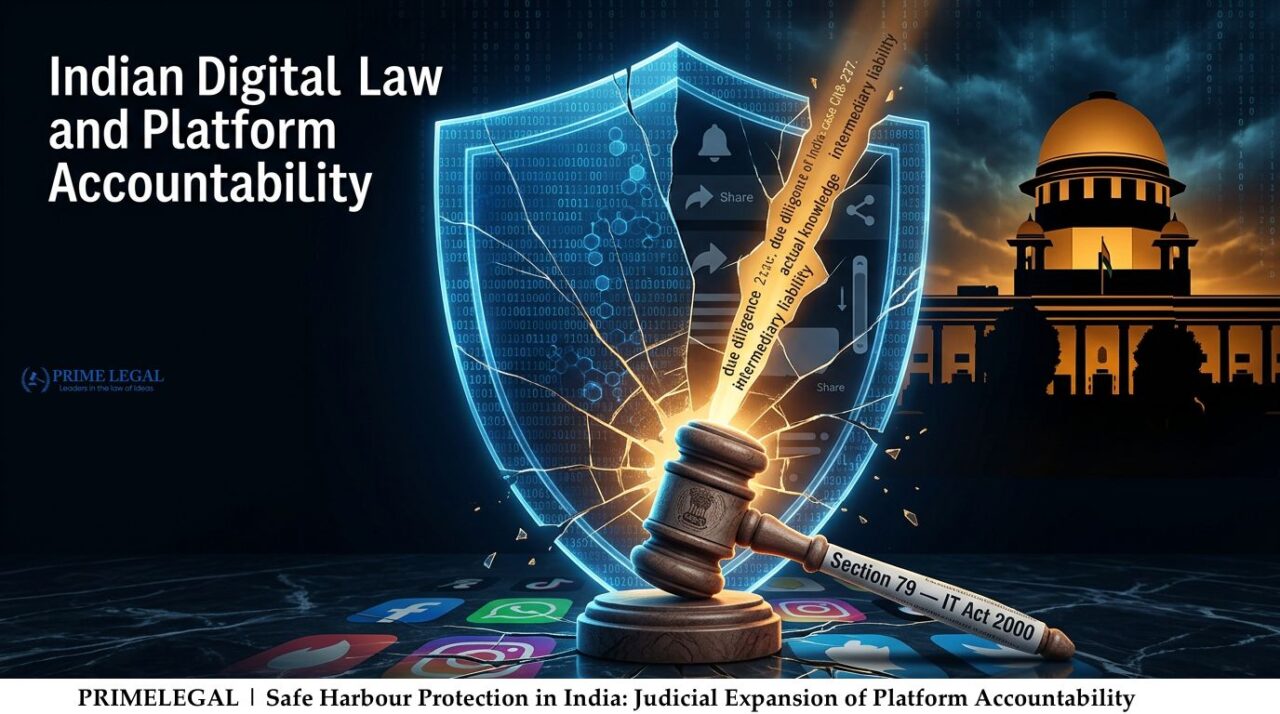
The doctrine of safe harbour under Section 79 of the Information Technology Act, 2000 (IT Act) protects intermediaries like social media platforms, search engines and e-commerce platforms from incurring liability for the act of a third-party hosted on their platform. Indian courts now, however, through stricter judicial interpretation and due diligence obligations, have started to expand platform liability and accountability. With X Corp v. Union of India (2025), the Karnataka High Court analysed intermediary obligations, government’s powers and the conditional nature of the safe harbour protection under Section 79. This article explores the case simultaneously with the new IT Rules, 2026 and Intermediary liability guidelines.
INTRODUCTION
Everyday internet interactions and digital functions depend heavily on intermediaries such as social media platforms, online marketplaces, messaging services and search engines. The doctrine of safe harbour was developed to ensure that these corporations are protected from incurring liability for posts uploaded by its users.
This protection is provided by Section 79 of the Information Technology Act, 2000. But regulators and courts have been actively strengthening intermediary obligations, as seen unfolding with cases such as X Corp v. Union of India (2025).
Recent developments with intermediary liability, centred around AI-generated content and governmental advisories, further is an indication that India is gradually transitioning from passive intermediary protection to active platform accountability.
SAFE HARBOUR UNDER SECTION 79 OF THE IT ACT
The rationale behind the protection offered by Section 79 of the Information Technology Act, 2000 is due to the reason that intermediaries only provide access to their platform and cannot be treated as active users or publishers. However, the intermediaries must not initiate transmission, select the receiver or modify information contained in the same. They are also required by law to observe due diligence, making the protection granted conditional.
One of the earliest cases concerning this doctrine was Avnish Bajaj v. State (NCT of Delhi) [116 (2005) DLT 427], popularly known as the Bazee.com case, where the CEO was prosecuted after obscene clip was sold through the website. The Delhi High Court observed the need for statutory safety harbour protections for intermediaries since they faced difficulties in regulating user-generated content.
In Shreya Singhal v. Union of India (AIR 2015 SC 1523), the Court held that intermediaries cannot be compelled to determine themselves whether a content is unlawful or not and said content can be taken down upon receiving a valid court order or government notification issued under 69A of the IT act. This was done to prevent excessive censorship and to protect free speech.
In MySpace Inc. v. Super Cassettes Industries Ltd [(2017) 236 DLT 478], the Delhi High Court examined issues concerning copyright infringement. The Court ultimately held that intermediaries cannot reasonably monitor each and every file or post uploaded by users on their platforms. Thus, intermediaries can only be held liable after they have knowledge of a specific infringement of copyright. The intermediary obligations got significantly broadened with the introduction of the IT Rules, 2021, which laid down additional requirements such as grievance officers, compliance officers, identifiability and expeditious removal of flagged content.
X CORP v. UNION OF INDIA
The conversation around intermediary liability picked up after X Corp challenged the constitutional validity of the Sahyog portal and the use of Section 79(3)(b) read with Rule 3(1)(d) of the IT Rules, 2021 for orders to take down content. The Karnataka High Court delivered its judgment on 24 September 2025.
For its argument, X Corp stated that Section 79 does not allow the government to have power to block content. Officials have the power to block online content by the authority given in Section 69A of the IT Act, and it contains protections such as written justifications and processes for review.
The government later argued that intermediaries must follow legal orders that are issued to maintain public order and online safety in the country. Failure to do so may result in loss of immunity. Authorities also defended the Sahyog portal as a tool intended to facilitate communication between law enforcement bodies and digital platforms.
Justice M. Nagaprasanna rejected many of X Corp’s arguments and upheld the broader legaal structure The Court emphasised that safe harbour protection under Section 79 is conditional and dependent upon compliance with due diligence obligations.
The reasoning in X Corp is similar to that in Kent RO Systems Ltd. v. Amit Kotak (2017). The Delhi High Court stated that intermediaries are at a risk of losing safe harbour protection if they do not take action even after being aware of unlawful content on their platform. Some argued that the Karnataka High Court’s decision might weaken the protections set by Shreya Singhal and can increase the risk of magnifying state’s censorship powers. Broad takedown authority combined with unclear compliance rules can encourage platforms to remove lawful speech to avoid penalties
FROM PLATFORM NEUTRALITY TO PLATFORM RESPONSIBILITY
As global trends change, this shift is visible in many countries. For many governments, it is necessary to reconsider if intermediaries should remain immune because of problems like false information, speech that promotes hatred, manipulated media, harassment on the internet but also risks to the safety of the nation – but the method used in India is a cause for legal concern under the constitution because the executive branch has a large amount of power to control what is published online.
The challenge is to find a balance, between holding companies responsible and giving them the freedom to operate. Excessive immunity may allow platforms to evade responsibility for harmful online conduct, while excessive liability may incentivise censorship and chill democratic discourse. The future of intermediary liability in India will therefore depend upon whether courts can preserve procedural safeguards while accommodating the state’s increasing regulatory ambitions.
CONCLUSION
The doctrine of safe harbour in India has evolved significantly from its original objective of protecting intermediaries from liability for third-party content. Judicial decisions such as Shreya Singhal, MySpace and X Corp v. Union of India demonstrate the growing emphasis on intermediary accountability and regulatory compliance.
Enhanced due diligence obligations, stricter takedown timelines and regulation of AI-generated content in the new amendments added to the shift. While these measures may improve digital governance and online safety, they also raise concerns regarding free speech, executive overreach and procedural safeguards.
India’s intermediary liability framework is therefore moving steadily from platform neutrality toward platform responsibility, with courts expected to play a crucial role in balancing accountability with constitutional freedoms.
“PRIME LEGAL is a National Award-winning law firm with over two decades of experience across diverse legal sectors. We are dedicated to setting the standard for legal excellence in civil, criminal, and family law.”
WRITTEN BY: SAMANA

