
INTRODUCTION
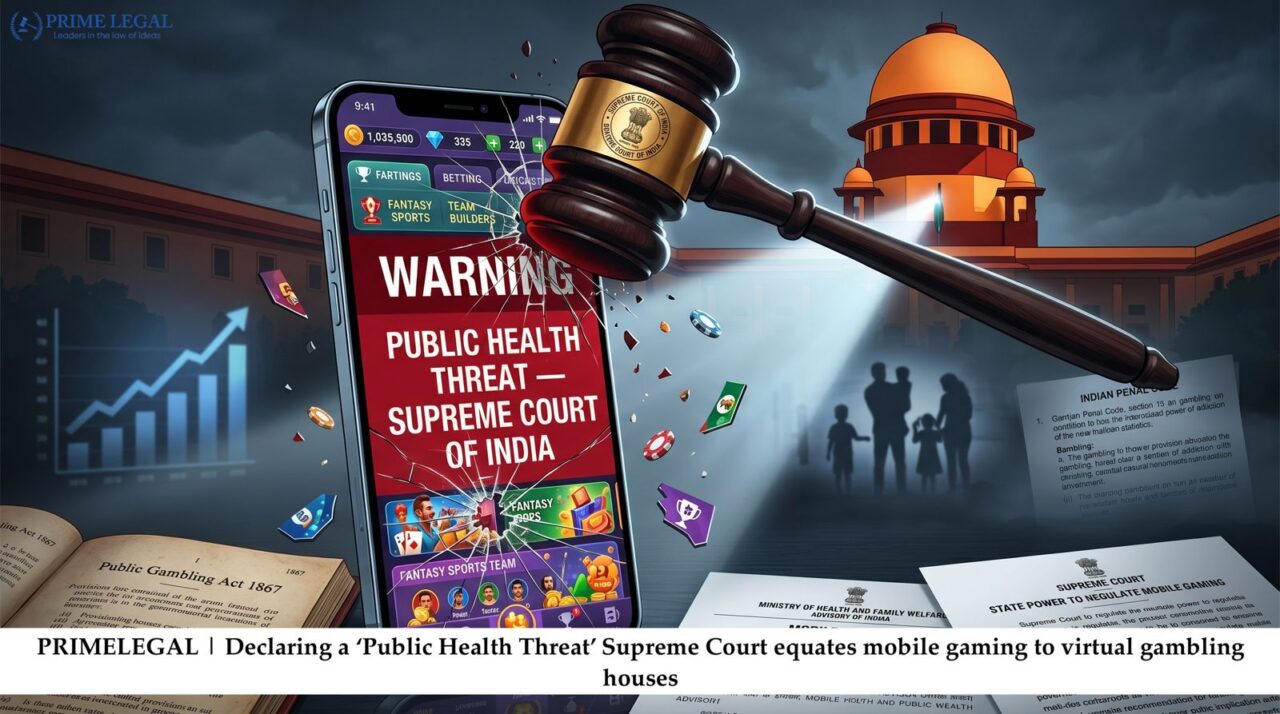
On May 27, 2026, the Supreme Court of India passed a ruling that will affect the lives of multiple mobile phone users throughout the country . It declared that each smartphone in India is a VIRTUAL GAMBLING HOUSE and the money gambling industry is unconstitutional be it via a smartphone . The ruling was issued and is touted as the most important decision in Indian gaming law history.
BACKGROUND
The bench presided by Justice J.B. Pardiwala and Justice R. Mahadevan pronounced the above-mentioned judgment in the case of State of Tamil Nadu & Ors. v. Junglee Games India Pvt. Ltd. & Ors. (2026 INSC 594). The case is a bundle of petitions that have later been filed before the same High Court in Karnataka and Madras challenging state legislation banning online games involving monetary stakes.
The dispute has deep roots. The State of Tamil Nadu had made the following two Acts, namely, Tamil Nadu Gaming and Police Laws (Amendment) Act, 2021 and Tamil Nadu Online Gambling Act, 2022-23, which broaden the definition of “gaming” to include gaming on games of skill, such as rummy and poker, conducted online. In 2021, Karnataka too made modifications to the Karnataka Police Act, 1963. Both sets of laws were challenged by online gaming companies.
The Madras High Court and the Karnataka High Court declared the same to be unconstitutional, finding that games of substantial skill are protected under the Article 19(1)(g) of the Constitution and Entry 34 of the State List refers to games of chance alone. The states took their dispute to the Supreme Court. In the meantime, the battle had expanded to a much larger size. The Union government has submitted that unregulated online games with real money have become a high-risk online environment, where known instances of suicides have increased, money laundering and terror financing are going on, and Indians are losing around ₹20,000 crore per year on such platforms.
KEY POINTS
- The Supreme Court was clear on its side of the state. Once the element of wagering is introduced, the nature of the game is not relevant and if the activity is of any kind listed in the words “betting and gambling” it falls outside the protection guaranteed by Article 19(1)(g). That is, when money is used to “bet” on the game, then its constitutional protection is removed from its corpus.
- In view of this, the appeals of both the States of Tamil Nadu and Karnataka was allowed and the impugned judgments of both the High Courts was set aside. Part II of the 2021 Amendment Act, certain sections of the 2022/23 Tamil Nadu Online Gambling Act and a series of key sections of the 2021 Karnataka Amendment Act have been found to be within the constitutional parameters.
- While holding the Tamil Nadu and Karnataka laws banning online betting and gambling even on games of skill, the Court did make the observations. Public order is defined by the Court as a state of tranquillity among members of society, peaceful and orderly social existence by members of society, the maintenance of the even tempo of community life, public safety, public interest and protection from social and economic disruptions. Most strikingly the Court noted: “Every cell phone is now a virtual common gaming parlour. The bench said that the physical nature of a gambling house was no longer necessary in the age of digital technology – the house has become mobile, travelling in the user’s pocket.
- The Court recognized that internet wagering and gambling is an emerging and prevalent issue that threatens the public order, public tranquillity and public health.
RECENT DEVELOPMENTS
The verdict came at a time when the industry was already reeling. In August 2025, India implemented the Promotion and Regulation of Online Gaming Act (PROGA) which made it illegal to run online money games that entail the placing of money with promises of winnings. The law was enacted on May 1st, 2026, only weeks before the Supreme Court decision. Most of the big platforms like Dream11, MPL, PokerBaazi and Zupee halted real-money gaming the second it happened.
The economic consequences were no less dire. The Supreme Court also confirmed that all such platforms collect player money on the full amount of such amounts at a rate of 28% GST. That ruling was followed by the demands of taxes which sum up to almost ₹2.5 lakh crore, equivalent to the revenue of most Indian states for a year. More than 3,000 workers lost their jobs, due to the lack of income. In essence, the industry did not exist anymore as an economic business classification.
CONCLUSION
Over the years, India’s gaming jurisprudence had been defined by the “predominance of skill” test, which the fantasy sports and rummy lobby had long claimed and successfully established gaming as a skill-based activity, deserving of legal protection. The ruling could prove to be a landmark decision in online gaming law in India. Future litigation may be affected by the fact that courts will have to increasingly consider in addition to the theoretical nature of a game, the actual social consequences of it. The Court held that states have the power to regulate—and even ban—wagering on any game played for money, including games of skill, and that public-order and public-health arguments are valid for banning online wagering on games of skill, particularly in light of the harms that money gaming wagers in such games have caused. The decision brings India into the list of some of the world’s strictest regimes regarding digital gambling, a stark turnaround from a three-year ago prediction that the market might grow into one of the biggest online gaming economies in Asia.
“PRIME LEGAL is a National Award-winning law firm with over two decades of experience across diverse legal sectors. We are dedicated to setting the standard for legal excellence in civil, criminal, and family law.”
WRITTEN BY: ARNAV NAIK

