
INTRODUCTION
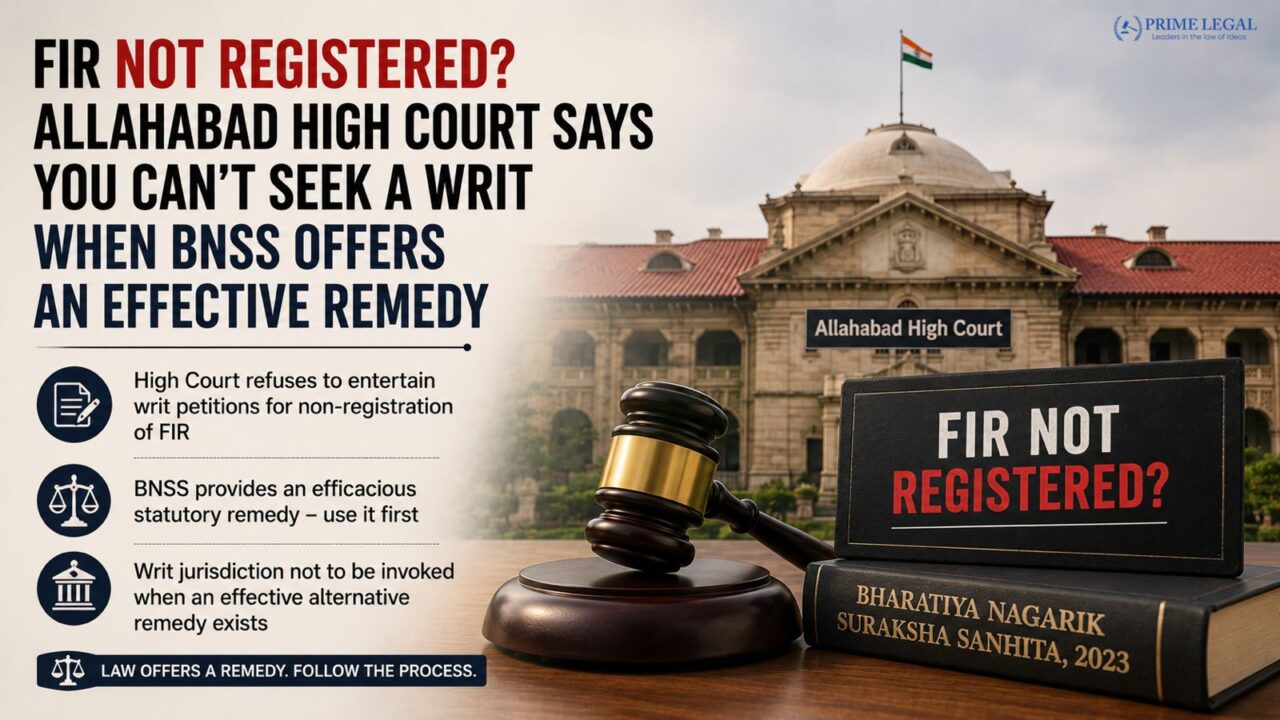
In the case of Chandan Kumar v. State of U.P. & ors (2026 LiveLaw (AB) 456), the Allahabad High Court clearly stated that a writ of mandamus cannot be issued in favour of the petitioner without being able to establish his clear right and a corresponding public duty imposed on an authority. In the Division Bench, Justice J.J. Munir and Justice Indrajeet Shukla ruled that if the Petitioner’s primary grievance is related to the non-registration of a criminal case, then he cannot exercise the writ jurisdiction directly. Rather, they have to rely on effective statutory remedies provided by Chapter XIII of Bharatiya Nagarik Suraksha Sanhita (BNSS), 2023.
BACKGROUND
Chandan Kumar is the petitioner in the matter who alleged that he had lost three cheques issued by his firm M/S Ananta Enterprises. However, no action was taken when a complaint was lodged at Police Station Colonelganj, Prayagraj on 5th November 2025. Later he was told by his bank that one of the cheques for Rs. 80,000, had been encashed.
The petitioner found that the cheque had been deposited into the consumer account of Fusion Wellness Centre which belonged to a woman called Urmila Gupta for payment of electricity dues to the Executive Engineer of the electricity department.
Petitioner has contended that the cheques were never issued in the name of the petitioner Urmila Gupta and that its fraudulent use amounted to an offence under the Bharatiya Nyaya Sanhita, 2023, alleging that she was involved in collusion with the electricity department officials.
Having received no response to the complaints submitted through the Chief Minister’s Portal, the petitioner sought a Writ of Mandamus for the authorities to resolve his complaints within a reasonable time in the High Court under Article 226 of the Constitution of India.
KEY POINTS
- It is clear from the Allahabad High Court that writ of mandamus cannot be issued mandatorily but can be issued at the discretion of the court.
- The petitioner has to prove that the authority has a non-discretionary legal obligation to provide the petitioner the remedy claimed and that the petitioner has a specific legal right to it.
- The Court pointed out that the petitioner had failed to establish any statutory or legal right that was violated and how the respondents were bound to remedy the petitioner’s grievance.
- The bench restated ten principles for the writ of mandamus, restating that the obligation imposed must be public, and must stem from the Constitution, a statute, rules or common law.
- Mandamus is not a substitute for the remedies which are provided in a civil court, and cannot be granted in connection with a private controversy, not involving a public duty.
- The petitioner’s grievance was found to be a grievance of inherent nature, relating to the non-registration of a criminal case and the Court noted that the BNSS already gives a complete framework for the same.
- The Court observed that the petitioner has an effective remedy available under Chapter XIII of the BNSS, 2023, relating to information to police and powers of police to investigate the case and remedies on refusal to file FIR.
- The writ petition was struck off and the petitioner was free to seek the statutory protection available under the BNSS.
ANALYSIS
The Allahabad High Court’s verdict is a strong affirmation of the Doctrine of Exhaustion of remedies before the Constitutional Courts. The Court’s systematic analysis of the requirements for issuing a writ of mandamus meant that it provided clarity on how writ jurisdiction is not meant to be a vehicle for primary fact-finding or investigation for criminal complaints.
The verdict is especially important as it highlights the success of the recently passed Bharatiya Nagarik Suraksha Sanhita, 2023. In this context, the Court referred directly to Chapter XIII of the BNSS, suggesting that the legislature has already implemented measures to take action against the police inaction when it comes to FIR registration.
Such a mechanism is likely to overload the constitutional courts and make the legal process unnecessary. So, the order will reduce the number of writ petitions being used to start criminal proceedings.
CONCLUSION
The judgment in Chandan Kumar v. State of U.P. does provide a clear demarcation on the issue of the misuse of writ petitions in the context of mere failure to register FIRs. The Allahabad High Court has made it abundantly clear that aggrieved persons must avail of the strong and dedicated procedural safeguards offered in Chapter XIII of the BNSS, 2023. In doing so, this decision upholds the special status of the writ of mandamus while supporting the statutory systems that have been created to manage criminal justice.
“PRIME LEGAL is a National Award-winning law firm with over two decades of experience across diverse legal sectors. We are dedicated to setting the standard for legal excellence in civil, criminal, and family law.”
WRITTEN BY: SHEEN

