
CASE NAME: KXXXXX v. THE STATE GOVT. OF NCT OF DELHI & ANR
CASE NUMBER: CRL.A. 320/2026 (with CRL.M.A. 10175/2026) CNR No.: DLHC010132792026
COURT: High Court of Delhi at New Delhi
DATE: 3 September 2026
QUORUM: Hon’ble Ms. Justice Madhu Jain
FACTS
The prosecutrix, who was a married woman, was living with her husband (who had sustained an injury by falling from a roof in 2007, leading to 75% disability and incapable of producing any offspring) and her adopted son (adopted in 2014). Respondent No. 2, Anoop, who was known to the family, would come to their house and, since 2017, had indulged in physical relations with the prosecutrix without her consent through intimidation and temptation. Once, she was intoxicated with a substance and then sexual relations ensued. This continued and comprised multiple instances of sexual and unnatural intercourse against her will through threats and intimidations. The prosecutrix conceived and delivered a child on 20 June 2019. In the process of inquiry, DNA samples of the prosecutrix, the accused and the child were sent for forensic tests at Forensic Science Laboratory, Rohini, and the report of the test showed that Respondent No. 2 was the biological father of the child. Later, the prosecutrix disclosed these incidents to her husband and family members and resultantly FIR number 138/2021 dated 17 March 2021 was lodged against the accused at Police Station Dwarka North under Sections 376, 377, and 506 IPC (Equivalent to Sections 64 BNS, no equivalent for Section 377 in BNS, and 351 BNS). Subsequently, the FIR was charge-sheeted under Sections 328, 376(2)(n), 377, 506, and 509 IPC (Equivalent to Sections 123 BNS, 64(2) BNS, no equivalent for Section 377 in BNS, 351 BNS, and 79 BNS). Cognizance was taken on 7 September 2021 and the case was committed to Sessions Court and registered as SC number 151/2022. Charges were framed on 23 February 2024 and thereafter, after trial, the Additional Sessions Judge, Dwarka Courts acquitted the accused of all charges on 7 October 2024. Aggrieved with this decision, the prosecutrix filed the present appeal under Section 419 BNSS (corresponding to Section 378 Cr.P.C.).
ISSUES
- Whether the evidence given by the prosecutrix, even with respect to inconsistency and improvement therein, was credible and adequate to support the prosecution case leading to conviction.
- Whether the DNA evidence proving paternity proved that there was no consent or rape within the meaning of Sections 376(2)(n), 377, 328, 506 and 509 IPC [Section 64(2) BNS, no corresponding provision in BNS to Sections 377, 123 BNS, 351 BNS and 79 BNS].
- Whether the delay in registering the FIR, the contradictions between the complaint, Statement Under Section 164 Cr.P.C. [Section 183 BNSS] and the evidence in Court, made any difference to the prosecution case.
- Whether the appreciation of evidence by the Trial Court is perverse or manifestly illegal or due to incorrect appreciation of the evidence in the case on appeal against acquittal.
- Whether the presumption under Section 114A Indian Evidence Act [Section 120 BSA] was considered or whether it had been rebutted by the Accused.
LEGAL PROVISIONS
- Section 328 IPC (Section 123 BNS) – Causing hurt by means of poison, etc., with intent to commit an offence.
- Section 376(2)(n) IPC (Section 64(2) BNS) – Punishment for rape where the offender repeatedly commits rape on the same woman.
- Section 377 IPC (no direct equivalent in BNS; non-consensual sexual acts now covered under Sections 63–64 BNS) – Unnatural offences.
- Section 506 IPC (Section 351 BNS) – Criminal intimidation.
- Section 509 IPC (Section 79 BNS) – Word, gesture or act intended to insult the modesty of a woman.
- Section 114A Indian Evidence Act, 1872 (Section 120 BSA) – Presumption as to absence of consent in certain prosecution for rape.
- Section 419 BNSS (corresponding to Section 378 Cr.P.C.) – Appeal in case of acquittal.
- Section 313 Cr.P.C. (Section 351 BNSS) – Statement of the accused.
- Section 164 Cr.P.C. (Section 183 BNSS) – Recording of confession or statement by Magistrate.
ARGUMENTS
APPELLANT:
It was contended that the Trial Court did not consider the point that the evidence of the prosecutrix was cogent, consistent and trustworthy and the law recognizes that it is possible to convict the accused based on the evidence of the prosecutrix alone if the evidence is credible. The contention was that the Court had made the mistake of considering minor contradictions in the testimony of the prosecutrix and ignoring the DNA test report, which proved beyond doubt that the respondent was the biological father of the child. Reference was made to decisions of the Supreme Court, where it had been held that the evidence of DNA test was clinching and delay or minor inconsistencies in the evidence do not render it untrustworthy. It was pointed out that the plea of the respondent regarding the consensual relationship was improbable in terms of Section 313 Cr.P.C. (Section 351 BNSS). Appellant argued that the case was supported by the suspicion and testimony of her husband (PW-2) and the DNA test report, and that partial acknowledgment of physical intercourse by the accused had not been given due importance. It was also argued that, according to Section 114A Indian Evidence Act (Section 120 BSA), once sexual intercourse is proved and the woman declares that she has not consented, it would be for the accused to prove otherwise.
RESPONDENTS:
It was argued by the learned APP on behalf of the State that the Trial Court had rightly understood the evidence in relation to its findings after evaluating the testimonies of prosecution witnesses, documentary evidence and defense put forward by the accused. It was said that there was no illegality, infirmity and perversity in the challenged judgment that would necessitate an intervention by the Appellate Court, and the same were based on correct understanding of the material placed on record.
ANALYSIS
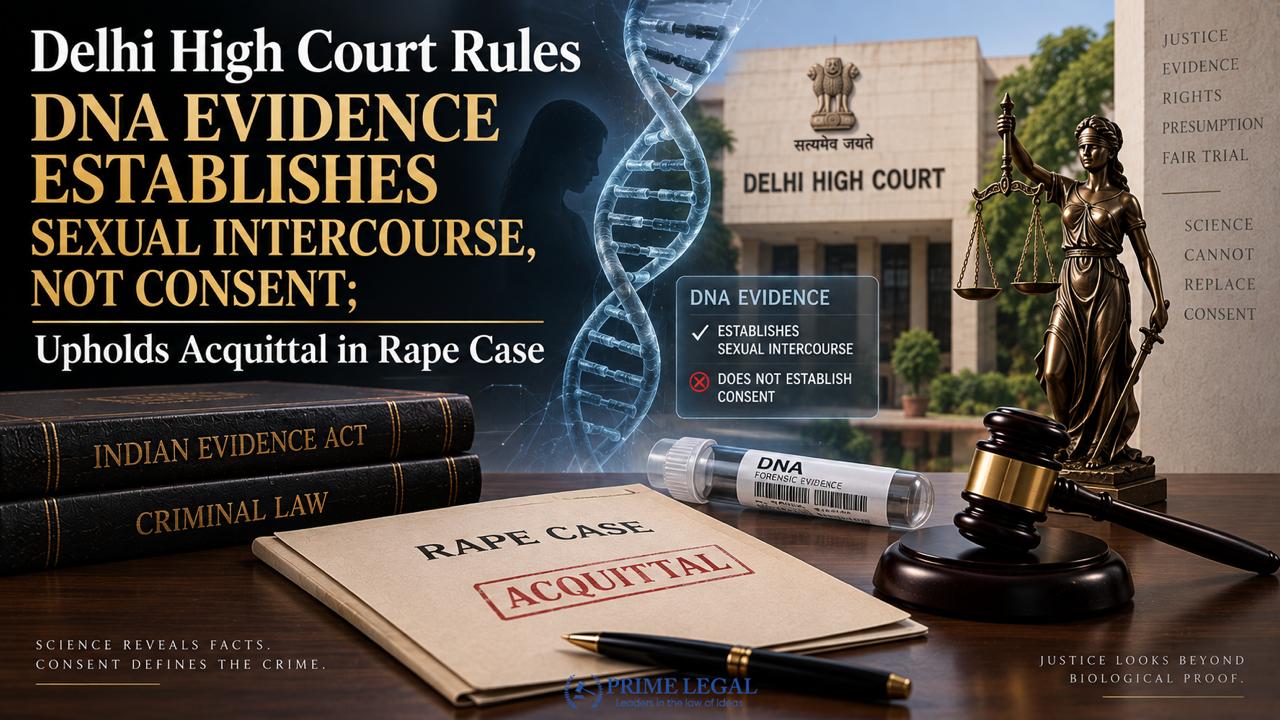
These principles were restated as regards appeal against acquittal: An appellate court must not intervene simply because there is a different view; intervention may be justified only where the view of the Trial Court is perverse, blatantly illegal, based on misinterpretation of the material evidence, or where there is no other conclusion but one of guilt in light of the evidence.The Court agreed that the DNA report proved paternity and intercourse, but the report alone cannot prove the circumstances surrounding the intercourse and the fact that there was no consent. Despite the proper application of the statutory presumption under Section 114A Indian Evidence Act (Section 120 BSA), the Court must still determine whether there was establishment of the basic facts and adequacy of the defence circumstances to rebut the presumption. There were also significant discrepancies on account of the use of the intoxicant, the state of awareness during the first incident, the occurrence of the pregnancy and the suspicions of the husband, the 100 number call, as well as the allegations of nudity in the form of nude photos and videos, none of which was corroborated with any electronic record. In addition, the mode of communication between the two, through frequent calls as well as monetary help provided by the appellant to his wife, were considered as relevant circumstances by the High Court for determining the truthfulness of the complainant. Although the High Court acknowledged the fact that conduct of the prosecutrix cannot be stereotypically evaluated and delay cannot, in itself, determine the credibility of the case of prosecution, it also ruled that the combined effect of the discrepancies had a significant bearing on the reliability of the prosecution version. The absence of defence evidence did not relieve the prosecution of its burden to prove guilt beyond reasonable doubt.
JUDGEMENT
There was no justification to interfere with the judgment of acquittal, dated 7th October 2024, of the Additional Sessions Judge, Dwarka Courts, New Delhi. It was opined that the findings given in the judgment of the Trial Court were based on the appreciation of evidence and could not be considered as being perverse or manifestly illegal or wholly unreasonable. The DNA evidence has been properly considered and rightly appreciated as being in relation to the issue of paternity and sexual intercourse, and not necessarily as an evidence in relation to the absence of consent. The Court opined that the Trial Court has looked into the evidence and came to a finding which was reasonably possible on the basis of the material available to it, and the possibility of a different finding is not enough for interfering in an appeal against acquittal. Accordingly, the appeal was dismissed and the judgment of acquittal was upheld.
CONCLUSION
In this case, the Delhi High Court rejected the appeal of the prosecutrix in connection with the acquittal, stating that the opinion of the Trial Court was a possible opinion based on the evidence in view of material contradictions in the testimony of the prosecutrix, failure of corroboration of the allegations in the case and circumstantial evidence which created reasonable doubts about the charges of the prosecution. From the judgment, it is evident that the testimony of the prosecutrix alone may lead to a conviction but it should be credible and consistent without material contradiction and even DNA evidence alone cannot prove absence of consent and all elements of the offenses.
“PRIME LEGAL is a National Award-winning law firm with over two decades of experience
across diverse legal sectors. We are dedicated to setting the standard for legal excellence in
civil, criminal, and family law.”
WRITTEN BY: KHWAISH SACHDEVA

