
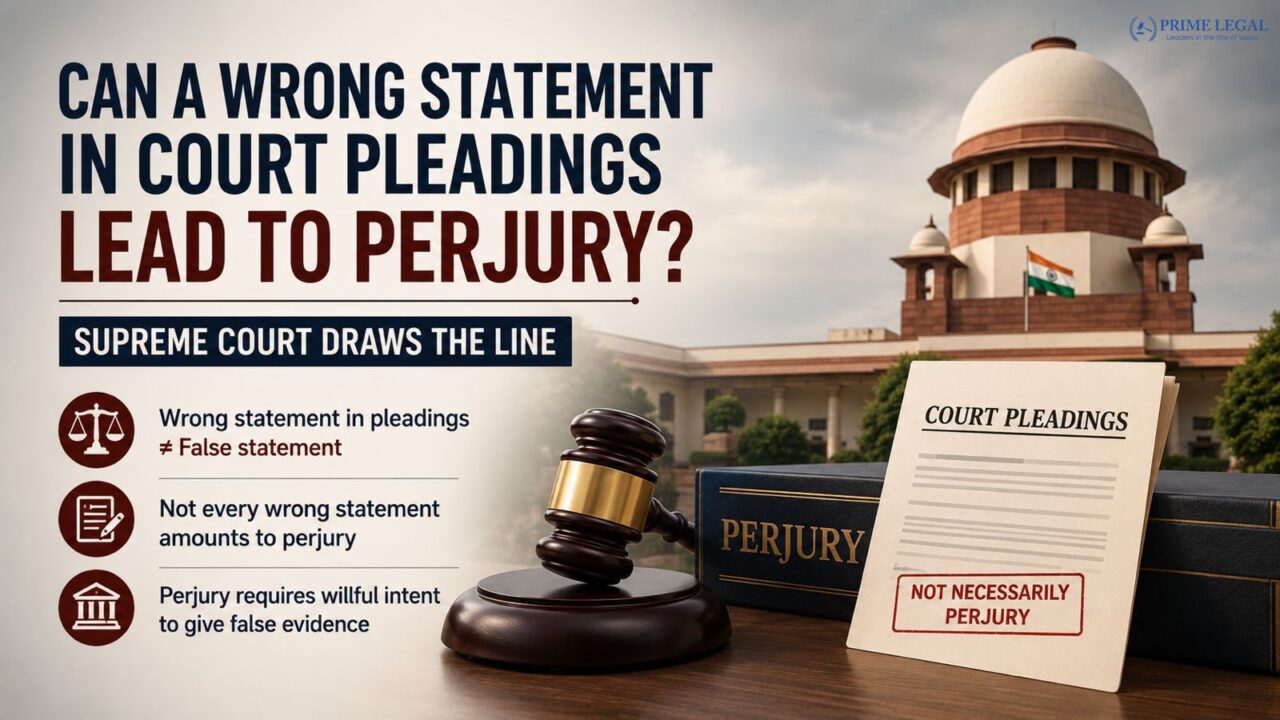
CASE NAME: Prabhakar Yeshwant Masram V Sou Tula Namdeorao Jaipurkar
CITATION: 2026 INSC 724
CASE NUMBER: CRIMINAL APPEAL NO.1365 OF 2015
COURT: The Supreme Court of India
DATE OF JUDGMENT: 21.07.2026
QUORUM: Justice Ujjal Bhuyan & Justice Atul S. Chandurkar
FACTS:
The respondents initiated a civil suit for obtaining a permanent injunction prohibiting the appellants from interfering with their enjoyment of the property in dispute. The trial court passed an interim injunction in favour of the respondents. Soon after, the trial court found a prima facie case of violation of the injunction order and proceeded to take action against the appellants under Order XXXIX Rule 2A CPC. This order was challenged by the appellants before the appellate court and they obtained an interim stay. The respondents made allegations that the appellant and his legal counsel had made false statements in the appeal and the stay application. The appellate court was moved by the respondents under Section 340 of the Code of Criminal Procedure prosecution was initiated under Section 193, 199 and 200 of Indian Penal Code, which was confirmed by the High Court later on. This led to the filing of a petition by the appellants in the Supreme Court against the unlawful orders already issued by the lower appellate court.
ISSUES:
- Whether on the basis of a prima facie satisfaction that ‘wrong statements’ were made by a party in his pleadings that were prepared by his counsel, power under Section 340 of the Code of Criminal Procedure, 19731 can be exercised for directing filing of a complaint against both of them for the offence punishable under Sections 193, 199 and 200 of the Indian Penal Code, 1860?
LEGAL PROVISIONS:
- Sections 340 and 341 of the Code of Criminal Procedure, 1973 [Sections 379 and 380 of Bharatiya Nagarik Suraksha Sanhita, 2023 (BNSS)]
- Sections 193, 199 and 200 of the Indian Penal Code, 1860 [Sections 229, 236 & 237 of Bharatiya Nyaya Sanhita, 2023 (BNS)]
- Order XXXIX Rule 2A of the Code of Civil Procedure, 1908
CASE LAWS:
- Iqbal Singh Marwah and another Vs. Meenakshi Marwah and another [2005 INSC 129]
- Santokh Singh Vs. Izhar Hussain and another [1973 INSC 96]
- James Kunjwal Vs. State of Uttarakhand and another [2024 INSC 601]
ARGUMENTS:
Appellants:
The appellants claimed that the lower courts erred in ordering proceedings under Section 340 of the Criminal Procedure Code. It was contended that these mistakes were typographical errors and that they had already brought this issue to the notice of the court in an application for correction much prior to the invoking of Section 340 of the Criminal Procedure Code by the other party. Further, it was stated that there was no evidence to prove that fraud was committed by the appellants and therefore the facts did not fulfil the necessary conditions for ordering prosecution under Section 340 of the Criminal Procedure Code.
Respondents:
The respondents stated that the appellant and his counsel intentionally made wrong statements in the appeal and the stay application misrepresenting the position of earlier proceedings in the High Court. They argued that the wrong statements made it possible for the appellants to get the interim stay order, which hurt the interests of the respondents. They alleged that such intentional wrong statements were offences punishable under Sections 193, 199 and 200 of the IPC and made it possible to start action under Section 340 CrPC.
ANALYSIS:
The Supreme Court highlighted that there is a material difference between making a ‘wrong statement’ and ‘false statement’ in the context of Sections 199 and 200 of the Penal Code. A ‘wrong statement’ of fact may not always have the character of a ‘false statement’. While making of a ‘wrong statement’ may not fall within the ambit of Sections 199 and 200 of the Penal Code, a ‘false statement’ would qualify as relevant material for being considered as an offence under the said provisions. The threshold for initiating action for an offence punishable under Sections 199 and 200 of the Penal Code is the making of a ‘false statement’ and not the making of a ‘wrong statement’. It is so because a ‘false statement’ denotes a deliberate intention in making such a statement; in other words, it is a wrongful or erroneous statement made intentionally to gain an undue advantage. Further, Section 340 (1) of the Cr.P.C. mandates that a Court before directing an inquiry to be made into any offence referred to in Section 195 (1) (b) of the Penal Code, should form an opinion that it is expedient in the interests of justice that such inquiry is in fact necessary. The High Court has, thus, proceeded to improve the impugned order in an appeal preferred by the appellants, who were in fact aggrieved by the same. Such a course is not permissible in law.
JUDGEMENT:
The order dated 19.01.2006 passed by the 7th Additional District Judge, Nagpur in M.C.A. No.28 of 2004 as well as the judgment dated 14.08.2012 passed in Criminal Appeal No.125 of 2006 by the learned Single Judge of the High Court was quashed and set aside. The application preferred by the plaintiffs under Section 340 of the Cr.P.C. were dismissed. The Criminal Appeal was allowed.
CONCLUSION:
The Supreme Court allowed the appeal and quashed the orders that initiated prosecution against the appellants under Section 340 of the Code of Criminal Procedure. It stated that there is a difference between a “wrong statement” and a “false statement” and that only false statements made on purpose should lead to prosecution for perjury. Since the mistakes alleged were only typographical mistakes that had been previously corrected, and since the courts had not made the essential finding that there should be some prosecution in the interest of justice, the criminal proceeding was declared to be invalid.
“PRIME LEGAL is a National Award-winning law firm with over two decades of experience across diverse legal sectors. We are dedicated to setting the standard for legal excellence in civil, criminal, and family law.”
WRITTEN BY: SOMSUTA PAUL
Read the judgement copy below:
PRABHAKAR YESHWANT MASRAM AND ANOTHER VERSUS SOU TULA NAMDEORAO JAIPURKAR AND ANOTHER

