
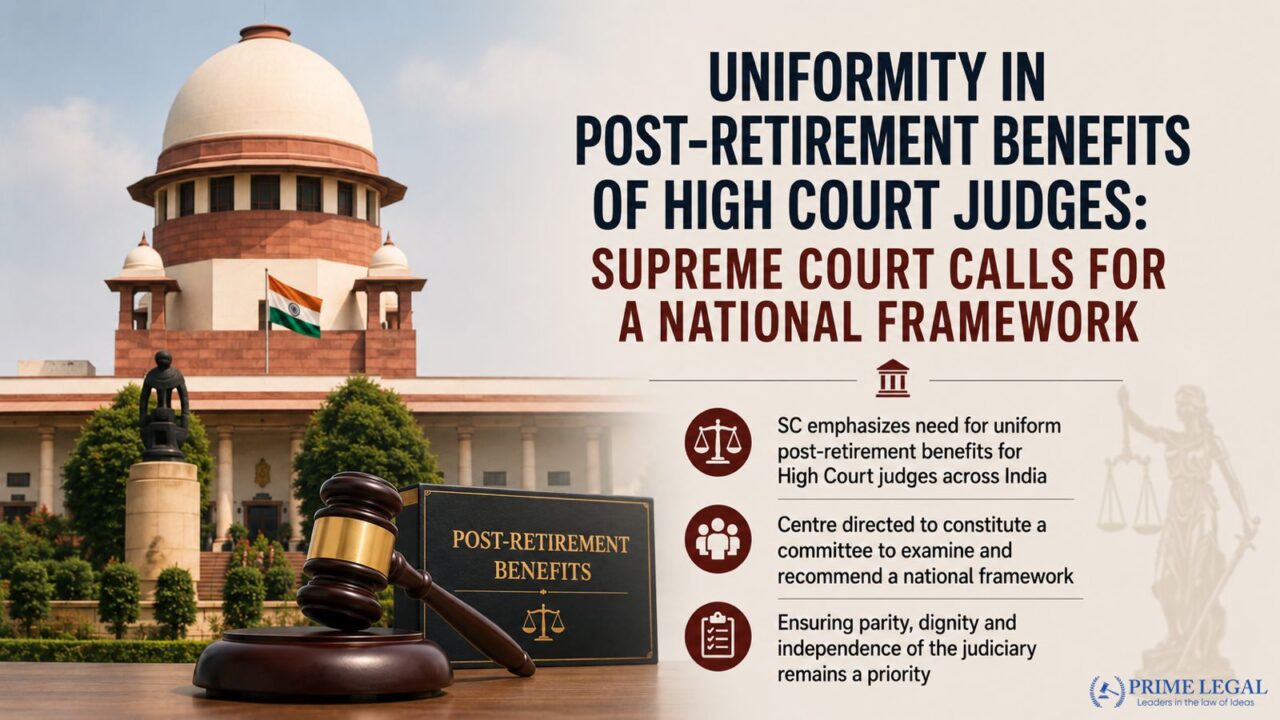
INTRODUCTION:
In an effort to bring uniformity in the higher judiciary, the Supreme Court has asked the central government for a standardized national policy on post-retirement benefits for retired Chief Justices and Justices of High Courts. A Bench led by Chief Justice of India, Surya Kant noted that Judges holding the same constitutional post should not have different post-retirement benefits based on the state of service. The Court instructed the Central Government to constitute a committee within 15 days in order to draft a uniform policy for post-retirement facilities.
BACKGROUND:
The issue came into consideration while dealing with a petition made by Justice V.S. Dave, the chief of the Association of Retired Judges of the Supreme Court and High Courts, on the security and other post-retirement facilities provided to retired judges of High Courts. The court took into account that though some States provide the retired judges with accommodation, security, transportation, secretariat assistance, and necessary facilities, others provide much less or no such benefits. It was observed that such disparity leads to unequal treatment of judges who have performed the same duties throughout their course of service.
The Bench expressed concerns over the current disparity and asked the Central government to form a committee within two weeks. The committee should include representatives from the Union, the states, and other stakeholders. The function of the committee is to suggest guidelines for a single national policy to cover aspects such as security, drivers, the government-provided accommodation during official work, as well as the secretarial help provided after retirement. Further, the committee is to suggest how the process of funding should work for the Centre and states and provide with recommendations within a three months’ time frame. The Chief Justice of India Surya Kant noted that “caring for senior citizens is part of our tradition.”
KEY POINTS:
- The Supreme Court instructed the government to form a committee within two weeks.
- The committee will recommend standard national guidelines regarding the post-retirement service of retired High Court judges.
- However, the existing facilities differ largely from one State to another even though the judges hold the same constitutional post.
- The proposed guidelines would include provisions for accommodation, security, transportation, secretarial assistance etc.
- Further, the committee will provide recommendations on how to fairly distribute the costs of services between the Centre and the States involved.
ANALYSIS:
The authority vested in the High Court judges is derived from the Constitution under Articles 214–231. Since there is no difference in the constitutional status of these judges among different States, the post-retirement benefits availed by the judges should not be dependent on the financial capacity or policy of individual States. A uniform framework would ensure that the retired judges are treated uniformly irrespective of their place of service.
The Supreme Court’s directive also expands on its recent initiatives to streamline employment conditions within the judiciary. The Court had already ruled on the application of the concept of the “One Rank, One Pension” doctrine to ex-High Court judges. It reiterated the point that all judges of uniform constitutional standing are entitled to equal treatment and should not be treated differently. The Court has, at the same time, shown judicial restraint by delegating the formulation of the policy to a committee while ensuring that constitutional values govern the executive’s decision-making process.
CONCLUSION:
The order given by the apex court is an important step towards closing the gap when it comes to the treatment of retired judges of High Courts across the country. By calling for a uniform national framework, the Supreme Court has made it clear that constitutional offices are dignified regardless of the states in which they are located.
“PRIME LEGAL is a National Award-winning law firm with over two decades of experience across diverse legal sectors. We are dedicated to setting the standard for legal excellence in civil, criminal, and family law.”
WRITTEN BY: SOMSUTA PAUL.

