
INTRODUCTION
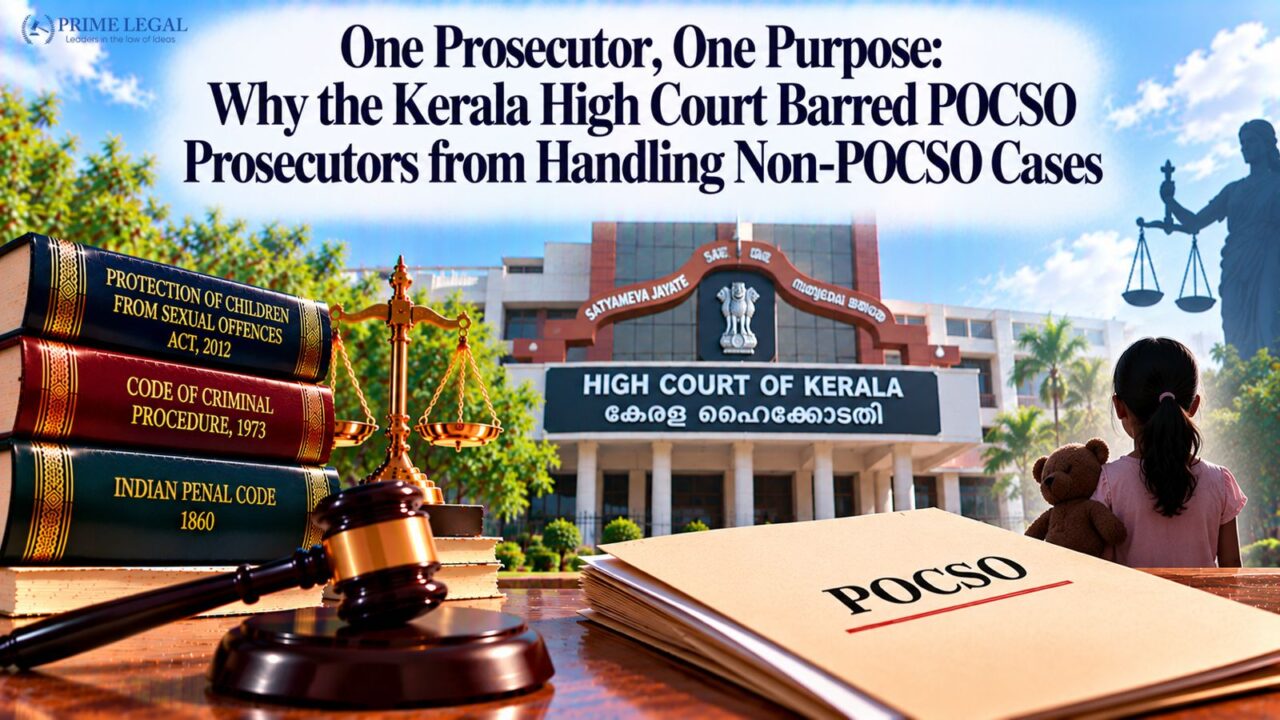
In October 2026, the Kerala High Court made an important ruling that strengthened the specialised framework of child protection laws by cancelling a Government Order that allowed Special Public Prosecutors in POCSO courts to handle non-POCSO cases. The High Court explicitly stated that the Prosecutors appointed under POCSO would only deal with POCSO cases and nothing else. This judgment is a strong reminder that the statutory framework created for ensuring prompt dispensation of justice to child victims will not be compromised for the sake of administrative convenience or overlapping functions.
BACKGROUND
The controversy originates from the Kerala government’s executive order that authorised SPPs, who are appointed for cases under the POCSO Act, to also conduct cases beyond POCSO, including the cases under the Juvenile Justice Act. This has caused a legal confrontation with various parties, including the District Court Bar Association Thodupuzha, which raised the argument that the government had directly breached Section 32 of the POCSO Act, which states that the SPP should only be appointed for conducting cases under POCSO.
This dispute has ramifications for the entire POCSO Act itself, as it is meant to provide a separate and speedy child-friendly framework of justice. The Supreme Court of India had issued strict directions in the suo motu proceeding In Re: Alarming Rise in the Number of Reported Child Rape Incidents,2026 SCC Online SC 2018, for establishing special courts and special prosecution for the cases under the POCSO Act to avoid delays that come with regular criminal prosecutions.
KEY POINTS
- The Kerala Supreme Court nullified the Government Order, asserting that POCSO Special Public Prosecutors should not become compromised by non-POCSO issues.
- The Court stressed the exact wording of Section 32(1) of the POCSO Act, thereby stressing the importance of the word “only” regarding the obligation put before the prosecutor.
- The State Government has to appoint unique Special Public Prosecutors only for POCSO cases within six weeks.
- The Supreme Court ordered the state to ascertain the establishment of the permanent exclusive POCSO Special Courts in the remaining 13 districts in four weeks.
- The decision of the Supreme Court established that involving prosecutors in different kinds of matters creates delays in trials, preventing children from their basic right to speedy trials and honours under Article 21 of the Constitution.
ANALYSIS
The Kerala High Court’s ruling can be seen as a classic illustration of the principle of strict interpretation of statutes. By interpreting the word “only” in Section 32 according to its literal meaning as well as the purpose of the law, the Court has prevented executive excess with respect to the use of state resources that is not in accordance with the intention of the law.
Apart from the statutory interpretation, the judgment takes into consideration the psychological impact it has on child abuse victims. The child can be traumatised as a result of the experiences of the criminal justice system. The provisions of the POCSO Act require timelines for certain actions to take place, such as the collection of evidence within 30 days and completion of the trial within a year. In the case of a prosecutor handling POCSO as well as general criminal cases, the result would be delays and overlapping of hearings. The young victim may have to undergo different phases of the criminal process and therefore undergo secondary trauma during the process.
CONCLUSION
The ruling made by the Kerala High Court on October 14, 2026, is a landmark victory for children’s rights law in India. With the judgment, the court has safeguarded the special judicial system from issues such as backlog and compromised administration by doing away with the overlapping duties among the POCSO prosecutors. The ruling is that henceforth the state cannot afford to take any shortcuts in the prosecution of offenders against children’s rights.
“PRIME LEGAL is a National Award-winning law firm with over two decades of experience across diverse legal sectors. We are dedicated to setting the standard for legal excellence in civil, criminal, and family law.”
WRITTEN BY: SWETHA DUTTA

