
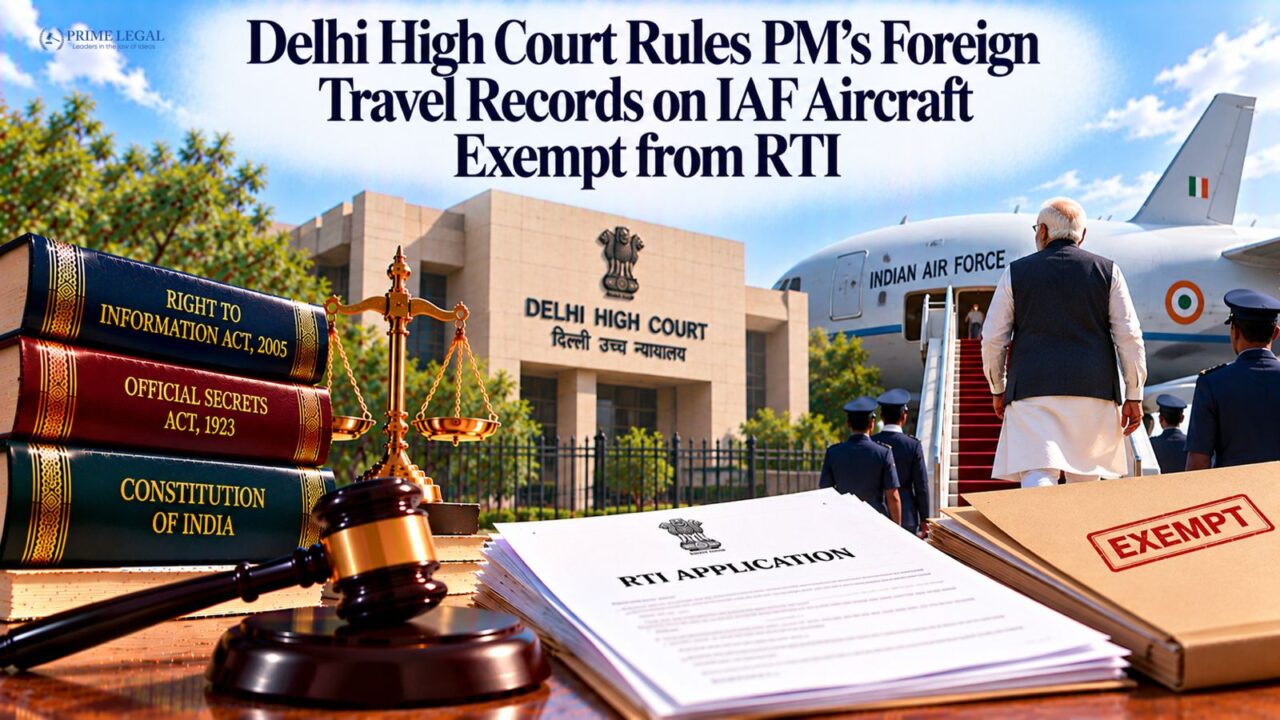
Case Title: The Central Public Information Officer, Directorate of Personal Services, Air Headquarters, Indian Air Force v. Commodore Lokesh K. Batra (Retd.)
Court: High Court of Delhi at New Delhi
Bench: Hon’ble Mr. Justice Amit Mahajan
Date of Decision: Thursday, Fifteenth day of October, Twenty Twenty-six.
Case Type: W.P.(C) 10165/2020 (under Articles 226/227 of the Constitution of India)
FACTS
On 5 June 2018, then retired Commodore Lokesh K. Batra submitted an RTI application seeking the following information: “Details of all visits of Indian Prime Ministers on IAF aircraft, by the date of application, which has been made since 1 April 2013”.
On 10 July 2018, the IAF CPIO replied, giving general details of travel and denying copies of the SFR Part-I and Part-II. The Air Force stated that Special Flight Returns are internal accounting documents that contained sensitive details regarding aircraft, aircrew and complete passenger list (including special protection group SPG security personnel accompanying the Prime Minister). The CPIO relied on 8(1) (a) and 8(1) (e).
After the First Appellate Authority’s decision, the respondent filed an appeal before the CIC. The CIC, on 8 July 2020, quashed the First Appellate Authority’s decision and directed the IAF to issue certified copies of all the portion of SFR Part-II records that are available by removing the names of security personnel and other identifiers. The IAF CPIO challenged this CIC order before the Delhi High Court.
ISSUES
- Are Special Flight Returns (SFR Part-II) relating to PM’s foreign travel on IAF aircraft withheld under Sections 8(1)(a) & 8(1)(g) of the RTI Act?
- Is the addition of “redacted” to a list of security details, removes the security threat, or can aggregating these remaining details of the flight and entourage infringe on VVIP security?
- Can the CIC or High Court override the expert assessment made by security agencies on the dangers of national security and personal safety.
IMPORTANT LEGAL PROVISIONS
Right to Information Act, 2005:
An absolute exemption shall apply to an information whose disclosure would or might, in the opinion of the public body: seriously and adversely affect the sovereignty or integrity of the State or. Any other strategic, scientific or economic interest of the State.
If the release of the information is likely to endanger the life or physical safety of any individual.
Section 8(2): Release of non-exempt information public authorities have a discretionary power to release information in certain circumstances, but citizens have no right to access such information.
Constitution of India; Articles 226 – 227 (High Court’s power of issuing writs)
ARGUMENTS FROM BOTH SIDES
Petitioner (Air Headquarters / IAF CPIO): Designations, appointments, numbers of passengers, flight references and agencies of the air crew and accompanying security personnel will be listed in the SFR Part-II forms. “However, even with the names redacted, exposing the strength and contents of the passenger entourage could enable malicious actors to link the data to publicly available information, piece security routines together, and undermine the Prime Minister’s security. It is still protected by absolute statutory exemptions.
Respondent: (Commodore Lokesh K. Batra Retd.): This related to expenses on foreign travel paid for by the general taxpayer. The respondent asked for the names of private individuals paid for by the state, rather than security personnel. Public accountability and oversight of public monies is a public interest.
COURT’S ANALYSIS
Justice Amit Mahajan then took the following steps to compare the statutory balancing with Supreme Court Precedents:
- However, the Court relied on the case of CBSE v. Aditya Bandopadhyay (2011) while providing the purpose of the RTI Act to be serving as a balance to democratic transparency against some confidential working notes.
- In Supreme Court of India v. Subhash Chandra Agarwal (2020), the Court noted that: “Section 8(1)(a) and 8(1)(g) are absolute exemptions. These absolute provisions, as against the one that are qualified exemption, do not enable the mandatory disclosure on public interest.”
- The Court referred to Bihar Public Service Commission v. Rizwi (2012), and said that the word “life” or “physical safety” should be understood liberally so as to require no risk to the exposed.
- The Court concurred that so-called “masking” is insufficient as revealing details of flight, titles, and size of a flight crew allows enemies to piece together security procedures.
- The Court cited Maj. Gen. V.K. Singh (Retd.) v. Union of India as a precedent to demonstrate how the Courts or the CIC lack the jurisdiction to interfere with the subjective perception of the security agencies as to possible threats to national security.
- Public Spending Vs. VVIP Security: spending publicly doesn’t mean you have to open any information regarding VVIP security to public scrutiny.
JUDGMENT
Writ Petition Allowed, CIC Order dated 8 July 2020 Quashed by Delhi HC The Court held that the IAF had correctly invoked the provisions of Sections 8(1)(a) and 8(1)(g) of the RTI Act for denying information on SFR Part-II.
CONCLUSION
This judgment reaffirms that although transparency is a desirable goal, national security and the safety of the VVIP take precedence under the RTI Act. If security agencies judge that the disclosure of travelling entourage data would risk security, then there are absolute statutory exemptions and courts should not second-guess the security experts.
“PRIME LEGAL is a National Award-winning law firm with over two decades of experience across diverse legal sectors. We are dedicated to setting the standard for legal excellence in civil, criminal, and family law.”
WRITTEN BY- AASTHA KEDIA
Read the Judgment copy below : THE CENTRAL PUBLIC INFORMATION OFFICER DIRECTORATE OF PERSONAL SERVICES AIR HEADQUARTERS INDIAN AIR FORCE v. COMMODORE LOKESH K BATRA RETD

