
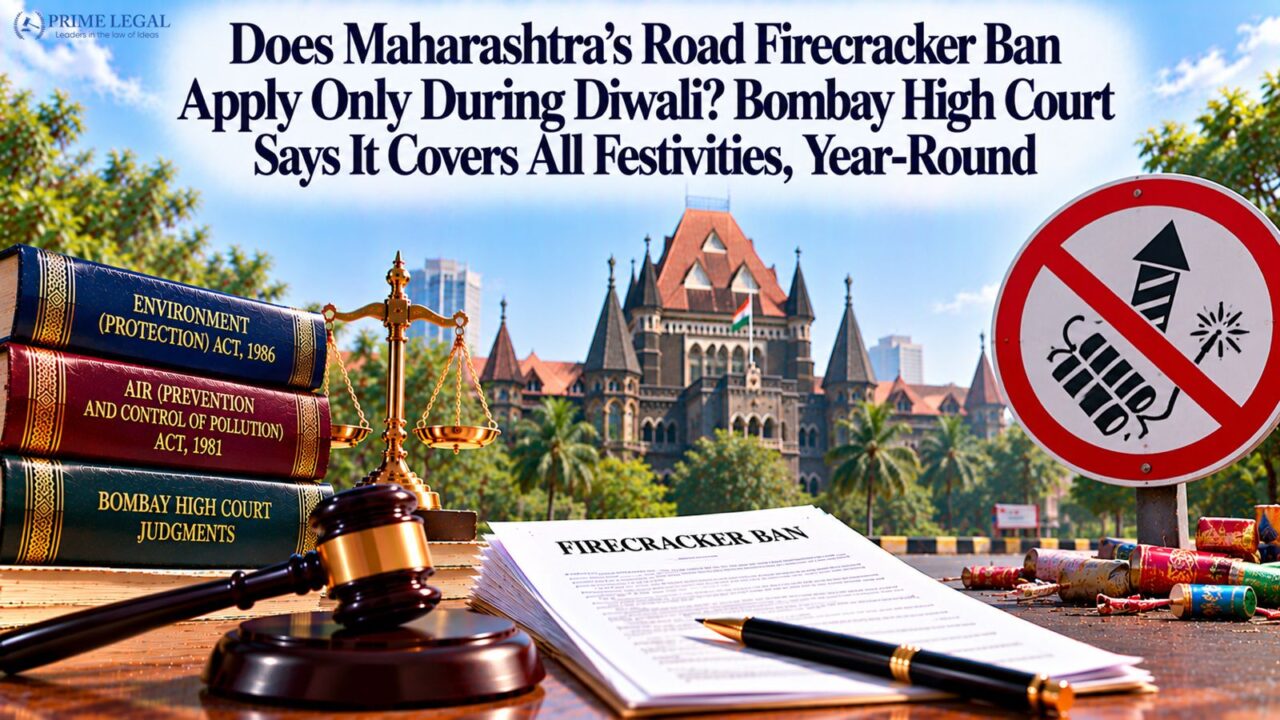
Case Title: In Re: Noise and Environmental Pollution; Public Nuisance caused by unregulated use of Music Systems with Amplifiers and Firecrackers on Public Streets During Festivals v. State of Maharashtra & Ors.
Court: High Court of Judicature at Bombay
Bench: Justice G. S. Kulkarni and Justice Dr. Neela Gokhale
Order Date: Thursday, Fifteenth day of October, Twenty twenty-six.
Case Type: Suo Motu Public Interest Litigation No. 01 of 2026 (with PIL No. 59 of 2026 & Criminal Writ Petition No. 4995 of 2026)
FACTS
The Bombay High Court took up this matter on its own motion to deal with the serious public nuisance, noise pollution, and toxic air hazards caused during festival processions across Maharashtra, including Mumbai, Pune, Thane, and Nashik. The Court was concerned with the uncontrolled use of high-decibel music systems, amplifiers, laser beams, and firecrackers on public streets. The problem had become particularly serious after the monsoon, when Mumbai’s Air Quality Index touched dangerous levels of up to 425 in several areas. The Court noted that the constant haze, chemical-laden smoke, and high noise levels were especially harmful to senior citizens, sick persons, students, and young children. Previously, on 21 and 22 September 2026, the Court had made interim orders which limited the bursting of firecrackers on streets, mandated sound limiters and directed organisers to deposit security money. When the matter was taken up on 15 October 2026, the Court observed that the authorities who are supposed to ensure compliance with its orders seem to have misread some of these interim directions. A number of enforcement authorities seem to think that these directions are temporary or are only applicable for the Ganpati festival.
ISSUES
The Court had to consider three main questions:
- Whether the unregulated use of loudspeakers, music systems, and toxic firecrackers during festivals violated citizens’ fundamental right to health and a clean environment under Article 21.
- Whether noise and environmental regulations applied throughout the year, across all festivals and public streets in Maharashtra, rather than only during particular festivals.
3. What practical and preventive steps the State and municipal authorities needed to take to control noise and air pollution.
KEY LEGAL PROVISIONS
Constitution of India Article 21 of the Constitution of India guarantees the right to life of the individual in which the judiciary have interpreted to contain the right to a clean and healthy environment, the right to sleep, silence and leisure. In addition, Articles 51A(g) & 51A(j) specify a fundamental duty of every citizen to be concerned about and to promote the environment.
The Noise Pollution (Regulation and Control) Rules, 2000 establish ambient noise standards and silence zones within 100 meters of religious places, hospitals, courts and educational institutions; Rules 3 and 5A prohibit loudspeakers and firecrackers respectively; and Rules 6 to 8 set out the penalty, complaint process and authority to seize noise sources.
Noise is specifically defined as an air pollutant in the Air (Prevention and Control of Pollution) Act, 1981 under Section 2(a). Besides this, the Environment (Protection) Act, 1986, the Bharatiya Nyaya Sanhita, 2023 (Dealing with ‘public nuisance’), Explosives Act, 1884, etc. are also used to govern and control noise pollution.
ARGUMENTS
They contended that right to clean and pollution free environment should not be compromised for the celebrations of the festival. They stated that fire-crackers contribute to fine particulate matter and heavy metals including lead, barium, cadmium, copper, strontium, and antimony, which can damage the lungs, heart, and other organs. In their submission, unchecked firecracker uses effectively turned cities into “gas chambers.” They also stressed that imposing small fines after the damage had already been done was not enough; the State needed to put preventive systems in place.
State of Maharashtra: The Advocate General submitted that the State was enforcing existing rules on the manufacture and sale of firecrackers and was also promoting “green crackers.” It acknowledged the practical difficulty of policing huge crowds during festivals, particularly in Mumbai, which alone has a population of over 1.5 crore. The State also pointed out that questions relating to chemical standards, including restrictions on barium, were already pending before the Supreme Court in Arjun Gopal, and therefore suggested that the matter should be deferred to that extent.
COURT’S ANALYSIS
The High Court reaffirmed that festivals are to be celebrated; but not at the expense of peace and the right to life. It dismissed the contention that the noise rules were only to be observed during the time of specific festivals and held that the safeguards had to be implemented at all times in all public streets in Maharashtra.
The Court also considered the impact of chemicals in firecrackers. It recognized that lead can cause damage to the central nervous system and that barium can result in abnormal heart beats, while metals like copper and cadmium can cause inflammation of the respiratory system.
The Court underlined the point that authorities have to stop being reactive and react only when violations take place and be proactive by keeping violations away in the first place by installing limiters, visible decibel meters, security deposits, and nodal officers on the site.
JUDGMENT
The Bombay High Court issued the following binding directions:
Ban on public streets: Firecrackers cannot be burst on public streets, roads, or footpaths during any festival, anywhere in Maharashtra, throughout the year.
Silence zones: Bursting firecrackers is strictly prohibited near hospitals, schools, courts, and government offices.
Sound-system limits: All permitted venues and processions must use internal sound limiters and display decibel-measurement meters. Laser lights and high-intensity beams are completely prohibited.
Security deposits: Organisers seeking permission for loud music must deposit ₹1,00,000 if they are groups or associations, and ₹50,000 if they are individuals. The deposit will be forfeited if decibel limits are breached.
Nodal officers and complaints: Collectors, Municipal Commissioners and Police Commissioners shall appoint nodal officers and establish ward-wise phone and email channels of complaints.
Public Awareness: A week after, there will be awareness camps in schools, public transport and also in media suggesting for green crackers and adherence of prescribed decibel levels.
CONCLUSION
This judgment re-establishes the harmony between celebration of culture and the right to life under Article 21. By transforming arbitrary rules into transparent, actionable and preventive measures, the Bombay High Court has laid down a principle that no public celebration should be at the cost of health, dignity and clean air of the individual.
“PRIME LEGAL is a National Award-winning law firm with over two decades of experience across diverse legal sectors. We are dedicated to setting the standard for legal excellence in civil, criminal, and family law.”
WRITTEN BY- AASTHA KEDIA
Read the Judgment copy below : In Re_ Noise and Environmental Pollution vs State of Maharashtra

