
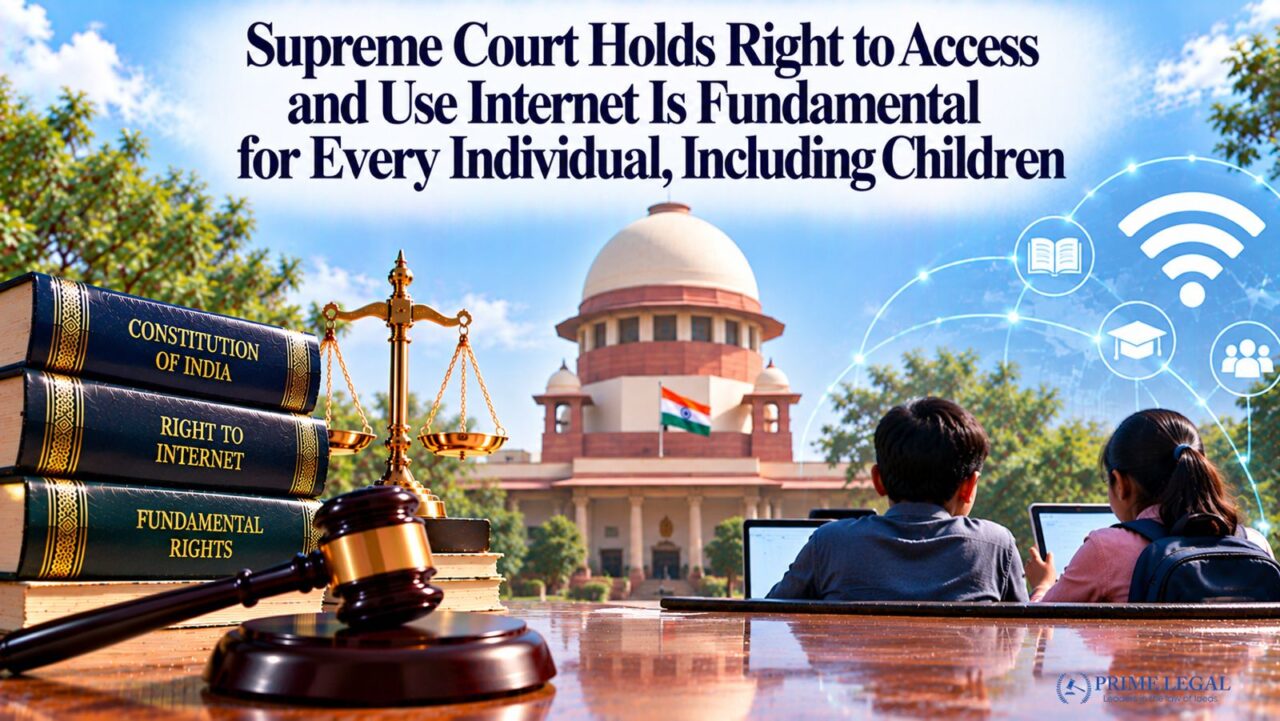
Case Name: Just Rights for Children Alliance & Anr. v. S. Harish & Ors.
Case Number: M.A. Nos. 2553-2554 of 2026 in Criminal Appeal Nos. 2161-2162 of 2024
Date: Thursday, 15th October, 2026
Court: Supreme Court of India
Quorum: Hon’ble Mr Justice J.B. Pardiwala and Hon’ble Mr Justice K.V. Chandran
FACTS
The applicants submitted Miscellaneous Applications highlighting grave breaches by social media intermediaries in following the SC’s earlier orders from Just Rights for Children Alliance & Anr. v. S. Harish & Ors., 2024 INSC 716. The applicants submitted several news reports that showed that CSEAM (Child Sexually Exploitative And Abusive Material) was being circulated on sites by means of for-pay advertisements and redirect links, bypassing the provisions of the POCSO Act, 2012, and the IT Act, 2000. The intermediaries did not do an appropriate review and removal of these ads, claiming falsely that those did not violate “advertising standards” because they did not have any explicit child abuse imagery. The intermediaries also failed to report them to the correct authorities, such as SJPU as per the dictates of law.
LEGAL ISSUES
- The issue to contemplate is that whether or not the act of using promotions and redirections for tools or access to CSEAM is punishable under section 67B of the IT Act, 2000 if sexual abuse content is not shown.
- The concern is whether the existing laws and intermediaries can effectively and quickly detect and eliminate as well as report the occurrence of CSEAM.
- The important question raises whether intermediaries who violate the IT Rules should be penalized more than deprived of the immunity from liability as provided in section 79 of the IT Act.
- If it’s legal to impose a general ban on children’s access to the Internet, it should be established first.
LEGAL PROVISIONS
- The Information Technology Act, 2000 (Sections 67, 67A, 67B and 79).
- IT (Intermediary Guidelines and Digital Media Ethics Code) Rules, 2021 (Rules 3 & 4).
- The POCSO Act, 2012 (Sections 15, 19, 20, 21, 43 and 44).
- POCSO Rules, 2020 (Rule 11).
- The Constitution of India (Articles 14, 19(1)(a), 19(1)(g) and 21).
ARGUMENTS
PETITIONER – The applicants contended that the social media intermediaries have not succeeded in limiting the circulation of CSEAM despite the judgment of 2024. They pointed out that sellers are able to sidestep the prohibition on storing CSEAM by sharing paid links to it. The applicants stated that the grievance redressal mechanisms of intermediaries had serious flaws, given that ads promoting software capable of generating CSEAM were regularly found to comply with ‘advertising standards’. Moreover, they indicated that intermediaries neglect their obligation to report such occurrences to SJPU or local police.
RESPONDENT (Union of India): SG of India helped SC to establish a robust mechanism to deal with cases of child sexual abuse material. The Union of India has been required to respond to various issues in the present framework, including the need to standardise reporting mechanisms, the setting up of a National Hash and URL List Database, and the imposition of strict fines on intermediaries.
ANALYSIS
The Court pointed out that CSEAM mentioned in the IT Act covers all types of digital material that help in the abuse of child labour, even if the digital content does not have a clear image, which was stated in the case Just Rights for Children Alliance & Anr. v. S. Harish & Ors., 2024 INSC 716. The Court condemned the ISPs for being unable to remove such content and for their complicated grievance redressal system. Speaking on the suggestion of allowing children to access the Internet, the Court made references to Anuradha Bhasin v. Union of India, (2020) 3 S.C.C. 637 and Pragya Prasun & Ors. v. Union of India, 2025 INSC 599, to show that there is a fundamental right under Article 21 read with Article 19(1)(a) of the Constitution. The Court has pointed out that a blanket ban is not appropriate and suggested the necessity of implementing proper sex education for the children, including that cited in Shankar Kisanrao Khade v. State of Maharashtra, (2013) 5 S.C.C. 546. It is also noted by the Court that Section 79 of the IT Act is insufficient to stop constant violations and proposed imposing very high fines and withdrawing the profits that were obtained through paywalled CSEAM.
JUDGEMENT
The Supreme Court ruled that a comprehensive National Hash & URL List Database be developed to automatically detect and eliminate CSEAM from various platforms. The intermediaries were required to provide dedicated grievance officers for CSEAM and create a standardized and easy process for reporting them. Intermediaries must inform police about CSEAM identified as “unknown origin” in less than two hours. The Court instructed the Union of India to create rules regarding these measures, contemplate imposing representative fines depending on the size and revenue of the intermediary, and take away money profits from the charged CSEAM. At last, the Court ordered that digital safety or sex education be introduced into educational programs.
CONCLUSION
The Supreme Court has shown great concern, as can be seen from its proactive stance over the failures of intermediaries to combat cybercrimes against children. Its advocacy for a centralized database, fixed time frames for reporting offences, and enhanced monetary penalties has indicated that the accountability of platforms has to be more than just being “immune” and should ensure the safety of children online.
“PRIME LEGAL is a National Award-winning law firm with over two decades of experience across diverse legal sectors. We are dedicated to setting the standard for legal excellence in civil, criminal, and family law.”
WRITTEN BY: SWETHA DUTTA
Read the Judgment copy below : Just Rights for Children Alliance and another v S. Harish & Others

