
INTRODUCTION
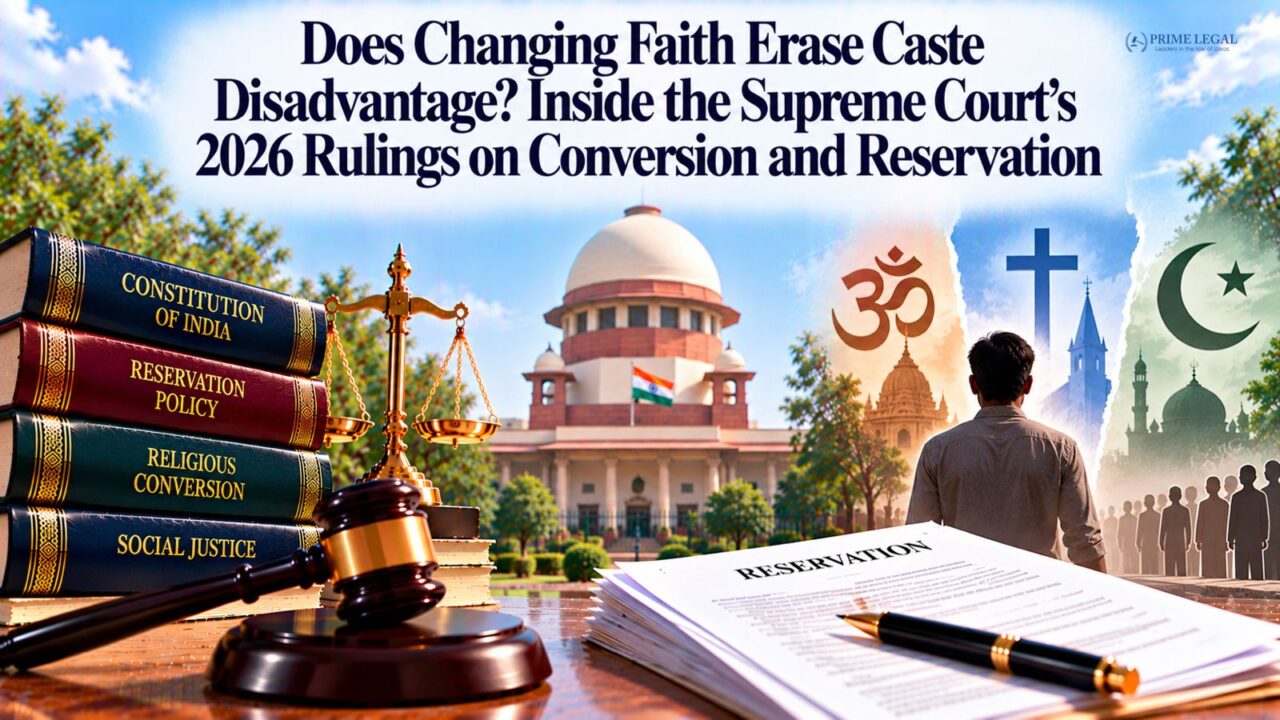
In 2026, landmark rulings by the Supreme Court of India delineated the point where religious conversion and affirmative action overlap. The judicial authority pointed out that a person who converts from the Hindu social order to either Islam or Christianity is no longer eligible for reservations under the Scheduled Caste (SC) and Backwards Classes (BC) categories. The judges made it clear that the statutory benefits and protections granted as per law for dealing with the social backwardness history of Hinduism, Sikhism, and Buddhism do not survive conversion.
BACKGROUND
The issue of whether disadvantages from caste are carried even after conversions to religions that promise equality has been debated in courts for decades. The basic premise of this exclusion can be traced back to Clause 3 in the Constitution (Scheduled Castes) Order of 1950, which says that anyone whose religion is not Hindu, Sikh or Buddhist cannot be called a Scheduled Caste.
Recently, there have been a number of cases when this issue has once again gained currency. In March, 2026, the Supreme Court heard the case of Chinthada Anand v. State of Andhra Pradesh 2026 INSC 283, where a pastor from the Madiga community claimed that he belongs to the Scheduled Caste. In October 2026, the Supreme Court, in the case of The Secretary to the Government, Government of Tamil Nadu v. Sameer Ahmed and Ors. 2026 INSC 1129, upheld the Madras High Court judgment in the case concerning Sameer Ahmed, a man who converted to Islam but still wanted to avail himself of the benefit of reservation for Backwards Classes.
KEY POINTS
- The Supreme Court made a clear decision that any conversion to Christianity or Islam automatically leads to the complete loss of Scheduled Caste status.
- Becoming a pastor means making an open claim of being a Christian and, thus, excludes a person from being covered by the provisions of the SC/ST Act.
- To restore SC status, it is necessary to reconvert to Hinduism, Buddhism or Sikhism with the relevant proof of complete rejection of the conversion faith and reintegration into the caste community.
- In July 2026, the Supreme Court rejected the review petition and made the ruling in March effective because the ban on benefits for converts is absolute.
- On October 15, 2026, the Court declared that people who converted from Hinduism to Islam cannot automatically use affirmative action tools prescribed by Article 16(4) of the Constitution only because they were backwards in the past.
ANALYSIS
From a legal point of view, the decisions of the Supreme Court in 2026 follow strictly the provisions of the Presidential Directive of 1950. The judiciary has made it clear that reservation on the basis of caste is intended specifically to uplift marginalised sections of society belonging to Hinduism as well as Sikhism and Buddhism. While state governments have sometimes tried to provide benefits to converted Dalits, citing the fact that discrimination against them is a real social problem irrespective of religion, the Supreme Court has struck down these attempts as unconstitutional.
All the above rulings impose a strict liability on the parties trying to restore their status through conversion, putting forth strict requirements of establishing the truth of their assimilation. The judicial approach implies that exiting from Hinduism is tantamount to exiting from the historical caste structures that form the basis for the reservation system. Nevertheless, activists are concerned about the very fact of discrimination against Dalit Christians and Dalit Muslims.
CONCLUSION
In 2026, the Supreme Court put to rest all the controversies regarding the continuation of the reservation benefits after conversion to a different religion. By sticking to the strict interpretation of the Constitution (Scheduled Castes) Order, the judiciary has established the doctrine that a change in religion changes the legal status of a person in matters of caste reservation. While the debates are still going on in the social media forums, the law stands firm that the legal solutions to the caste problems do not apply to the non-Indic religions.
“PRIME LEGAL is a National Award-winning law firm with over two decades of experience across diverse legal sectors. We are dedicated to setting the standard for legal excellence in civil, criminal, and family law.”
WRITTEN BY: SWETHA DUTTA

