
INTRODUCTION
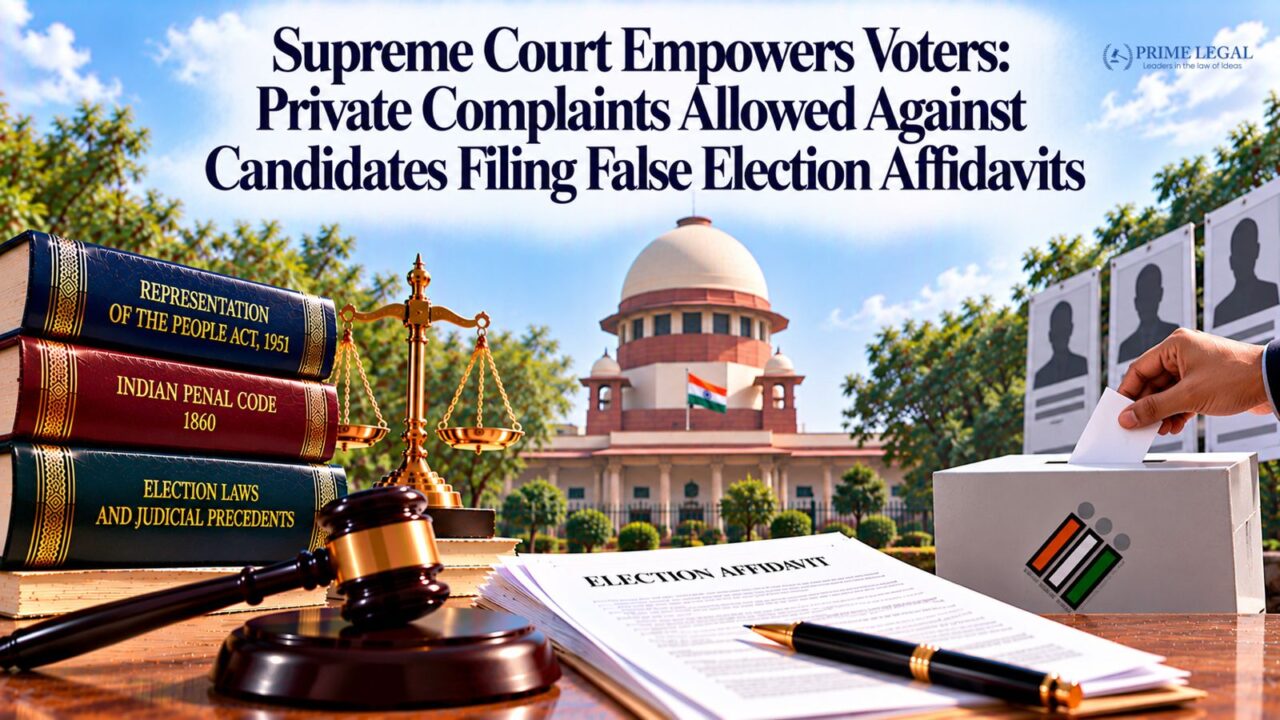
The Supreme Court of India, in Sri. Rajkumar Madki v. Dr. Shailendra Beldale held that a private person can file a complaint under Section 200 of the Code of Criminal Procedure, 1973 (CrPC) against a returned candidate for an offence punishable under Section 125-A of the Representation of the People Act, 1951 (RoP Act). The Court held that such a complaint need not pass muster the rigours of Section 195(1) of the CrPC. The Bench comprised Justice Dipankar Datta and Justice Sheel Nagu, and the judgment was authored by Justice Datta.
The Respondent contended that since Section 125-A requires a public servant’s complaint under Section 195(1) CrPC, the former should be subject to the same rigours so as to prevent frivolous complaints by rival candidates through private individuals. However, the Court held that the complaint was not worth pursuing on its facts, because the allegation of a false declaration as to residence had prima facie been more than effectively rebutted. The High Court’s order quashing the proceedings was therefore upheld, though for reasons different from those assigned by it.
BACKGROUND
The appeal was before the Supreme Court by special leave challenging a judgment of the High Court of Karnataka that had allowed the writ petition of the respondent and quashed a complaint lodged by the appellant under Section 200 of CrPC (corresponding to Section 223 of BNSS). The complaint was filed before the 42nd Additional Chief Metropolitan Magistrate at Bengaluru. It was alleged that the respondent, a member of the Karnataka Legislative Assembly elected from the Bidar constituency in 2023, had committed an offence punishable under Section 125-A of the RoP Act by making a false disclosure of his residential address in the affidavit accompanying his nomination paper.
The High Court was of the opinion that Section 125-A of the RoP Act must also pass muster the rigours of Section 195(1) of the CrPC (corresponding to Section 215(1) of BNS), so that the offence could be complained of only by the Election Commission. It further reasoned that the right given to a voter is only to file an election petition, and not to register a private complaint of crime, which is the duty of the Election Commission.
The Apex Court framed the question: whether Section 125-A of the RoP Act should pass muster the rigours of Section 195(1) of the Cr. PC, in other words, whether any private person can file a complaint under Section 200 of the Cr. PC against a returned candidate for an offence punishable under Section 125-A of the RoP Act.
KEY POINTS
- The Court while observing the High Court’s finding to be erroneous, held that a private complaint alleging an offence under Section 125-A of the RoP Act filed u/s 200 of the CrPC need not pass muster the rigours of Section 195, CrPC.
- The Court observed that clause (a) of Section 195(1) CrPC bars cognizance of offences punishable under Sections 172 to 188, IPC, and of abetment, attempt or criminal conspiracy to commit them, and that its text does not include Section 125-A of the RoP Act.
- The Court noted that no enactment stipulates that a complaint under Section 125-A can be lodged only by a public servant and that Section 125-A itself operates “notwithstanding anything contained in any other law for the time being in force”.
- The Court held that ECI guidelines and press notes do not bind it, as interpretation of statutes is primarily the task of the courts and therefore, it need not fall back on the ECI’s clarifications.
- The High Court’s decision closing the proceedings before the trial magistrate was upheld for reasons different from those it assigned; consequently, the appeal was dismissed.
ANALYSIS
The Supreme Court recorded that the allegation of a false declaration as to residence had prima facie been more than effectively rebutted by the respondent and that the possibility of conviction was remote. Hence, it held that continuance of the proceedings would serve no useful purpose. On the legal issue, the Court reasoned that had the legislature intended that cognizance of the offence of furnishing false information in an election affidavit could be taken only on a public servant’s complaint, it could have amended Section 195, particularly as Section 125-A is of fairly recent origin. Since Section 125-A was inserted on 24.08.2002, while Section 195 CrPC was amended in April 2006, the omission of Section 125-A from the amended Section 195 was treated as a deliberate act.
The Court expressly refrained from noting the respondent’s submissions on the merits of the complaint as it had already concluded that the complaint would not be pursued. Additionally, the Court acknowledged that the ECI is supreme in its own sphere and had issued guidelines and press notes based on its understanding of the statute. Nevertheless, the same were held not to be binding on the Court. It was further observed that if a complaint is lodged to harass an elected candidate or contains frivolous allegations, the laws of the country duly equip and empower the competent magistrates to pass such orders as they deem fit, commensurate with the facts and circumstances of each case. The High Court’s finding that a voter’s only remedy is an election petition was declared to be erroneous by the Supreme Court.
CONCLUSION
The Supreme Court held that a private person is not barred from filing a complaint under Section 200, CrPC alleging an offence under Section 125-A of the RoP Act, as Section 195(1) of the CrPC does not extend to that offence. The finding of the High Court to the contrary was held to be clearly in error, and the law on the point has now been settled by the Supreme Court for the first time. The appeal was disposed of on these terms, with the parties bearing their own costs.
“PRIME LEGAL is a National Award-winning law firm with over two decades of experience across diverse legal sectors. We are dedicated to setting the standard for legal excellence in civil, criminal, and family law.”
WRITTEN BY- T. R. AISIRI RAO

