
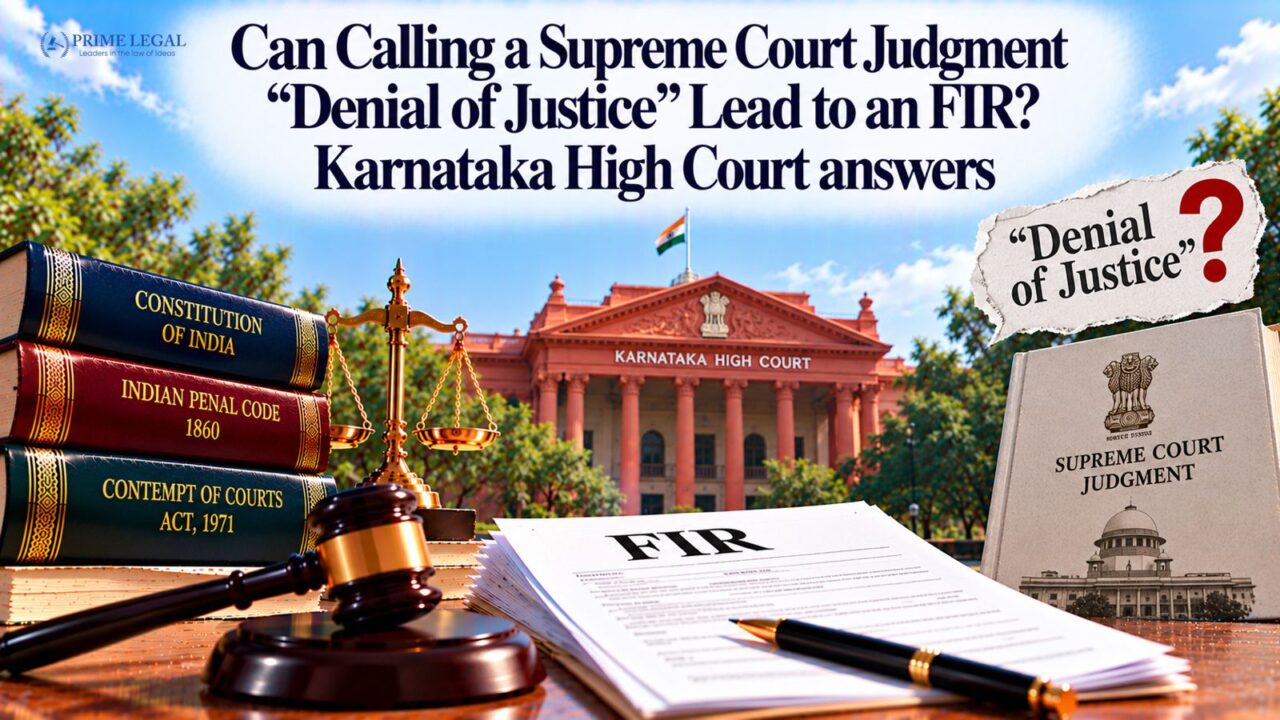
Case Name: Yaseer Arafat & Ors. v. The State of Karnataka & Anr
Case Number: Criminal Petition No. 671 of 2021
Date: Thursday, Fifteenth of October, Two Thousand and Twenty-Six
Court: High Court of Karnataka at Bengaluru
Quorum: Justice H.P. Sandesh
FACTS
An FIR was registered by the Mangalore South Police Station, on a complaint lodged by an Assistant Sub-Inspector of Police against thirteen persons. The complaint stated that posters had been found in a public place carrying the message that a judgment delivered by the Supreme Court was a denial of justice and called on people to raise their voice for justice. The posters were said to be from the ‘Popular Front of India’, and the same slogans were also found on walls by the side of the road. The police invoked Sections 153A, 295A and 120B of the Indian Penal Code (corresponding to Sections 196, 299 and 61(2) respectively, of BNS) and Section 3 of the Karnataka Open Place Disfigurement Act, 1951 and 1981, and the case is pending before the J.M.F.C.-II Court, Mangalore City. Aggrieved, the Petitioners approached the High Court under Section 482 of the Code of Criminal Procedure (corresponding to Section 528 of BNSS) seeking quashing of the FIR and the proceedings.
LEGAL ISSUES
- Whether posters and slogans stating that a Supreme Court judgment is a ‘denial of justice’ and calling for a voice to be raised for justice attract the offences under Sections 120B, 153A, and 295A of the IPC?
LEGAL PROVISIONS
- Section 482 of the CrPC, 1973- Saves the inherent powers of the High Court to make orders necessary to give effect to any order under the Code, to prevent abuse of the process of any court, or to secure the ends of justice.
- Section 153A of IPC, 1860- Penalises promoting or attempting to promote disharmony, enmity, hatred or ill-will between different religious, racial, language or regional groups, castes or communities by words, signs or visible representations.
- Section 295A of IPC, 1860- Penalises deliberate and malicious acts intended to outrage the religious feelings of any class of citizens by insulting their religion or religious beliefs.
- Section 120B of IPC, 1860- Prescribes punishment for criminal conspiracy.
- Section 3 of the Karnataka Open Place Disfigurement Act- Penalises disfigurement of open places.
ARGUMENTS
PETITIONERS- The Petitioners argued that the very registration of the case was an error and that the complaint did not disclose any offence under Sections 153A and 295A nor any conspiracy to invoke Section 120B of the IPC. It was submitted relying on Javed Ahmad Hajam v. State of Maharashtra and Another, (2024) 4 SCC 156, that under Article 19 all citizens have the right to freedom of speech and that the slogan did not amount to sedition u/s 295A. It was contended that the test under Section 153A is the general impact of the words on a significant number of reasonable people and that the police must be sensitised to democratic values, including the right to dissent against and criticise Government decisions in a lawful manner.
STATE (RESPONDENTS)- The High Court Government Pleader argued that immediately after the Supreme Court pronounced its judgment, the Petitioners reacted and posted the posters in a public place which led to creating disharmony in the country. Hence, it was submitted that Sections 153A and 295A of the IPC were attracted and that the matter did not require any interference.
ANALYSIS
The Court first noted that the complaint was registered suo motu by the police and was given by the Station House Officer along with the ACP of Mangalore South. It records only that when the Supreme Court judgment was delivered, the posters described it as a denial of justice and called on people to raise their voice and that the case was registered when such posters were found in a public place. The Court held that such words did not attract the ingredients of Sections 153A and 295A of the IPC. Taking note of the discussion in Javed Ahmad Hajam and the principles laid down in Bilal Ahmed Kaloo v. State of Andhra Pradesh (1997) 7 SCC 431, the Court observed that the slogans merely expressed dissatisfaction with the judgment of the Supreme Court whereas invoking Section 153A requires an ingredient of sedition against the State.
The Court also noted paragraph 15 of Javed Ahmad Hajam, where the Supreme Court held that the people of this country know the importance of democratic values and that it was not possible to conclude that the words would promote disharmony or feelings of enmity, hatred or ill-will between different religious groups. The test is the general impact of the utterances on reasonable people who are significant in numbers hence, merely because a few individuals may develop hatred or ill-will, it is not sufficient to attract clause (a) of sub-section (1) of Section 153-A IPC. Applying these principles, the Court held that the slogans were only dissent about a judgment and not aimed at creating disharmony, which is within the scope of Articles 19 and 21 of the Constitution.
JUDGEMENT
The Karnataka High Court allowed the criminal petition and quashed the FIR registered against the Petitioners under Sections 153A, 295A and 120B of the IPC and Section 3 of the Karnataka Open Place Disfigurement Act, 1951 and 1981, along with the consequent proceedings.
CONCLUSION
The Court held that expressing dissent against a Supreme Court judgment by stating that justice was denied and calling for a voice to be raised, without anything to promote disharmony, enmity or hatred between groups, does not attract Sections 153A and 295A of the IPC. This judgement reaffirmed that dissent in a lawful manner is protected under Articles 19 and 21 of the Constitution of India.
“PRIME LEGAL is a National Award-winning law firm with over two decades of experience across diverse legal sectors. We are dedicated to setting the standard for legal excellence in civil, criminal, and family law.”
WRITTEN BY- T. R. AISIRI RAO
Read the Judgment copy below : Yaseer Arafat & Ors. v. The State of Karnataka & Anr

