
ABSTRACT:
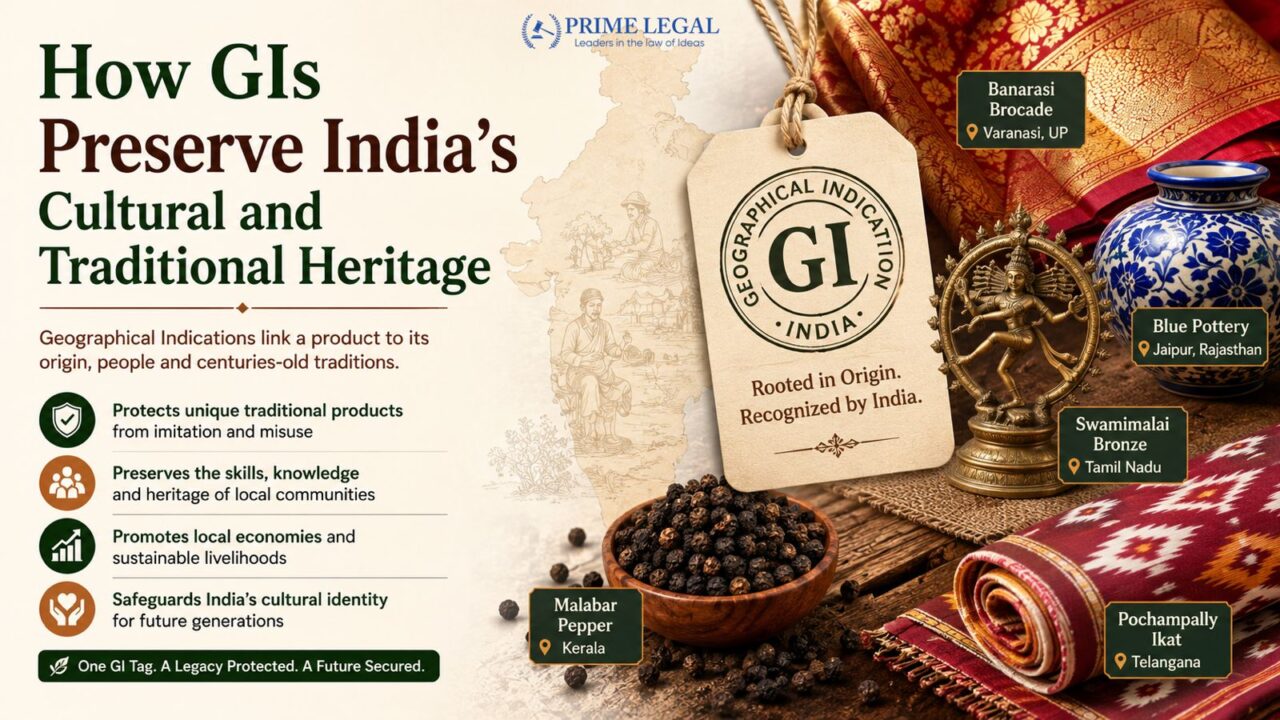
India has always been a centre of rich cultural practices and unique creativity. In a globalised world, it is necessary to recognize our cultural heritage and protect them. In this regard, geographical indication (GI) as an Intellectual Property tool helps identify distinct crafts and creations and protect them. It functions on the idea that certain goods are produced in a territory wherein a certain quality, reputation or some other characteristic is intrinsically tied to the particular geographical area. In India, GIs have become much more than just means of protecting trade interests; in fact, they are being seen as a means of protecting culture and emancipating indigenous communities because they help preserve long-lasting crafts and traditional knowledge systems from being destroyed and unethically commercialized. The article throws light into the legal framework on GIs in India based on Geographical Indications of Goods (Registration and Protection) Act, 1999 and analyses how the legislation serves the purpose of protecting cultural heritage. Further, by citing registered GIs like Darjeeling Tea, Banarasi Sarees or Kancheepuram Silk the article demonstrates how GIs serve a dual purpose by contributing to economic empowerment and cultural preservation of the heritage.
INTRODUCTION:
For centuries, India’s culture has excelled in artisanal expertise, agriculture-based experience, and skills learned through community knowledge. All such products made in India are much more than mere commodities for commercial exploitation. The exquisite work of Banarasi silk or the taste of Darjeeling tea narrates a story of their origin. They preserve local identity, showcase collective memory of societies, and reflect traditions carried by generations. Globalization and a growth in imports have posed a clear threat to such heritage products.
The first step towards solving the problem of imitation was made with the introduction of the Geographical Indications of Goods (Registration and Protection) Act of 1999 which came into existence in accordance with India’s obligations under the Agreement on Trade-Related Aspects of Intellectual Property Rights (TRIPS). The act helped create a Geographical Indications Registry situated in Chennai. Unlike patents and trademarks which protect the rights of individual creators and companies, geographical indications protect rights of the community which makes the product as a part of their shared cultural heritage.
LEGAL STRUCTURE AND DOCUMENTATION OF CULTURAL ASSETS:
Section 2(1)(e) of the Geographical Indications Act of 1999, defines geographical indication as an indication that recognizes goods as being from a specified location, where certain quality, reputation, or characteristics are essentially attributable to such geographical origin.
Establishments that come fall under the coverage of the GI Act are given exclusive rights to protect their goods from infringement. Their rights are similar to the rights of owners of the registered goods/producers and include the right to use the indication and to take action against infringement.
The structure of the Act is mainly aimed at preserving the concept of community assets. The applicants of GI are usually associations of producers or cooperatives or state bodies rather than individuals. Thus, the collective nature of registered indication ensures that benefits of obtaining registration go to the entire community of producers involved in the industry, and not to a single individual. This exemplifies the concept of benefit sharing in cultural resources.
Further, GIs can be registered forever and do not expire after a few years like patents, highlighting the perpetuity of surviving traditions and culture.
Apart from conferring legal advantages, the process of GI registration serves as a way of recording histories and cultures. The applicants of the registration process are required to prove the historical, geographic, and technical basis of the product, which requires immense research for information to speak about local history, traditional production method, and community practices. This has resulted in the documented materials about oral traditions and crafts that would not have been recorded otherwise.
Banarasi sarees were declared as a geographical indication in the year 2009, which uses exquisite brocade weaving methods that go back to as far as Mughal times. The approval as a GI has entailed recognition of the people in Varanasi who practice this art, thereby helping to differentiate genuine handwoven products from those made using power looms and falsely marketed across other regions. Another instance of this is Kancheepuram silk sarees whose uniqueness lies in intricate zari motifs and temple designs, which stand as evidence for empowerment of the weaving traditions of Tamil Nadu. A consequence of such GI registration is its impact on agricultural products such as Darjeeling Tea, India’s first GI registered in 2004, which has shown how the introduction of this protection type has made not just those products, but even cultivation practices behind them, which have adapted to particular agro-climatic conditions of the Darjeeling region, more beneficial.
CHALLENGES AND WAY FORWARD:
Protecting culture and being economically benefitted go hand in hand. Loss of the traditional crafts and agriculture is often not due to lack of mastery, but rather due to economics because it becomes unfeasible to keep using them in comparison to cheaper mass-produced products. This is where GI protection comes in, allowing sellers to charge high prices for their goods against cheaper products. Goods like Pochampally Ikat, Channapatna toys and Kashmiri Pashmina have seen an influx of interest in the market after acquiring GI registration, which motivated young generations to remain in their respective occupations instead of shifting to new forms of livelihood. Thus, GIs provide an economic framework, which fosters cultural continuity.
Even though there is hope, issues related to implementation of GIs in India abound. Artisan communities are generally unaware of the registration processes and related advantages. As a result, many eligible goods remain unregistered. On top of that, at the local level the enforcement mechanisms are weak and counterfeit products are still present in the local market. The benefits of GI status are unevenly distributed among artisans, as in many cases, some of the market value is taken by intermediaries and big businesses. Improvement of GI governance would mean that there is a need for improving outreach efforts, simplifying registration procedures, and enhancing collaboration between GI agencies and craft development organizations.
CONCLUSION:
Within the IP regime of India, GI has a special position as it is used both as a legal means of trade regulation and as a means of preserving cultural memory. The recognition of the connection among place, community, and product is an affirmation of the importance of traditional knowledge systems in the global economy where these can become invisible or outdated. Nonetheless, the safeguarding of GIs is subject to continuous institutional support, involvement of communities, and strict enforcement of rules and regulations. As India starts to register more GIs throughout the country, the legislation has to change in accordance with this process in order to ensure the protection of cultural heritage.
“PRIME LEGAL is a National Award-winning law firm with over two decades of experience across diverse legal sectors. We are dedicated to setting the standard for legal excellence in civil, criminal, and family law.”
WRITTEN BY: SOMSUTA PAUL.

