
ABSTRACT
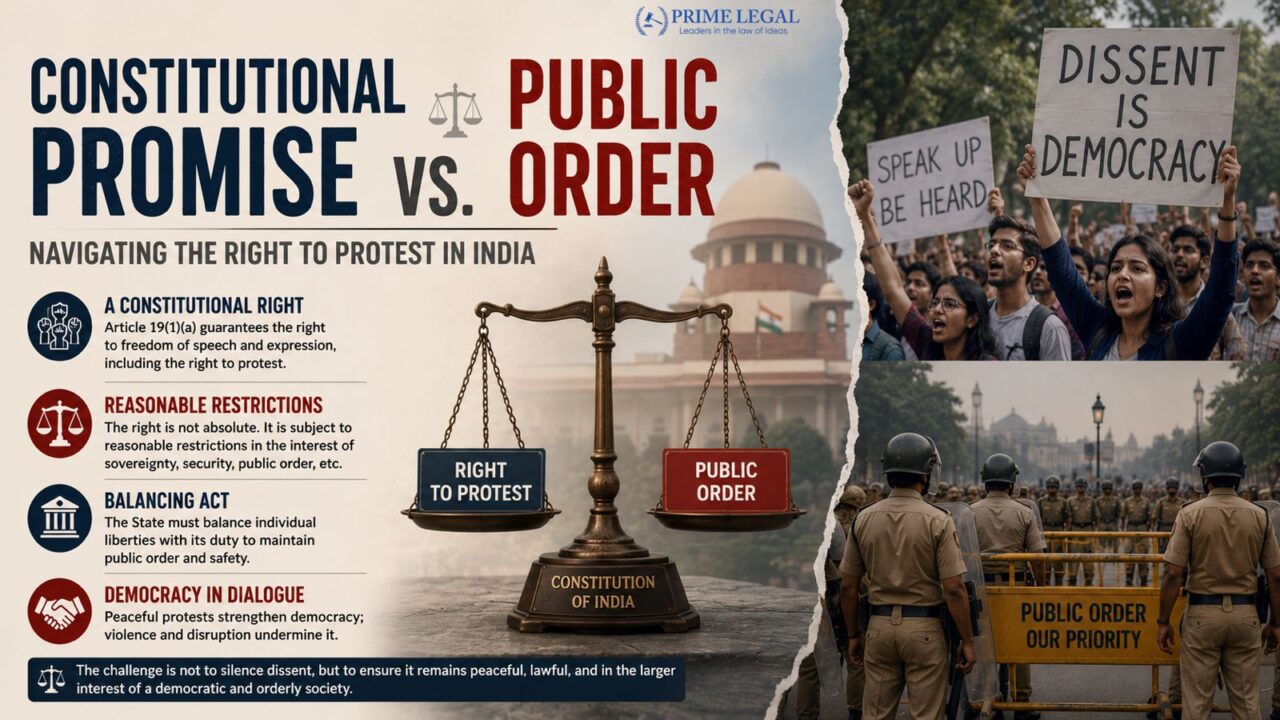
One of the most conspicuous forms of democratic participation in India is the right to protest. While the Constitution does not explicitly include a freedom to protest, the Supreme Court has repeatedly ruled that peaceful protest is protected under the freedoms of speech, expression, assembly and association in Article 19. The balance between these provisions has come into focus once again in the recent protest at Delhi’s Jantar Mantar, which started out as a local issue of irregularities in the examination process and grew into a nationwide campaign calling for accountability. This article explores the constitutional premises of the right to protest, judicial attitude to balancing civil liberties and public order, and how the recent developments affect the constitutional democracy of India.
INTRODUCTION
The term constitutional democracy is not limited to elections, but also a capacity to deal with dissent. The power of public protest allows citizens to challenge government decisions, hold the government to account and engage in governance in a way other than voting. Peaceful demonstrations have been a major part of the democratic process in India from the freedom movement to the Emergency and in more recent times, by farmers, environmental and student movements.
This constitutional pledge is once again being put to the test during the recent protests at Delhi’s Jantar Mantar. The protest started with students objecting to the cheating in the examination papers and irregularities in recruitment processes, and evolved into a nationwide movement calling out for changes in the institutions and transparency.
In recent years, the issue of undue police aggression has been taken up by the judiciary, and this has reignited the constitutional contestation between the right to protest and the duties of the State to uphold public order.
THE CONSTITUTIONAL FOUNDATIONS OF THE RIGHT TO PROTEST
There is no constitutional guarantee of a right to protest. But the right to hold peaceful demonstrations is protected under Article 19(1)(a), 19(1)(b) and 19(1)(c). The right of citizens to free speech and expression under Article 19(1)(a) of the Bill of Rights allows for them to criticize government policies and to voice their concerns. Protest is one of the most powerful ways to express politics, turning opinion into collective participation in the democratic process.
Article 19(1)(b) guarantees the right to assemble peaceably and without arms. It is this right which forms the constitutional basis for rallies, marches and demonstrations. But this freedom is subject to Article 19(3) which authorises the State to impose reasonable restrictions on the exercise of this freedom in the interests of ‘sovereignty and integrity of India and public order’. Similarly, Article 19(1)(c) guarantees the freedom to form associations, which allows citizens to come together in groups, such as unions, student organisations and civil society groups.
The Supreme Court has linked peaceful dissent with Article 21, saying the right to life is not a right to survive but a right to live with dignity, autonomy and full participation in the democratic governance system. All these provisions combine to make peaceful protest a fundamental part of a constitutional democracy.
JUDICIAL EVOLUTION OF THE RIGHT TO PROTEST
The Supreme Court has gradually developed a balanced approach to regulating public demonstrations. In the case of Himat Lal K. Shah v. Commissioner of Police (1973 (1) SCC 227), the Court acknowledged the right to hold public meetings in public streets as well as reasonable regulation.
In the case of Mazdoor Kisan Shakti Sangathan v. Union of India, AIR 2018 SUPREME COURT 3476, the Court itself had addressed the protests held at Jantar Mantar, and held that even though the right to peace and convenience is sacrosanct, the entire ban on demonstrations was not permissible. Rather, the authorities have to take regulatory action that is compatible with both competing rights.
In the same vein, in Amit Sahni v. Commissioner of Police (The Shaheen Bagh case) (AIR 2020 SUPREME COURT 4704), the Court reiterated that peaceful protest remains constitutionally protected, but stated that indefinite public road occupations are not allowed insofar as they interfere with the rights of others.
In Anuradha Bhasin v. Union of India (AIR 2020 SUPREME COURT 1308), the Court also held that the restrictions on the internet need to meet the constitutional test of necessity and proportionality, which is very pertinent in the context of public protests.
CONSTITUTIONAL ISSUES AT THE JANTAR MANTAR PROTEST IN NEW DELHI
Recent complaints reflect the real-world challenges of addressing civil rights and law and order. It is clear that authorities have the power to control the time, place and manner of protests, but not to the extent that meaningful protest is no longer possible. The constitutional right is likely to become meaningless if all the prominent public spaces are made unusable.
Likewise, law enforcement agencies will break up illegal gatherings and take action against violence, but the force used must be commensurate and necessary. Articles 19 and 21 may be infringed upon when peaceful protesters are given excessive force. In contrast, when demonstrations turn violent or pose a threat to the public order, the State bears a constitutional duty in respect of the restoration of the order.
The temporary ban on Internet services in the course of the protests also contains constitutional aspects. Internet shutdowns after Anuradha Bhasin can’t be routine administrative measures. They are expected to be outstanding, proportionate and substantiated by clear need. General restrictions on communication, journalistic activity, teaching and peace-building are likely to have consequences that are significantly beyond the aims of maintaining order.
Ultimately, public order cannot be equated with governmental convenience. Where there is no real threat to peace and security, constitutional limitations are valid only on the grounds that they are for the purpose of political discomfort.
THE WAY FORWARD
Protest and public order should not be seen as being in conflict, but as existing side by side in a constitutional manner. It is essential to have an enabling regulatory regime to enable peaceful demonstrations and to avoid violence and disruption. Clear rules on granting permission, freedom of protest spaces, well-trained police forces dedicated to de-escalation processes, judicial monitoring of emergency measures, and ongoing dialogue between police and protest organisers can all help to reinforce this balance. A confident constitutional democracy is one that reigns over dissent but does not crush it.
CONCLUSION
The Constitution envisions an active citizenry, not passive, as actors in governance. The peaceful form of protest is therefore not only tolerated but it is an integral part of democratic accountability. The State too has its equal responsibility to maintain public order and to protect the rights of others. The balance is one of the biggest constitutional challenges in modern India, as seen in the recent movements at Jantar Mantar. At times measures to regulate demonstrations may be required, but they must at all times meet the constitutional criteria for legality, necessity, proportionality and accountability. Finally, the key test of the power of a constitutional democracy is how well it tolerates criticism without losing its grip on public order and the rule of law.
“PRIME LEGAL is a National Award-winning law firm with over two decades of experience across diverse legal sectors. We are dedicated to setting the standard for legal excellence in civil, criminal, and family law.”
WRITTEN BY: SHEEN

