
INTRODUCTION
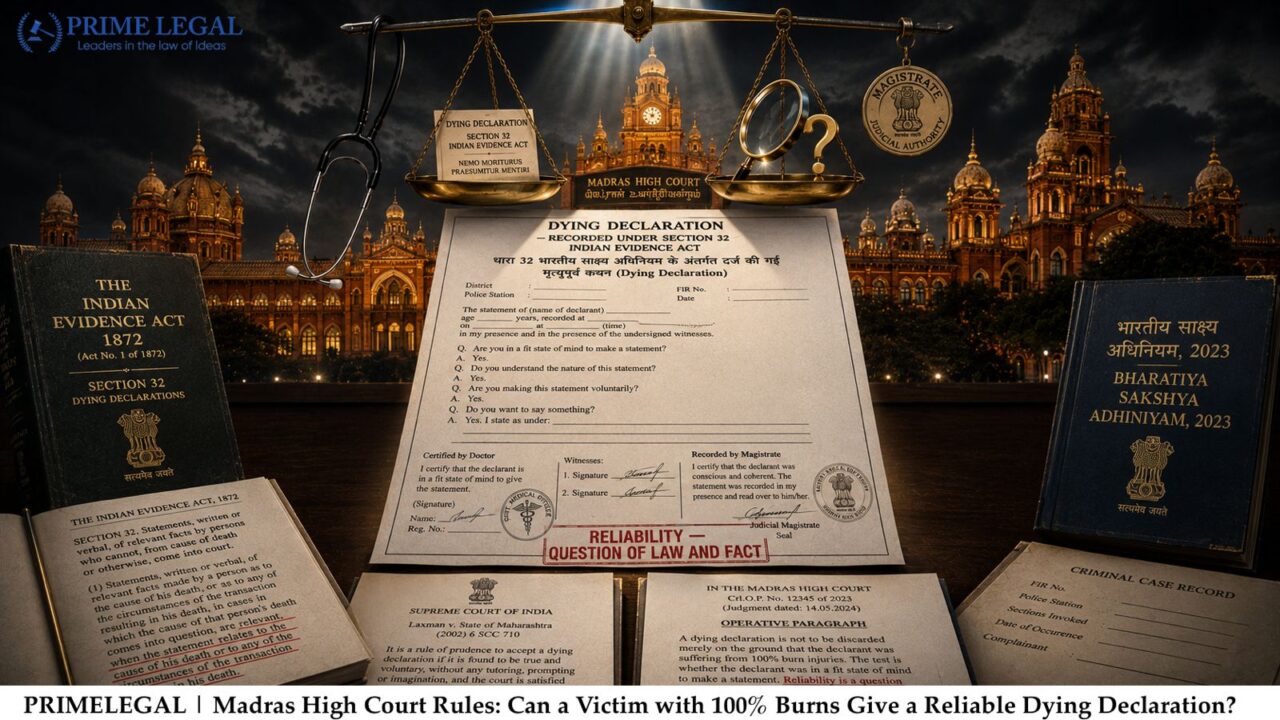
An essential principle of criminal law was recently reiterated by the Madras High Court in holding that a dying declaration by a person who has been 100% burned cannot be disregarded merely because of the severity of their injuries. In a recent criminal appeal contesting a murder conviction, the court reaffirmed that just because someone has suffered severe physical injuries from burn wounds, this does not mean they were unable to provide a clear, credible dying declaration (testimony) because it was within their cognitive ability to do so. This decision emphasises that the best way to determine whether a dying declaration can be trusted is to look at the mental state of the individual at the time and whatever the appropriate medical documentation establishes regarding the mental competence of that individual, so that no individual judgment would prevail over the mechanical judgment made by how many burn wounds one suffered.
BACKGROUND
A tragic incident occurred in which a woman suffered extensive burns from her husband after many domestic disputes. After being brought to the government hospital, she was found to have suffered from 100% degree burns and was given a dying declaration to a Judicial Magistrate. She explicitly accused her husband of the crime, but she had been certified by a medical officer that she was conscious, oriented, and mentally fit to make the statement before the recording was made. The trial court relied heavily on this declaration in convicting the husband of the offense of murder under Sec. 302 of the Indian Penal Code. According to the husband, it is highly improbable that a person who is 100% burned could produce an accurate statement without any guidance from someone else and thus would not be capable of giving a true account of the events surrounding their injuries due to the high level of pain and the need for large amounts of medication due to the pain being experienced. The defence contended that due to the extreme pain, the victim would have been incapable of producing a statement free of influence from those present; therefore, it is not safe to convict based upon the evidence given.
KEY POINTS
- The High Court unequivocally rejected the Defence’s contention, finding that the victim’s percentage of burns does not, of itself, determine the victim’s state of mind capacity.
- In making this decision, the Bench observed that the treating physician had provided a definitive opinion of the victim’s mental competence before and at the time that the victim gave the statement to the Magistrate.
- The Court found that the Judicial Magistrate had complied with the statutory safeguards by ensuring that the victim was oriented and that the victim voluntarily provided their statement without any external influence or assistance.
- The Court found that according to the principles of Medical Jurisprudence, there have been proven cases of victims of severe, third-degree burns who were oriented and cognizant at the time of their death and were able to articulate their thoughts clearly, before dying from secondary shock.
- The Only Basis for Conviction without Additional Corroboration. The High Court stated that pursuant to established Supreme Court jurisprudence, a dying declaration may be a single basis for conviction if proven truthful, voluntary, and recorded.
“Even in cases of extensive, including 100%, burns, a declaration may be accepted if it is established that the declarant was in a conscious and fit state of mind at the time of making the statement. The decisive test is not the extent of the injuries, but whether there is reliable evidence to show that the deceased was mentally fit and capable of making the declaration. Only where there is evidence that the declarant was unconscious or otherwise incapable of making a statement, the dying declaration is liable for rejection,” the court said.
RECENT DEVELOPMENTS
The current ruling follows a recent increase in domestic violence and dowry death appeals wherein defence lawyers typically seek to discredit dying declarations by focusing on the nature of the burn injuries sustained by the victim. Furthermore, this ruling will lead to a more consistent application of procedural guidelines by the Judicial Magistrate and medical professionals when creating these statements. Trial Courts will also likely place an increased importance on qualitative medical evidence relating to the victim’s actual state of mind, as opposed to simply the percentage of physical burns on the victim. Medical professionals also need to provide exact and timely evidence as to the cognitive state of the patient for the victim’s final words to hold up to a heightened level of appellate scrutiny.
CONCLUSION
The Madras High Court’s ruling is an important reaffirmation that law values truth and substantive justice above strict preconceptions of physical trauma. By stating that a person who has suffered 100% burns is capable of providing a legally admissible and credible dying declaration, the Court has eliminated a routine loophole previously used by some offenders of serious domestic crimes. This ruling will ensure that a dying burn victim’s last plea for justice is heard, acknowledged, and afforded a significant amount of evidentiary weight, provided the medical and judicial officials acted with due care.
“PRIME LEGAL is a National Award-winning law firm with over two decades of experience across diverse legal sectors. We are dedicated to setting the standard for legal excellence in civil, criminal, and family law.”
WRITTEN BY: VINEET SEERVI

