
INTRODUCTION
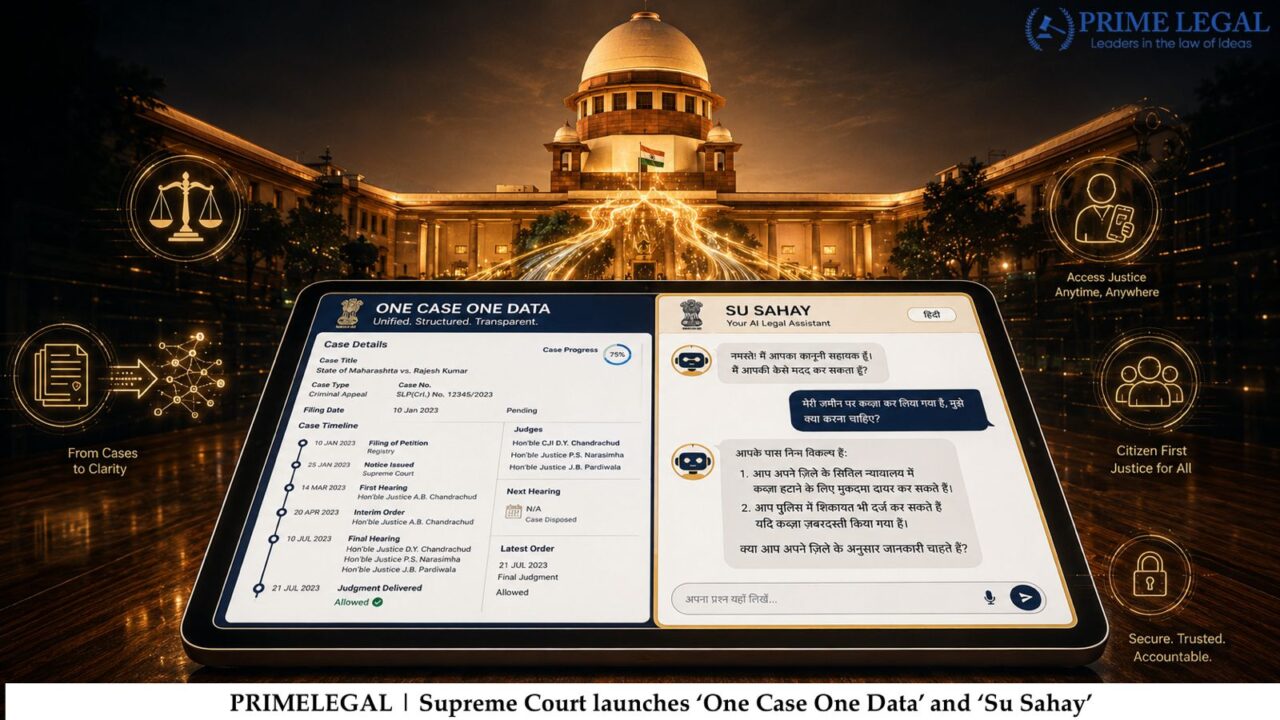
The Supreme Court of India has started two programs for digital systems, which are ‘One Case One Data’ and an artificial intelligence chatbot named ‘Su Sahay’. Those programs exist to make the management of courts stronger and to help people use court services more easily. As Chief Justice of India Surya Kant stated, the programs intend to combine legal information from all courts plus make it simpler for the public to communicate with the legal system using technology.
BACKGROUND
For a long time, the legal system in India has faced problems because databases are separate from each other, people wait a long time to see records and courts at different levels do not work together. It is common for the Supreme Court, High Courts, District Courts and Taluka Courts to store case information in different places. Because of this separation, the system repeats work but also does not function well.
To fix those problems, the legal system has used more digital changes through the e-Courts project, like electronic filing, hearings over the internet and access to legal decisions online. By starting One Case One Data besides Su Sahay, the system continues a larger plan to make court management modern and to make it easier for individuals to obtain justice.
KEY POINTS
- One Case One Data is a program for digital connection that creates a single database for the law.
- With this system, the Supreme Court, High Courts, district courts as well as taluka courts stay connected to each other.
- There is a goal in this system to make the collection of data automatic. And the system exists to help people verify information about cases on the internet in a fast manner across different legal offices.
- In this initiative, the Supreme Court is working to manage cases more effectively when it reduces how often records repeat and ensures that data remains correct plus precise.
- To help people who are involved in lawsuits, legal professionals and the public, the Supreme Court website is now integrated with Su Sahay, which is a computer program that uses artificial intelligence to make information but also services easier to find.
- As a result of a partnership between the National Informatics Centre and the Supreme Court Registry, this software is now available for public use.
- For those who need to use the website, the chatbot is available to provide guidance on how to move through the pages, how to see details about specific legal cases as well as how to use digital services.
BACKGROUND
On May 11, 2026, officials announced the programs during a session at the Supreme Court. By using digital tools to connect different parts of the system, the Chief Justice stated that the courts are trying to create a method for managing cases that is more organized and functions with less waste.
Due to those changes, people who study the law or those who watch the courts describe the action as a clear movement toward a system where processes are visible to the public, tasks happen quickly and individuals can reach services without difficulty. And because the judiciary is facing many pending cases next to difficult administrative tasks, the courts are using more artificial intelligence and digital tools for governance.
CONCLUSION
When the Supreme Court introduced One Case One Data besides Su Sahay, it changed how the Indian legal system uses technology. By connecting case records between different courts plus offering services where artificial intelligence assists the public, the Supreme Court is trying to make the legal system more open, more productive and easier for all people to use. Although the effectiveness of these initiatives will depend on proper implementation and coordination, they represent a progressive effort toward a modern and technology-enabled judicial system.
“PRIME LEGAL is a National Award-winning law firm with over two decades of experience across diverse legal sectors. We are dedicated to setting the standard for legal excellence in civil, criminal, and family law.”
WRITTEN BY: SAMANA

