
ABSTRACT
“Dining out has increasingly become a complex experience for consumers, not just due to culinary choices, but the additional fees presented on their final bill have become more difficult than ever to determine. While many new fees appear on restaurant bills, the service charge has perhaps resulted in the most substantial debate and tension between customers and restaurants over the years. A service charge is a fee charged to the consumer by the restaurant and does not have the same legal standing as government-mandated taxes. This article aims to clarify and explain the legal status of service charges in India by outlining Central Consumer Protection Authority (CCPA) guidelines and current court cases, as well as discussing the basic consumer rights that customers can use when evaluating whether they were obligated to pay or otherwise stay by refusing to pay the service charge.”
KEYWORDS: Service Charge, Consumer Protection, CCPA Guidelines, Unfair Trade Practices, Right to Refuse, Hospitality Industry, Tipping.
INTRODUCTION
For many diners, the pleasure of a nice meal can be spoiled once they receive their bill showing the inflated amount due to what’s commonly known as a “service charge.” Usually between 5% and 15% of the total bill amount. This fee is supposed to be passed on to the staff working at the establishment. Unfortunately, this fee is very poorly explained, creating all kinds of problems for diners. Thus, there is the ongoing question of whether or not this fee is a legitimate tax or simply an involuntary gratuity.
The consumer rights laws in India have been growing rapidly and have begun to scrutinise this charge more and more as it relates to consumer rights. The CCPA (Central Consumer Protection Authority) views the mandatory charging of service fees as an “unfair trade practice”, which has led to many court battles between restaurant associations and the government. As the court case is moved to the Delhi High Court, it will be important for consumers to know where their rights stand regarding what constitutes a legitimate tax vs. a discretionary service fee.
UNDERSTANDING SERVICE CHARGE VS. SERVICE TAX
A major reason that consumers are trapped in the “service charge trap” is that they confuse a service charge with taxes imposed by the government. The Goods and Services Tax (GST) is an absolute requirement that must be paid. Not paying your GST is against the law. Restaurants charge GST at 5% on food and beverages served in restaurants and at 18% on all food and beverages served in high-end hotels.
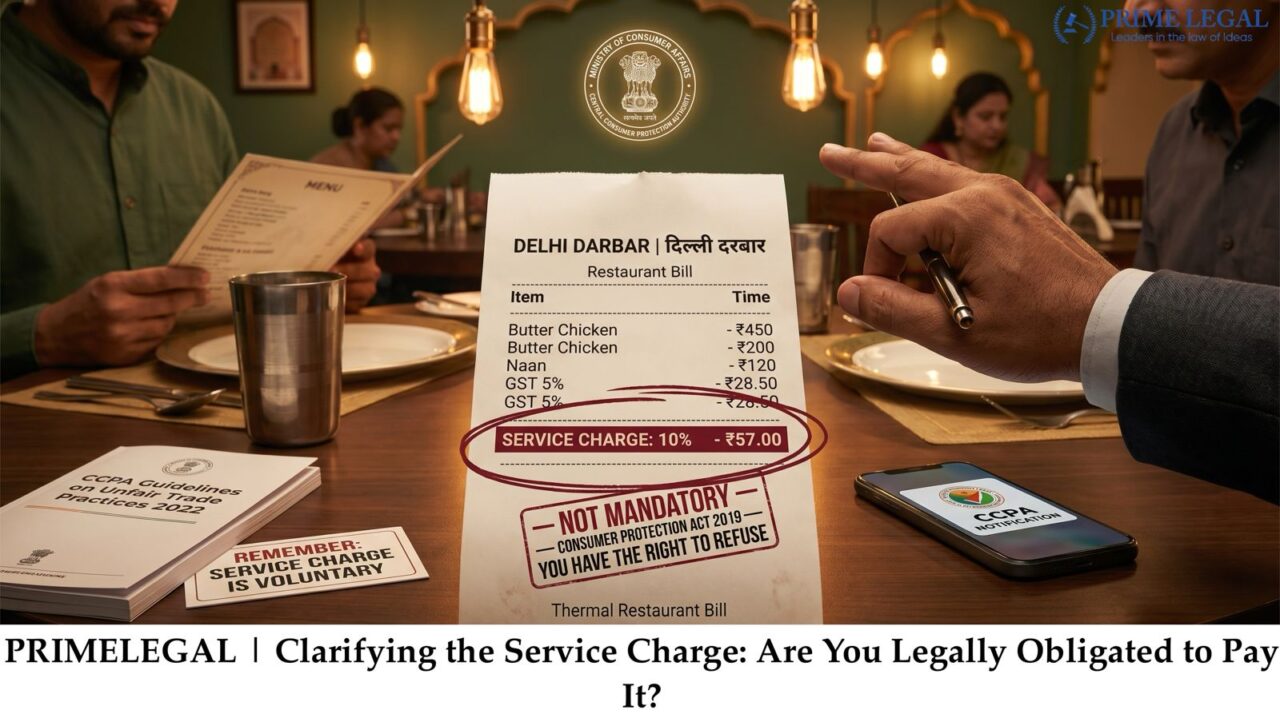
A service charge is a separate and distinct fee from the GST. A service charge is an arbitrary price that has been established by the restaurant owners and is not set by any governmental authority. Restaurants group the revenue received from service charges with the GST, thus creating a perception by the consumer that service charges are part of the official taxes imposed by the government. Consumer protection programs are working to eliminate this blurring of service charges with official taxes. By requiring a mandatory service charge, restaurant owners have removed the incentive to tip based on the service provided and instead have created a fixed operational cost associated with the total bill.
CCPA GUIDELINES: A SHIELD FOR CONSUMERS
In order to assuage the consumers’ complaints about forced tipping, the CCPA in July 2022 issued sweeping guidelines that banned automatic service charges being levied by hotels and restaurants. This regulatory authority also stated that the cost of service is already implicit in food pricing.
To protect consumers from forced service charges, the guidelines state:
- Restaurants cannot collect service charges automatically or implicitly included in the bill, they can only charge for the service in the manner discussed above.
- Restaurants cannot collect service charges by any name other than “service charge” (or its equivalent).
- Restaurants cannot force you to pay a service charge to enter the establishment.
- The service charge is totally voluntary on the consumer’s part, and the consumer has complete discretion to decide whether to pay.
If a restaurant continues to insist on the service charge being paid by the consumer, the consumer can ask for the service charge to be removed immediately. If the restaurant refuses to remove the service charge, the consumer may file a formal complaint with the National Consumer Helpline or file a claim with the appropriate Consumer Commission for unfair business practices.
LEGAL STANDPOINT AND JUDICIAL INTERVENTION
A major backlash from the National Restaurants Association of India (NRAI) and Federation of Hotel & Restaurant Associations of India (FHRAI) was triggered by the CCPA guidelines, prompting them to approach the Delhi High Court, arguing that service charge is basically a private contract between the customer and the restaurant. They argued that the service charge is clearly delineated in the restaurants’ menus, and by doing so, the customers are agreeing to its payment by entering the dining establishment.
At the initial stage, the High Court provided a stay of all the CCPA guidelines, provided the service charge is mandatory, and it is so stated prominently on the restaurants’ menus. The Court recently stated that terms such as “service charge”, by their very nature, mislead consumers into believing there is an actual government charge associated with a service charge. The Court also graphically illustrated how this terminology could be changed to “staff Welfare Fund”, so that there would be clarity and transparency regarding the nature of the payment. As of 2026, all parties involved are waiting for a formal and final ruling. However, there is generally a consensus among the courts that transparency is crucial and that a consumer cannot be surprised when they are charged for a service. Therefore, their express consent must be obtained.
EMPOWERING THE CONSUMER
At the centre of this mess is the consumer’s basic right to do business fairly. Hospitality is built on providing great service, and this cost should be appropriately included in the price of the product and/or service. Customers must pay for what they consumed (food) plus any required tax to the government. Anything else is completely voluntary.
When a customer visits a restaurant, the express financial agreement between both parties is limited to what was ordered. Social pressures should not replace legal requirements. The best method against unfair treatment of consumers is consumer awareness (know what you’ve agreed to). Customers should develop the habit of thoroughly reading their bills before they pay them. If a service charge is added without the customer’s permission and/or the service provided by the server was poor, customers have every right to request that the service charge be removed. Restaurants that use intimidation to get customers to pay for these types of charges violate the spirit of the consumer protection rights laws.
CONCLUSION
The ongoing dispute regarding service charge payment emphasises the intersection of the rights of consumers and the practices of the hospitality industry. Restaurant owners contend that service charge payments are essential for the welfare of their staff, but the consumers involved in paying those service charges believe they should decide how and what amounts they want to tip. The legal opinion continues to develop and evolve, and has emphasised that tips are meant to be voluntary gestures of goodwill or appreciation from one party to another and not a mandatory corporate fee being disguised as a tax. This entire matter has come down to two very important elements: transparency of all charges and what is viewed as “hidden” charges. As the regulatory climate changes, the “average” consumer needs to be empowered. Until such time that a final decision by the courts can be made regarding the matter, consumers should take a proactive approach and exercise their legal rights, including the right to challenge the total of their bill, question which taxes are collected by the government, and refuse to pay any default service charges. The best means for avoiding this situation is through consumer awareness and assertiveness.
“PRIME LEGAL is a National Award-winning law firm with over two decades of experience across diverse legal sectors. We are dedicated to setting the standard for legal excellence in civil, criminal, and family law.”
WRITTEN BY: VINEET SEERVI

