
ABSTRACT
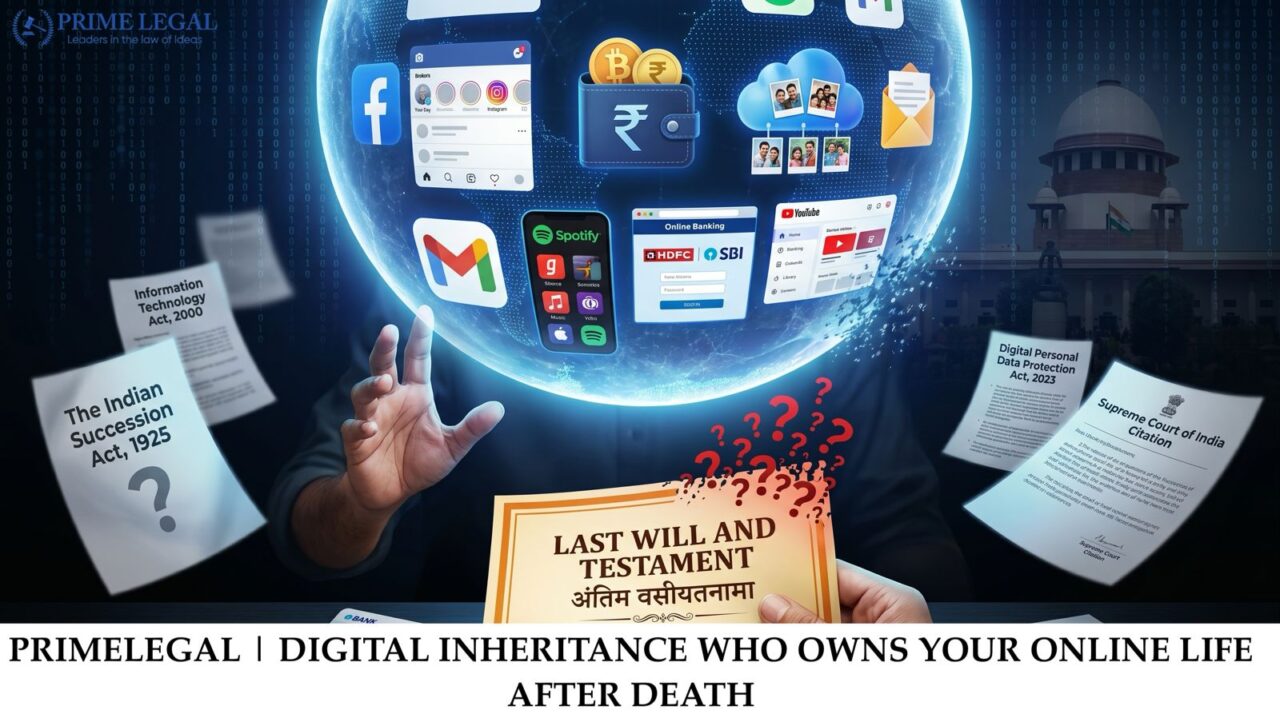
Now think of spending your entire life creating and curating a digital world: twenty years of Gmail threads, a monetised YouTube channel that earns lakhs, a Bitcoin wallet, thousands of family photos on Google Photos and a Facebook profile, which is now a living memorial of your relationships. Now imagine dying without a will that comes to deal with any of this. This is no longer a possibility in India now. It is the default.
KEY WORDS : Digital Inheritance , Digital Succession , Indian Succession Act , Terms of Service (ToS) , Virtual Digital Assets
INTRODUCTION
The law on inheritance in India was drafted at a time when property was land, jewellery and bank balances, the principal piece of which is the Hindu Succession Act, 1956, the Indian Succession Act, 1925 and the Muslim Personal Law (Shariat) Application Act, 1937. None of these statutes have the word digital in them and none of them predict how digital assets will be dealt with. Who owns your online life after death is a question in a legal limbo, affected by the lack of judicial clarity in India, archaic succession laws and Terms of Service agreements which most internet users have never read.
WHAT IS A DIGITAL ASSET
The term is much more general than many think. Professor Naomi Cahn of the University of Virginia School of Law identifies three broad categories: content assets (photographs, e-mails, documents, creative works), financial assets (cryptocurrency, PayPal balances, domain names, revenue-generating accounts), and social and memorial assets (social media profiles, blogs, gaming avatars and accumulated in-game currency). In the Indian context, we might add a fourth: assets held on domestic platforms Zerodha folios, PhonePe wallets, Meesho stores and content created on Snapchat. Digital Assets also include the currency exchanges across platforms of gambling or online net gambling such as Stake or Aviator . All such gambles despite being illegal in India are played in multiplicity through connection of VPN’s or other such means .
LAW OF SUCCESSION : A COMPLICATION
Property under the Indian Succession Act, 1925 (applicable to Christians, Parsis and those who die intestate outside personal law) is very broadly defined and it is open to a “purposive interpretation” that renders digital assets covered. Property is defined in Section 2(h) as “movable and immovable property.” A cryptocurrency holding, for example, is perhaps movable property, and is classified as such in the Income Tax Act 1961 (as amended in 2022), which defines Virtual Digital Assets as taxable property.
It is the case with cryptocurrency because, obviously, it has monetary value. The more difficult issue is whether the rights to an email archive or a Facebook page or the goodwill that may be attached to a verified Instagram account is property and can be passed on. There is no direct decision of any Indian High Court to this effect. In contrast, in the United States, In re Request for Order Requiring Facebook, Inc. to Produce Documents (2012) addresses whether a deceased user’s Facebook messages could be made available to her estate, and the court rules against the family in favor of the Terms of Service of Facebook.
In re Request for Order Requiring Facebook, Inc. to Produce Documents, No. 12-5067 (Delaware Superior Court, 2012). It’s not a legally binding opinion in India, but it is an authoritative opinion on the conflict between platform ToS and estate rights
In 2025, a ‘will’ that specifies the location of your flat in Koramangala but doesn’t mention your crypto wallet or your cloud photo archive is, well, a will without crypto.
THE CATCH : TERMS AND CONDITIONS
This is the greatest paradox. Most big platforms, such as Google, Apple, Meta and Spotify, regard your account as a personal licence, not a piece of property. Their Terms of Service make it clear that accounts cannot be transferred and are set to expire at death. Google’s Inactive Account Manager and Facebook’s Memorialisation feature are tools for the users, not legal rights. Google isn’t legally bound under Indian law to grant such access to a family in Chennai that wants to access a deceased father’s Google Drive that has years of business information.
The deficiency has been pointed out by India’s leading cyber law expert, Dr. Pavan Duggal, in his various writings. The Digital Personal Data Protection Act (2023) does not consider the rights of a nominee or legal heir to access data assets of a deceased.
DIGITAL CASH : CRYPTOCURRENCY
Specifically, in the case of cryptocurrency there is a very tentative clarity of law. Indian courts under the principles of property law would likely consider Virtual Digital Assets like Bitcoin or Ethereum held in a wallet to be movable property that can pass through a will or intestate succession under the tax provisions in the Finance Act, 2022 where it had categorised Virtual Digital Assets as “movable property,” and physical key possession is considered as de facto possession of the assets. The RBI’s new stance and the expected regulatory guidelines by SEBI for cryptocurrency exchanges also seem to suggest that the government does not deem these assets to be “legally nonexistent” which is part of the equation.
MORAL ASPECT
The legal isn’t the only problem, there is a deeply human problem. In 2021, a family in Kerala went to the Supreme Court to gain access to their son’s dead iPhone, which contained what they thought were the last messages from their loved one that could provide them some peace. Apple, as is its global policy, rejected, again without a court order. The family could only file a civil court case with a local court. It is not just an isolated instance. The road to grief in India is now littered with red tape and there is no specific law to show them the way.
Lessig (2006) noted that ‘private architecture’ the code that platforms write, effectively governs behaviours in ways not envisioned by legislation. In the digital inheritance landscape, that’s a very relevant insight, indeed Facebook’s algorithm determines whether your profile will be turned into a memorial or deleted completely, and Google determines whether your family inherits your Drive or it is deleted. Parliament has not made any decision yet.
THE ROAD AHEAD
At present, the Law Commission of India has not considered digital inheritance as a subject for study. The Ministry of Electronics and Information Technology (MeitY) is currently developing a Digital India Act which will be a successor to the IT Act, 2000 and which is expected to be a more comprehensive piece of legislation to address this. These are the demands of advocates for RUFADAA (Revised Uniform Fiduciary Access to Digital Assets Act), which include a clear chain of command (explicit consent in will, then platform tools, then fiduciary access to the legal heir within a set time frame), and specific provisions for financial digital assets.
In the meantime, the most sensible thing to do is to consider your digital life a part of your estate, until Parliament takes action. Make a list. Make a nomination on the platform that you are. Update your will with your lawyer’s help, making sure to include digital assets. And the uncomfortable reality that in 2025, a will stating that you’re leaving behind your flat in Koramangala, but that your crypto wallet and your photo archives on the cloud are missing, is an incomplete will for your digital life.
The law will have to eventually catch up. It always does. How many families will cross the river of grief in the dark before it strikes?
“PRIME LEGAL is a National Award-winning law firm with over two decades of experience across diverse legal sectors. We are dedicated to setting the standard for legal excellence in civil, criminal, and family law.”
WRITTEN BY: ARNAV NAIK

