
INTRODUCTION
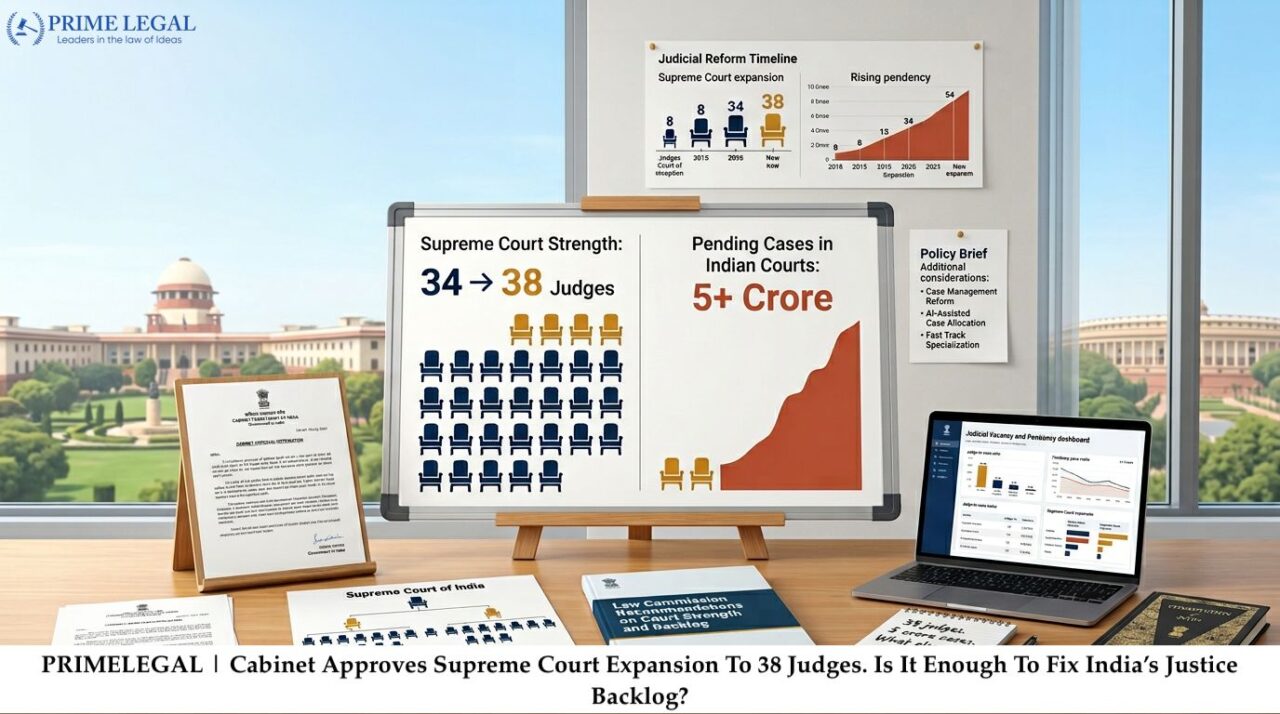
In May 2026, the Union Cabinet approved a proposal to expand the Bench of the Supreme Court, bringing the total number of judges (including the Chief Justice of India) to 38. This decision is made with the intention to speed up the process of disposal of cases, particularly those involving constitutional matters and long-pending appeals. However, as legal experts have pointed out, the expansion addresses only the “tip of the iceberg”, as the judiciary suffers with the backlog of cases that spans across every level of the Indian legal system.
BACKGROUND
The Supreme Court (Number of Judges) Act, 1956, originally provided for only eight judges. Over the decades, this number has been incrementally increased reaching 26 in 2009, 31 in 2014, and 34 in 2019 to keep pace with the rising pending litigation. Despite these increases, the pendency in the Supreme Court has consistently been around 80,000 cases. The bottleneck is often associated with the Court’s dual role: acting as a Constitutional Court (interpreting the law) and a Court of Appeal (hearing everyday grievances), which leaves little time for the disposal of complex, long-term litigations.
KEY POINTS
- While 38 judges is the highest strength in history till date, the volume of new cases often outpaces disposal of the old ones. Critics argue that without structural reforms, such as a permanent Constitutional Bench, the new judges will also simply be absorbed into the “overwhelming” appellate role of the court.
- The addition of four judges allows for the creation of two more division benches. Theoretically, this could result in the disposal of an additional 3,000 to 5,000 cases annually, provided the vacancies are filled immediately.
- Historically, the “sanctioned strength” is rarely the “actual strength.” The efficacy of this expansion depends entirely on the speed of the Collegium system and the Executive in clearing names to ensure the 38 seats do not remain vacant.
- The Supreme Court backlog is often a symptom of the crisis in High Courts and Trial Courts, where millions of cases originate. Expanding the top of the pyramid without fixing the base is seen by many as a temporary fix.
RECENT DEVELOPMENT
Following the Cabinet approval, the Ministry of Law and Justice introduced the Supreme Court (Number of Judges) Amendment Bill, 2026. This development was based on a report from the National Judicial Data Grid (NJDG) showing that pendency in the Apex Court had crossed the 82,000 mark.
To complement the expansion, the Chief Justice of India (CJI) recently announced the “Special Clearance Months,” where the four new judicial slots will be exclusively dedicated to hearing “after-notice” matters and decade-old criminal appeals. This is a tactical shift aimed at ensuring the increased strength translates immediately into a reduction of the oldest cases.
CONCLUSION
The expansion to 38 judges is a necessary acknowledgement for the Supreme Court’s crushing workload, but is unlikely to hit the actual problem of backlog of cases in the Indian judiciary. For the expansion to be truly beneficial, it must be accompanied by broader reforms, including the digitization of records as has recently taken place in the State of Sikkim, the discouragement of frivolousness by the Government and a more streamlined appointment process. Ultimately, while four extra judges provide more “hands on deck,” the ship of Indian justice requires deeper structural navigation to reach the shores of timely adjudication.
“PRIME LEGAL is a National Award-winning law firm with over two decades of experience across diverse legal sectors. We are dedicated to setting the standard for legal excellence in civil, criminal, and family law.”
WRITTEN BY: LISHIKA BATRA

