
INTRODUCTION
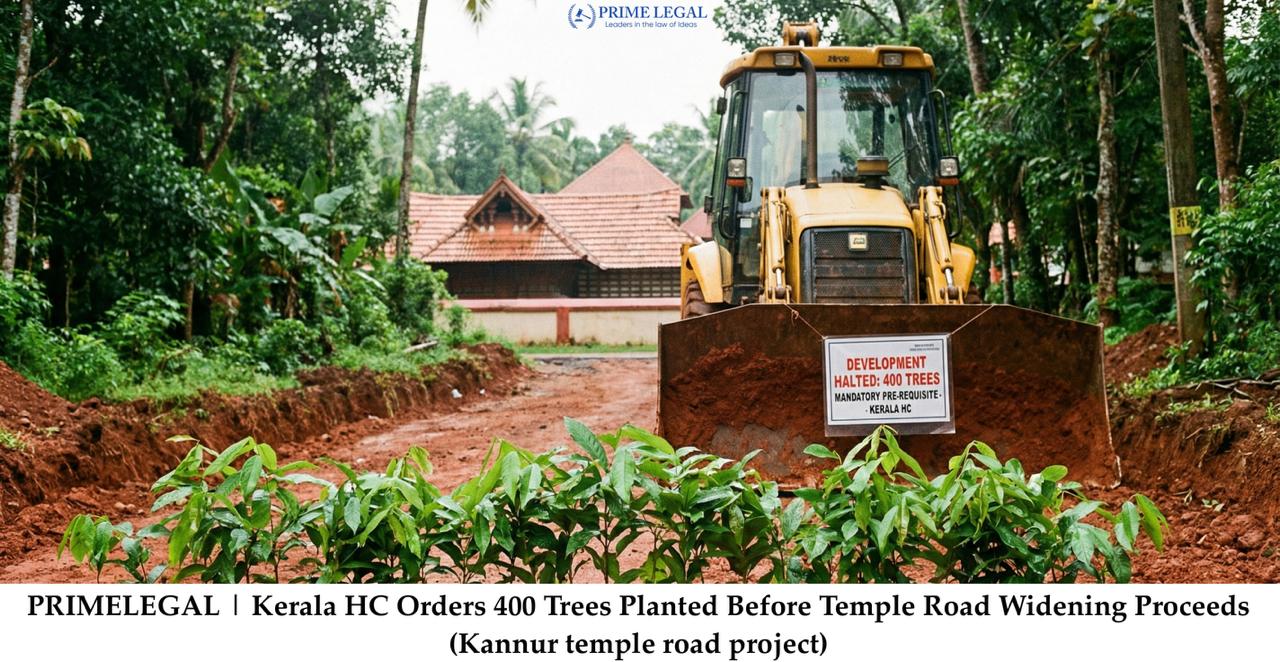
The Kerala High Court has allowed a controversial road‑widening project to the Sree Madayikavu Bhagavathy Temple at Madayipara in Kannur, but only upon the fulfillment of certain set of green conditions, including planting at least 400 indigenous trees before the work is taken to completion. A Division Bench of Justices Raja Vijayaraghavan V and K.V. Jayakumar held that the limited widening of the road approaching the hilltop does not pose a “real or substantial threat” to the laterite plateau’s fragile ecology, provided the State strictly follows a court‑approved afforestation and conservation plan. The ruling tries to strike a balance between devotees’ long‑standing demand for a safer road and environmentalists’ plea to preserve what the court itself recognized as a unique “ecological paradise.”
BACKGROUND
Two writ petitions were filed challenging a ₹1.42 Crore Public Works Department (PWD) project to improve and widen the road leading to the temple across the Madayipara plateau. The petitioners argued that the existing road of about 3.5 metres was proposed to be widened to 8.5 metres destroying the temple property and the biodiversity, natural flora and fauna of the region, which is done without a proper environmental impact assessment, risking irreversible damage to local ponds, grasslands and the area’s distinctive laterite‑based hydrology. They also invoked Section 29 of the Madras Hindu Religious and Charitable Endowments Act, 1951, contending that temple land could not be used for the road without prior sanction of the competent authority, and pointed out that roughly 40 mature tamarind trees had already been felled.
On the other side, the State and temple trustees said only marginal strips of land had been voluntarily surrendered to ease the movement of thousands of devotees who struggle to access the temple via a narrow, potholed road, insisting that the design would avoid sensitive waterbodies and habitats.
KEY POINTS
- The Bench held that temporary surrender of small portions of temple land to widen the road does not amount to “alienation” under Section 29 of the Madras HR&CE Act, and therefore does not require a mandatory prior‑sanction.
- After reviewing the alignment, width and construction method, the Court concluded that the likely environmental impact of taking the road from about 3.5 metres tarred width to 8.5 metres overall is “minimal” and does not pose any real threat to Madayipara’s ecology, flora or fauna.
- At the same time, relying on the Supreme Court’s sustainable‑development jurisprudence, the judges stressed that development near ecologically sensitive areas must be offset by concrete mitigation measures, not just promises on paper.
- The contractor has been directed to plant “not less than 400” trees of species indigenous and compatible with Madayipara’s landscape, in locations identified in consultation with the Divisional Forest Officer, with planting to be completed by June 2026.
- The Principal Chief Conservator of Forests has been tasked with preparing a comprehensive conservation and afforestation scheme for the wider Madayipara region and placing it before the Court by mid‑July 2026.
- The Public Works Department and local authorities must execute the project without disturbing ponds, natural watercourses or critical habitats, and are responsible for long‑term maintenance and survival of the newly planted saplings.
RECENT DEVELOPMENTS
In its detailed judgment in Vijesh C.K v. State of Kerala & Ors. (2026:KER:25499), the Bench dismissed both writ petitions but kept the matter for monitoring, directing the authorities to file compliance reports on July 16, 2026. The Court directed the Forest Department to treat the marginal strip of land, as said by the temple, on the same level as the landscape. This decision stresses on the fact that roadside trees and natural features are not easily dispensable obstacles to be casually cleared in the name of connectivity, but public assets that must be compensated for. Environmental groups have expressed disappointment that the widening was given assent, but have cautiously welcomed the binding requirement of 400 native trees and a supervised afforestation plan as a partial safeguard for the plateau’s biodiversity.
CONCLUSION
Kerala HC ruling aims to uphold the interest of both the sides by ordering that hundreds of indigenous trees be planted, ponds and habitats to be left untouched, and forest officials to remain actively involved, while ensuring better access for devotees. Judiciary advocating for sustainable development will ensure that nature is not destroyed by greedy humans, but preserved for the future generations as well. It is a matter of trial and error to see how well these safeguards work on the ground especially, the survival of 400 new trees through hot summers and monsoons, will determine if this is a model of sustainable development or just another judgment overtaken by the bulldozer.
“PRIME LEGAL is a National Award-winning law firm with over two decades of experience across diverse legal sectors. We are dedicated to setting the standard for legal excellence in civil, criminal, and family law.”
WRITTEN BY: ABIA MOHAMMED KABEER

