
CASE NAME: Rajesh Goyal v. M/S Lakshmi Constructions and others.
CASE NO: Special Leave Petition (Civil) number 27184 of 2025.
COURT: Supreme Court of India.
DATE: 25 March 2026.
QUORUM: Justice Sanjay Karol and Justice Nongmeikapam Kotiswar Singh
FACTS:
The dispute arose between the landlord, Laxmi Constructions, and Rajesh Goyal, the tenant of the house. The landlord here initiated an eviction proceeding against the tenant under section 21(2) of the UP Urban Premises Rent Control Ordinance 2021, on the ground of non-payment of the rent. Here, the Rent Authority, which was the additional district magistrate, passed an order dated 7 September 2021 holding that a valid landlord tenant relationship exists and ordered the tenant or the parties to vacate the premises within 30 days of time. This judicial order was consistently upheld at every judicial level. The Appellate Authority that is the District Judge he affirm to the order on 22nd January 2024, and the High Court also confirmed it in May 2024 under the supervisory jurisdiction.
The tenant then went to the Supreme Court of India and filed a Special leave petition under it which was being dismissed by the Court on 20th September 2024. The court has granted the time till 31st March 2025 to update the place to the tenant. After that, a review petition and a miscellaneous application being filed, but both resulted in the dismissal of the applications by the court. Despite all this, the tenant did not vacate the premises and instead filed a restoration application before the Rent authority challenging the originally eviction order void. Surprisingly, the Rent Authority allowed this restoration application 15th May 2025.
Aggrieved by all this, the landlord approached the High Court and set aside the restoration order and remanded the matter. Here, contempt proceedings were initiated before the Supreme Court due to noncompliance with its earlier eviction order as well and during these proceedings, the tenant undertook to vacate the premises within two weeks. However, the tenant again approached the Supreme Court challenge in the High Court’s order which led to the present case.
And in the present case, an additional dimension of the case was that the tenant raised the dispute regarding the title of the landlord, alleging that the sale deed in favour of the landlord was forged and it is not valid. This allegation was supported by a report prepared by the Additional District Magistrate in an administrative capacity here. Interestingly, the same officer acting as the Rent authority relied on this report to allow the restoration application, thereby reopening the matter. They had already attained finality up to the Supreme Court.
ISSUES:
- Whether the Rent Authority could entertain a restoration application after the eviction order had attained finality up to the Supreme Court.
- Whether the Rent Authority exceeded its jurisdiction by examining title disputes.
- Whether the order passed by the Rent Authority was without jurisdiction and the null and void.
- Whether entertaining such proceedings amounts to abuse of process of law and violation of judicial discipline.
- Whether action should be taken against the Rent Authority for disregarding Supreme Court’s order.
LEGAL PROVISIONS:
- Section 21(2) of UP Urban Premises Rent Control Ordinance, 2021- Allows the eviction on grounds such as non-payment of the rent.
- Section 38 of UP Urban Premises Rent Control Ordinance, 2021- Bars civil courts jurisdiction in rent matters and limits rent authorities to restrictions strictly to tenancy issues and not to title.
- Principle of finality of judgments- Once upheld till Supreme Court, the matter cannot be reopened.
- Doctrine of jurisdiction- Orders passed without jurisdiction and nullities.
- Doctrine of judicial discipline and binding precedents- Lower authorities must follow higher courts decisions.
ARGUMENTS:
APPELLANT:
The appellant attempted to justify the restoration proceedings by raising a fresh dispute in front of the court regarding the landlord’s title of the property. It was argued by the tenant that the sale deed through which the landlord claimed ownership was forged and obtained by concealment of the fats and that’s why it should not be held a valid sale deed. This claim was being supported by an administrative report submitted by the additional district Magistrate, which indicated that there are irregularities present in the sale deed under the Registration Act, 1908.
Further, the tenant continues that says the foundation of the landlord’s claim was doubtful and the eviction order itself should be reconsidered. Therefore, the Rent authority was justified in entertaining the restoration of the application and reopening the matter to prevent injustice in this case. Considering the base of the case to be doubtful has led the authorities to reopen the case and to seek justice in its decision.
RESPONDENT:
The respondent here, which is the M/S Lakshmi Construction, strongly opposed the tenants conduct by arguing that the issue of landlord tenant relationship had already been finally settled by multiple courts including the Supreme Court of the country. The tenants’ repeated litigation, including review and miscellaneous applications, had already been rejected and should not be entertained further by any other authorities as well. It was being held that it was contended that the restoration application was a deliberate abuse of the process aimed at delaying the eviction of the tenant from the property of the landlord. Further, the Rent Authority had no jurisdiction to examine such tidal disputes as its powers are limited strictly to tenancy issues under the Statute and it is exceeding its power by authorizing his jurisdiction over such case. The landlord also argued that allowing such restoration would effectively nullify the decision made by the Supreme Court, which is impermissible and undermines the authority of the judiciary in the country.
ANALYSIS:
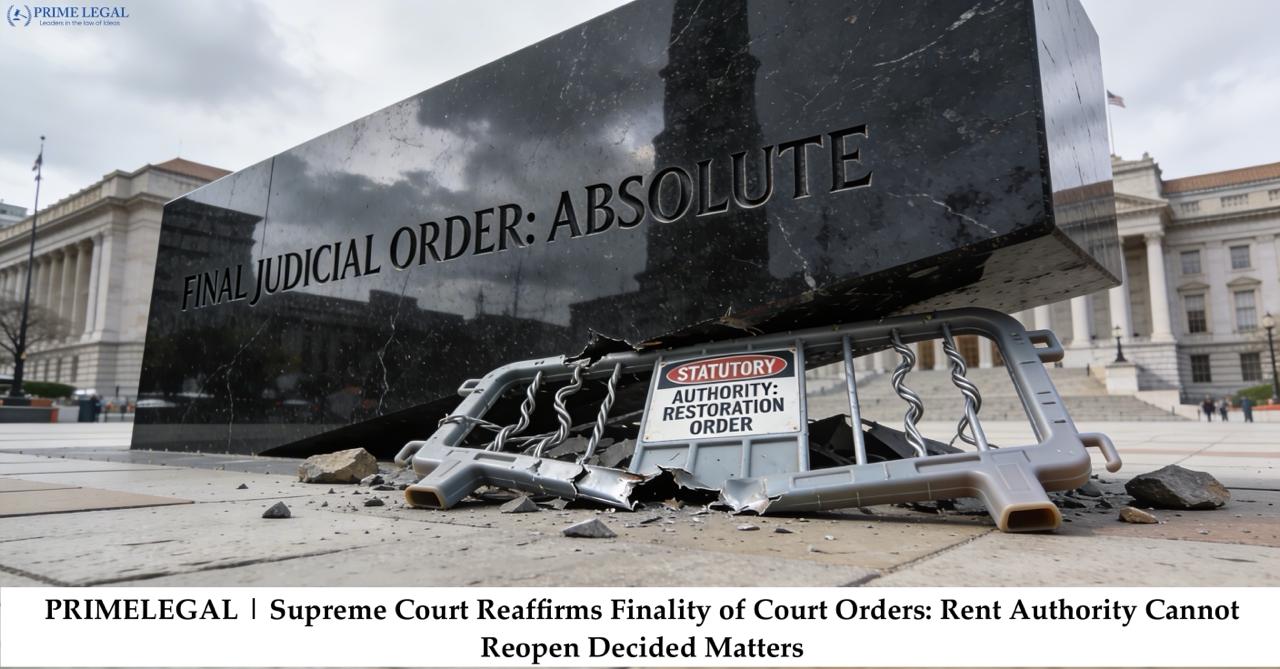
The Supreme Court has undertaken a truth analysis of both the procedural abuse and the jurisdictional overreach that has been made in this case and it has observed that the eviction order had attained complete finality, having been upheld at every judicial level, including the Supreme Court itself, and therefore reopening the matter through restoration application was fundamentally illegal and is not valid. The Court further emphasized that the Rent Authority is a creature of statute with limited jurisdiction here under section 38. It cannot adjudicate questions of title or ownership, which all exclusively within the domain of civil courts, and by entertaining such claims made by the tenants for the sale deed the Rent Authority clearly exceeded the power in this case, and hence it should be held voidable.
Here one more crucial aspect was being observed that the same officer has acted in two different capacities in this case, first as an administrative authority preparing the report alleging forgery, and later as a rent authority, relying on that report to allow restoration of the case. The Court hereby held that it is impermissible and will need to go conflict of roles and improper exercise of jurisdiction if not handled properly. Further, the court stressed the importance of judicial discipline and hierarchy in the country, stating that subordinate authorities cannot pass orders that effectively overrule or undermine the decisions of the higher codes, especially the Supreme Court of India. The court has highlighted that orders passed without jurisdiction and nullities, meaning that they have no legal effect from the beginning and stands void ab initio.
JUDGMENT:
The Supreme Court here dismissed the appeal holding that it was a clear case of abuse of the process of law and an attempt to overreach its earlier orders by exceeding its limits in the jurisdictional arena. It refused to entertain the matter on merits and declare the restoration order dated 15th May 2025, passed by the Rent Authority to be void and without jurisdiction. The Court further imposed costs of Rs.5 lakhs on the tenants to be deposited with the Supreme Court middle income group, Legal Aid Society. The Code in this case has also took a serious note of the conduct of rent authority in entertaining the restoration of application despite binding Supreme Court orders and issued a show cause notice as to why conduct proceedings should not be initiated. Exceeding the decision given by a higher court is itself impermissible and void in nature. And upon receiving an unconditional apology from the concerned officer, the court accepted the same and chose not to proceed further and the court clarified that this would not affect the officers career progression whatsoever. But the case here of reopening stays dismissed and the earlier order was being finalised.
CONLUSION:
In conclusion, this case strongly reinforces the principle of finality of the judicial decisions and the limited jurisdiction of statutory authorities, the necessity and the rising need of maintaining judicial discipline in the country. The Supreme Court made it clear that once the matter has been conclusively decided, it cannot be reopened through indirect or collateral proceedings. And it has clarified that the rent authorities cannot adjudicate issues of title and must strictly operate within their statutory limits without exceeding them. Further. And ultimately, the case serves as an important reminder that misuse of legal remedies and disregard for binding judicial orders will not be tolerated by the courts and will attract strict consequences.
“PRIME LEGAL is a National Award-winning law firm with over two decades of experience across diverse legal sectors. We are dedicated to setting the standard for legal excellence in civil, criminal, and family law.”
WRITTEN BY: MEENAKSHI DANGI
Read the judegement copy here

