
INTRODUCTION:
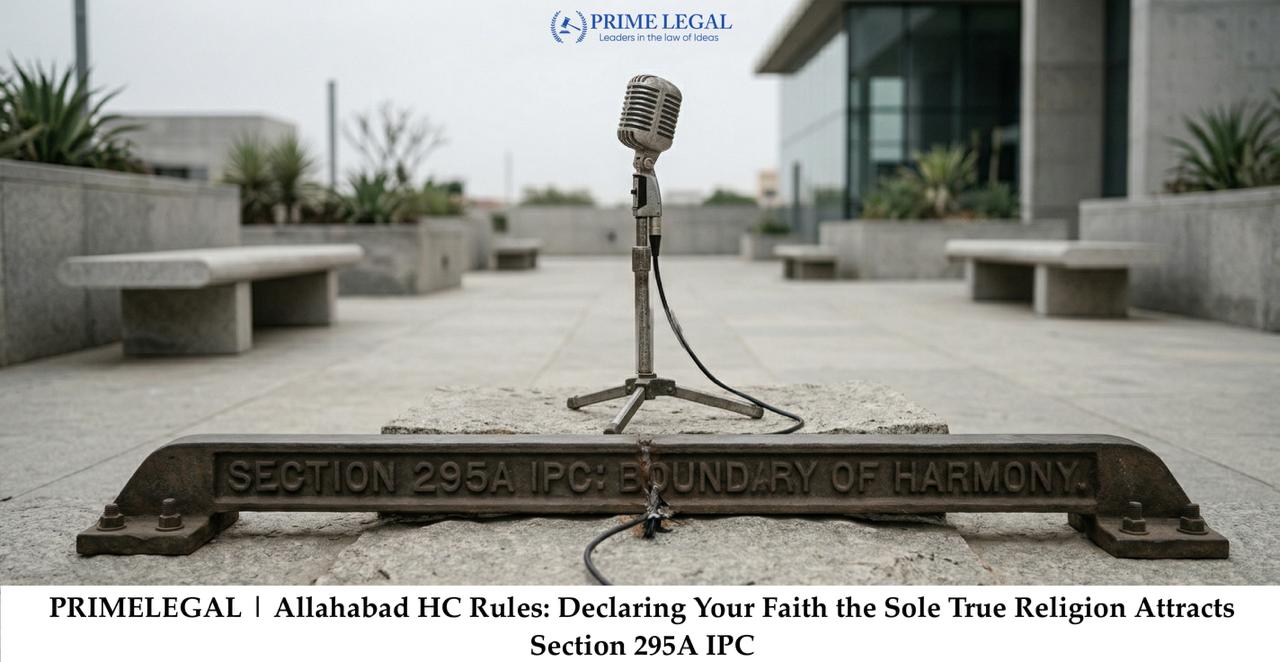
The Allahabad High Court has ruled that publicly declaring one’s own religion to be the ‘only true religion’ can be treated as an offense under Section 295A of the Indian Penal Code (Section 299 Of BNS, 2023) because it disparages other faiths and may outrage religious feelings, which can lead to religious outbreak especially in a secular country like India. This ruling has sparked a debate on the limits of free speech and what counts as insults to other religions in India. And hurting these religious feelings of other communities may fall under section 295A of IPC and is punishable.
Section 295A of IPC (Section 299 Of BNS, 2023) is about deliberate and malicious sites intended to outrage the religious feelings of any class by insulting its religion or religious beliefs. And here the court said that presenting one religion as the only true religion in the country which is stated to be secular. In a public meeting or prayer gathering, it can be seen as a disparagement of other faiths and would lead to a massive religious outbreak if not handled properly. Insulting other person based on their religion is held to be punishable under the Constitution and it’s considered a moral wrong as well.
BACKGROUND:
Here the case involved reverent father Vineet Vincent Pereria, who is a Christian priest from Kanpur who conducts a prayer meeting and allegedly said that Christianity is the ‘only religion’, implying that it was the only true or valid faith that a person should have in a country. He has neglected the other religions and said that Christianity is the only religion that is a that is a valid religion in a country. Thereafter, a complaint was filed by a local BJP worker who claimed that the statement heard the religious sentiments of Hindus and other non-Christian groups and was deliberately offensive. It is the statement given by the Christian priest that was offensive to all the other religions and the religious groups people having faith in. A FIR was registered under Section 295A of IPC (Section 299 Of BNS, 2023) at Bilhaur police station in Kanpur Dehat district.
Later, the priest moved an application under Section 528 of the BNSS, essentially asking the High Court to quash the case against him.
KEY POINTS:
- The term only true religion is disparagement of other religions and is being considered a very offensive term where the other religions are being disrespected. The court here held that claiming anyone’s religion as the only true religion is wrong in a secular country like India because it implies a disparagement of other faiths and people’s beliefs. Even if the statement is a power of religious preaching, it shouldn’t have been said because it denigrates or belittles other religions. In a public or semi-public setting, it can be seen as hurting their religious feelings.
- The court observed that Section 295A of IPC (Section 299 Of BNS, 2023) is attracted where an act is done with deliberate and malicious intent to outrage the religious feeling of any class by insulting its religion or faith. The judge here says that at the prime facie stage, the priest’s statement appeared to fall within the provision and therefore the case cannot be quashed yet as that statement was said to be wrong and is disrespectful to other religions.
- The court clarifies that believing one’s own religion to be true in private is not the issue, but the problem is to disrespect other people’s religion in a public or semi-public setting. Secularism in India means that no religion can be treated as superior or the only valid one in the public discourse especially when it may incite tension or hurt others’ religion and sentiments. A country like India treats all religions equally and respects them without entertaining any sort of disrespect.
- The High Court here refused to quash the FIR and effectively denied relief on the quashing petition front, meaning the investigation and trial under section 295A can be continued. Here the court has also noted that whether the statement was spoken in a private religious context or a public preaching context would be examined by the trial court in future. But at this stage there was enough material to proceed and that’s why the petition was not being quashed by the court.
RECENT DEVELOPMENTS:
The court passed by a single judge bench of Justice Saurabh Srivastava of the Allahabad High Court in March 2026. This case has been widely reported as significant interpretation of section 295A (Section 299 Of BNS, 2023) in the context of religious preaching and public statement about the only true religion. It comes at a time when Section 295A (Section 299 Of BNS, 2023) is frequently being used, including in cases involving artists, teachers, religious leaders and social media posts, often raising questions about freedom of speech versus religious sentiments in the country. The ruling here has attracted both criticism and support. Some argue it protects minority and majority religious feelings equally, while others worry it may chill religious preaching or blunt free speech rights. And hence could even be dangerous for the country’s peace in the future if not handled properly.
CONCLUSION:
In short, the Allahabad High Court has ruled that publicly claiming any religion to be the only true religion can be treated as an offense under Section 295A of IPC (Section 299 Of BNS, 2023), and if it is done in a way that disparages other faiths and outrageous their religious sentiments, it would be considered wrong and actions would be taken as a form of consequences. The court here did not say that all religions. Reaching is illegal, but it stressed that India’s secular structure would be damaged and it does not allow anyone of faith to claim exclusive truth in a manner that insults the other religions of the people. This decision is likely to influence how courts across India view religious statements during sermons, public speeches and social media posts, balancing the right of freedom of speech with the need to protect religious sentiments of the people in the country, which is termed to be a secular domain.
“PRIME LEGAL is a National Award-winning law firm with over two decades of experience across diverse legal sectors. We are dedicated to setting the standard for legal excellence in civil, criminal, and family law.”
WRITTEN BY: MEENAKSHI DANGI

