
INTRODUCTION
The Karnataka High Court has drawn a clear red line for Bengaluru’s nightlife: pubs, breweries and other liquor‑serving joints must now rigorously verify the age of every young‑looking patron at the door, using Aadhaar or other valid ID, before letting them in. Justice M. Nagaprasanna, hearing a challenge by a city brewery partner, refused to quash a criminal case arising out of the death of a 15‑year‑old boy and used the occasion to lay down strict due‑diligence duties on bar owners, calling protection of minors around alcohol “a moral imperative, not just a statutory formality.”
BACKGROUND
A Class 10 student went with his classmates to Legacy Brewing Company in Rajarajeshwari Nagar, Bengaluru January 31, 2026, after a school farewell event. Later, the boy fell from the seventh floor of his apartment complex and died. The post‑mortem and investigation reportedly found alcohol in his body and CCTV footage showing the group at the microbrewery earlier that day. Police first treated the incident as an unnatural death, but later registered a suo motu FIR against the brewery’s partners under Section 36(1)(g) of the Karnataka Excise Act, 1965, and Section 77 of the Juvenile Justice (Care and Protection of Children) Act, 2015, which criminalises supplying intoxicants to children. One of the partners, V. Chitti Babu, moved the High Court in V. Chitti Babu v. State of Karnataka insisting that staff served only food and water and that the boys had secretly brought their own liquor in a bag. He argued that the FIR was an overreach and should be quashed at the threshold.
KEY POINTS
- The Court refused to quash the FIR, holding that investigation was necessary to determine how minors entered the premises, whether any ID‑checking system existed and whether statutory duties of vigilance were honoured.
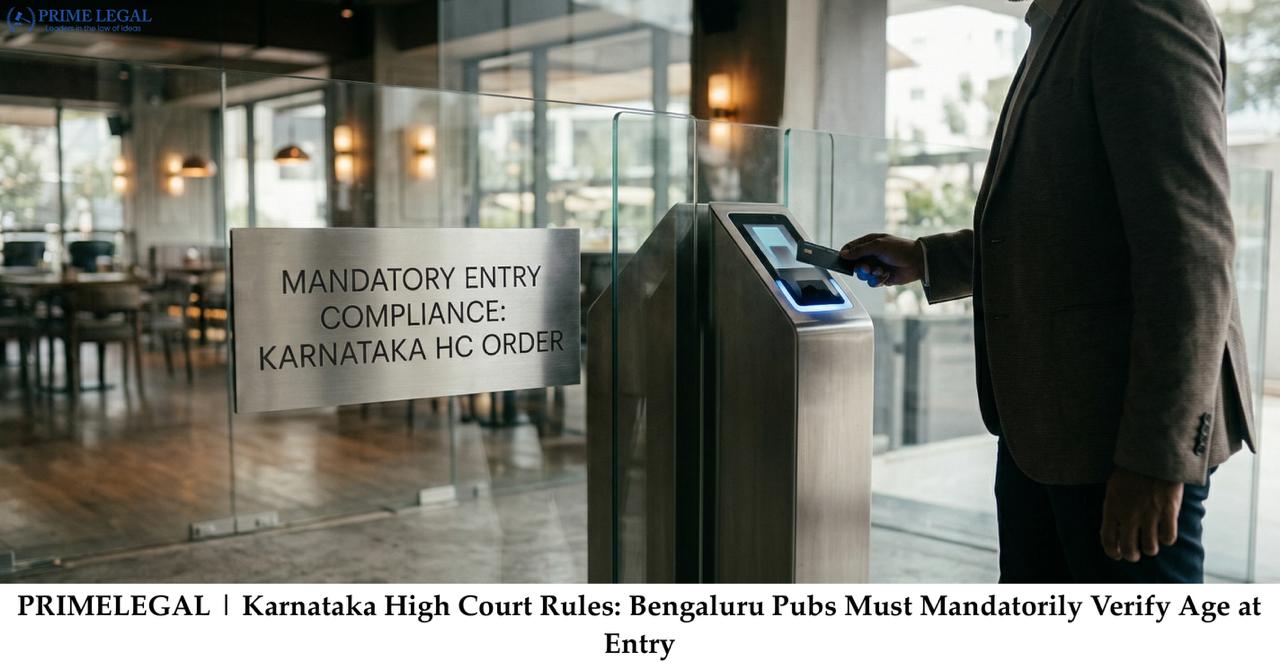
- Justice Nagaprasanna directed that breweries, pubs and similar liquor‑serving establishments “must initiate rigorous age verification protocols” at the threshold, using Aadhaar or other valid identification, and repeat checks when liquor is ordered by persons who appear youthful or underage.
- Age verification, the Court stressed, cannot be a “perfunctory ritual” but has to be a “living practice,” backed by prominent warning boards and insistence on documentary proof before entry and service.
- The judge underlined that managements cannot wash their hands of responsibility if minors manage to get in and consume alcohol, whether it is overtly served across the counter or covertly brought in and drunk inside; they can still face liability.
- Calling youth protection “not merely a statutory mandate but a moral imperative,” the Court warned that bar and brewery owners would be held accountable for lapses and that their licences could face consequences if age‑check norms were ignored.
- The directions were issued in the context of Bengaluru’s expanding pub and craft‑beer scene, with the judge noting that such urban spaces must adapt compliance practices to keep up with rising risks of underage drinking.
RECENT DEVELOPMENTS
Before delivering the final order, the High Court had already orally asked the Bengaluru Police Commissioner to issue a city‑wide circular making it clear that any pub or microbrewery which fails to insist on age proof at the door risks strict action, including cancellation of licence. The written judgment now gives teeth to that warning by embedding the obligation directly in a reasoned order arising out of a live case, rather than leaving it as a passing comment. Media reports suggest that city police are already working on standard operating procedures for enforcement, including surprise checks, scrutiny of CCTV footage and verification of whether establishments are actually asking for ID from college‑age crowds at peak hours. For pub owners and brewery partners, the ruling is a signal that it will no longer be enough to display a “No alcohol to under‑18” board; they will be expected to show tangible systems, ID scanners, manual checks, staff training to prove that minors are being filtered out at the gate.
CONCLUSION
The Karnataka High Court’s decision in V. Chitti Babu pushes Bengaluru’s bar culture to grow up, at least when it comes to who gets through the door. By pinning responsibility squarely on management and describing age verification as both a legal duty and a moral one, the Court has tried to close the comfortable gap between “we didn’t serve them” and “they drank here anyway.” If its directions are robustly enforced, the city’s pubs and breweries may have to re‑engineer their entry routines, but for parents and child‑rights advocates, that inconvenience is a small price to pay to keep teenagers one step further away from alcohol‑fuelled tragedy.
“PRIME LEGAL is a National Award-winning law firm with over two decades of experience across diverse legal sectors. We are dedicated to setting the standard for legal excellence in civil, criminal, and family law.”
WRITTEN BY: ABIA MOHAMMED KABEER

