
CASE NAME: M/s Bharat Udyog Ltd. v. Ambernath Municipal Council
CASE NO: Special Leave Petition Civil no. 1127 of 2017
COURT: Supreme Court of India.
DATE: 24 March 2026.
QUORUM: Justice Pamidighantam Sri Narsima and Justice Alok Aradhe
FACTS:
This case arose from a contractual dispute between Bharatiya Ltd. and the Ambernath Municipal Council regarding a Octroi collection contract. In this, the municipal council it constituted under the Maharashtra Municipal Council at 1965 issued a tender in March 1994 under Section 143 A for the collection of Oak Troy for one year (from April 1, 1994, to March 31, 1995). This tender fixed a minimum reserve price of Rs. 6,74,00,000 Below which bids would not be considered further.
In this the petitioner he participated in the bidding process and a most successful with a bid of Rs. 6,75,00,000. Was executed on 30 March 1994 and the petitioner commenced to work from April 1994 considering all the terms and conditions of the agreement. On May 2, 1994, the petitioner in this requested the municipal council to reduce the reserve price by Rs.40,78,517 Alleging that it was incorrectly calculated. This was being rejected by the municipal council on 27th May 1994 and the reason stated that the reserve price was fixed according to the government guidelines and it cannot be changed further.
Aggrieved by this, the petitioner, he initially filed a writ petition before the Bombay High Court but later withdrew it on 26th September 1994 with liberty to pursue the alternative remedies and after that he approached the state government seeking appointment of an arbitrator to resolve this case. The state government, despite not being a party to the contract here, issued a government resolution dated 14th November 1994 and appointed the Commissioner Konkan Division as an arbitrator under Section 143A(3) Treating it as a special case in this. Later, the arbitrator was directed to submit a report within one month and conducted the proceedings under the Arbitration Act of 1940 and stated the judgment.
The municipal council at that time was under an administrator appointed by the state, and the arbitrator issued notice and the municipal council filed a reply justifying the reserve price and opposing the reduction by stating the mentioned terms and conditions of the contract 26 December 1994 by reducing the reserve price to Rs.6,20,89,843 , which was the amount that was even lower than what the petitioner had requested in this case. Later, the petitioner filed an application under sections 14 and 17 of the Arbitration Act 1940 to make the award a rule of court or to finalize the set award by the arbitrator. The municipal council here objected that the award was null and void and that there was no arbitration agreement and the state government had no authority to appoint an arbitrator in this case in which the final award was being stated by the arbitrator. Later, the civil court it dismissed these objections as time barred and made the award enforceable from 22 December 2000. And on appeal, the Bombay High Court reversed this decision by holding that there was no valid arbitration agreement and here the state government had no jurisdiction to appoint an arbitrator and had exceeded its power and the entire process was a backdoor method to alter tender conditions. And here the petitioner then approached the Supreme Court of India via special leave petition to get justice.
ISSUES:
- Whether a valid arbitration agreement existed between the parties.
- Whether the state government had jurisdiction under Section 143A(3) to appoint an arbitrator.
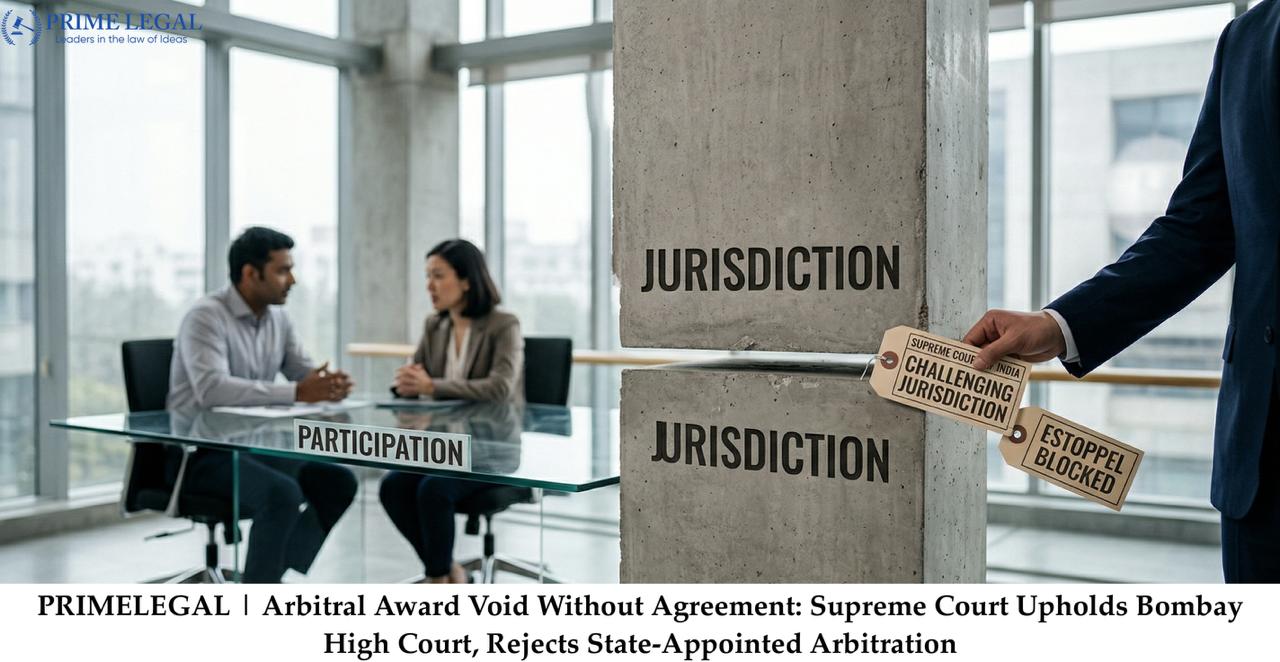
- Whether participation of the municipal council in arbitration proceedings amounts to waiver or acquiescence.
- Whether the arbitral award was valid or enforceable.
LEGAL PROVISIONS:
- Section 2(a), Arbitration Act, 1940 – Definition of arbitration agreement.
- Section 14 of Arbitration Act 1940- Requires the arbitrator to sign the award and file it in court.
- Section 17 of Arbitration Act 1940- Provides that if the court sees no reason to set aside or remit an award, it shall pronounce judgment in terms of the award and a decree shall follow.
- Section 30 of Arbitration Act 1940- states limited grounds for setting aside an award.
- Section 33 of Arbitration Act 1940- Any challenge to the existence or validity of an arbitration agreement or an award must be made by an application to the court which will then decide the matter of affidavits.
- Section 39 of Arbitration Act 1940- List specific appealable orders, such as those setting aside or modifying an award.
- Section 143A(3) Maharashtra Municipal Councils Act, 1965- State governments to decide disputes between a municipal council and its octroi collection agent, and its decision is final and binding.
- Clause 22 of Contract (dispute resolution clause)- States that a contract is not voidable simply because one party made a mistake about a matter of fact.
ARGUMENTS:
APPELLANT:
The petitioner here argued that municipal council had waived its right to challenge the jurisdiction by actively participating in the arbitral process and the proceedings held by it. It also contended that such parties amounted to acquiescence and therefore the Council could not later question the validity of the arbitration in this Act. The petitioner relied on. Such as N Chellappan v. Kerala State Electricity Board (1975) 1 SCC 289 and in the Sain Mittal v. Housing Board, Haryana (2002) 3 SCC 175 to argue that once party submit to arbitration, they are bound by the outcome as it is a legal proceeding, and it holds a status of credibility in the courts. Further, he argued that the Municipal Court had effectively accepted the decisions made by the arbitration or the existence of an arbitration clause, and the intention of the parties to resolve disputes through arbitration should be inferred even if the contract did not explicitly use the term arbitration. But since arbitration is considered as a form of resolution in the legal arena, it should be considered and it has certain valid clauses under it. After that, the petitioner contended that the objections raised by the municipal council were barred by limitation and therefore the award should not have been interfered with by the High Court. And the arbitration award should stand as valid as a decision of the court, and no other court should interfere in the decision.
RESPONDENT:
In this, the municipal council strongly opposed the validity of the arbitration proceedings, asserting that no arbitration agreement existed between the parties and that it is out of agreement. It argued that clause 22 Of the contract only provided for a departmental dispute resolution mechanism and not for an arbitration process. Hence, it was being claimed that the decision made by the army traitor will not hold any authenticity as it was not mentioned in the terms of contract for resolving the disputes. Here the Council argued that. The state government had no authority under either the contract or the statutes to appoint an arbitrator in this case. The government’s action was unilateral and without any consent, making the entire process legally invalid here.
The Council has also raised jurisdictional objections at the earliest opportunity without delaying the process, both before the civil Court and subsequently before the High Courts, and therefore the doctrine of waiver or estoppel did not apply as it was not being delayed by the Council. Therefore, respondent also described this arbitration proceedings as hurried, perfunctory and imposed, pointing out that the award was passed within an unusually short time frame without any proper adjudication process in this case.
ANALYSIS:
The Supreme Court undertook a very detailed examination of the statutory framework and contractual terms mentioned in this case, and the Court analysed Section 143A(3) of the 1965 Act. Stated that it empowers the State government to issue policy directions regarding the manner and procedure of octroi collection, not to interfere in contractual disputes or appoint arbitrators. The court here rejected the argument that this provision could justify the government’s action and hereby did not entertain it. The court also examined Clause 22 of the contract and concluded that it did not constitute an arbitration agreement. Instead, it merely provided for a hierarchical administrative mechanism for the dispute resolution referral to the collector and appeals within the governmental structure. There was number intention to submit disputes to arbitration, which is a fundamental requirement of the Arbitration Act 1940 under section 2(a). Later, the court emphasized the necessity of mutual consent for arbitration, and in this present case the municipal council had neither agreed to any sort of arbitration nor consented to the appointment of the arbitrator to resolve the dispute that happened in this case. This entire process was initiated unilaterally by the petitioner and the state government without the municipal council giving consent to it. Hence, on the issue of participation, the Court held that the mere participation does not confer jurisdiction where none exists. Since the arbitration itself was without any legal basis, the participation by the municipal council could not validate the proceedings here.
Finally, the court in this case held the High Court’s observation that the arbitration appeared to be backdoor method to alter public tender conditions, which is impermissible in law. And it noted the procedural irregularities happened in this case, including the unusually short duration of arbitration and the lack of proper adjudicatory process required in the form of arbitration to resolve any such disputes, reinforcing the conclusion that the award was unsustainable, and it should be quashed.
JUDGMENT:
The Supreme Court thereby dismissed the special leave petition made by the petition and upheld the Bombay High Court’s decision, holding that there was no valid arbitration agreement between the two parties and the municipal council did not agree to the set arbitration process and it ruled that the state government had no jurisdiction to unilaterally appoint an arbitrator and that the arbitral process were held as void ab initio. The Court further clarifies that mere participation, and arbitration does not create consent or conferred jurisdiction. And consequently, it was being held that the Arbitral award was declared null and unforeseeable and the High Court’s order setting it aside was affirmed by the Supreme Court of India.
CONCLUSION:
The Supreme Court, it conclusively held that the arbitration cannot be imposed without any mutual consent and a valid argument stating the arbitration clauses. Any arbitral proceedings conducted without any jurisdiction holds a nullity, and even participation by a party cannot cure such a fundamental defect. The case here reinforces the principle that statutory authorities and the governments cannot unilaterally alter contractual disputes mechanisms or impose arbitration, especially in the matter of public contracts.
“PRIME LEGAL is a National Award-winning law firm with over two decades of experience across diverse legal sectors. We are dedicated to setting the standard for legal excellence in civil, criminal, and family law.”
WRITTEN BY: MEENAKSHI DANGI.
Read the judgment here

