
INTRODUCTION
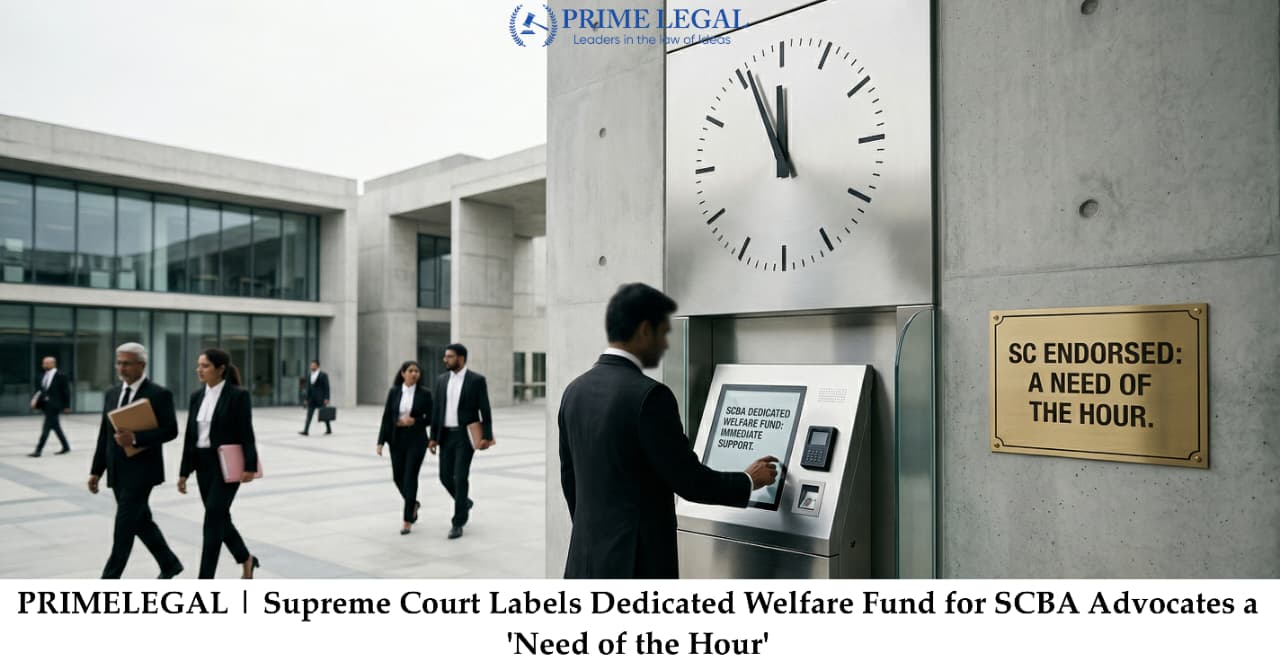
The Supreme Court has addressed a long‑standing concern of its own Bar by describing a dedicated welfare fund for Supreme Court advocates as the “need of the hour” while agreeing to examine a plea by the Supreme Court Bar Association (SCBA). The Bench has issued notice to the Union government, the Bar Council of India (BCI), the Bar Council of Delhi (BCD) and the Supreme Court’s Secretary‑General on SCBA’s writ petition seeking a court‑specific welfare mechanism for advocates practising before the SC. It acknowledges that, despite multiple welfare schemes for state bar members, lawyers who work primarily in the Supreme Court often are deprived when faced with illness, disability or sudden financial distress.
BACKGROUND
SCBA’s petition points to an anomaly in the Advocates’ Welfare Fund Act, 2001, particularly Section 27, which requires every ‘Vakalatnama’ to carry a welfare stamp, including those filed in the Supreme Court, but the money from these stamps is credited to state bar council funds, in this case, the Delhi Bar Council’s welfare fund. SCBA President Vikas Singh argued that many Supreme Court practitioners are detached from their “parent” state bar schemes yet receive no direct benefit from the welfare contributions generated by their own filings in the apex court. The petition says this is “collection‑only”, where Supreme Court vakalatnamas generate significant welfare revenue without any protection for SCBA members. SCBA has framed the issue as a constitutional one, contending that the absence of a dedicated welfare framework for this distinct class of practitioners undermines Articles 14, 19(1)(g) and 21 by denying them comparable social security.
KEY POINTS
- The Bench observed that introducing a specific “Supreme Court Rule 15A” to combat this gap is “definitely the need of the hour,” showcasing judicial sympathy for a structural solution rather than ad hoc charity.
- SCBA sought amendments to the Supreme Court Rules, 2013, especially insertion of a proposed Rule 15A and changes to the definition clause and Schedule III to create a Supreme Court‑specific welfare stamp regime.
- The petition proposes a mandatory “Lawyers’ Welfare Stamp” of about ₹500 per vakalatnama in some formulations on every matter filed in the Supreme Court, with the entire proceeds earmarked exclusively for the SCBA Welfare Fund.
- SCBA wants the fund managed by a high‑powered committee headed by the Chief Justice of India or a nominee judge, alongside SCBA office‑bearers and nominated senior advocates, to ensure transparency and fiduciary discipline.
- The petition seeks a declaration that references to the Supreme Court in Section 27 of the Advocates’ Welfare Fund Act, 2001, and in Rule 21 of the Delhi Advocates’ Welfare Fund Rules, 2001 (as amended), are unconstitutional to the extent they divert Supreme Court‑generated welfare funds away from SCBA members.
- According to the plea, denying SC lawyers the welfare safety despite their contributions amounts to arbitrary treatment vis‑à‑vis state‑level advocates and offends the spirit of equality and dignified livelihood protections under the Constitution.
RECENT DEVELOPMENTS
The Supreme Court has not yet accepted SCBA’s proposals but has formally issued notice to the Centre, BCI, BCD and its own registry to explain why a separate welfare architecture for Supreme Court practitioners should not be created. The case is registered Supreme Court Bar Association v. Supreme Court of India, W.P.(C) No. 294/2026 will test how far the Court is willing to go in re‑designing its rules and reading down parts of the Act to carve out a sui generis welfare regime for its own bar. Several bar leaders have regarded the Court’s “need of the hour” remark as a signal that the judiciary recognizes the struggle many young and first‑generation Supreme Court lawyers face.
CONCLUSION
The Supreme Court’s readiness to entertain SCBA’s plea marks an important shift from seeing advocates’ welfare as a matter of dire need to be incorporated to SBCA structure granting professional security and constitutional fairness. If the proposed welfare stamp and dedicated fund are eventually accepted, Supreme Court practitioners can gain a predictable safety net directly linked to their own filings, rather than relying on state‑bar schemes that often do not reflect their practice realities.
“PRIME LEGAL is a National Award-winning law firm with over two decades of experience across diverse legal sectors. We are dedicated to setting the standard for legal excellence in civil, criminal, and family law.”
WRITTEN BY: ABIA MOHAMMED KABEER

