
ABSTRACT
The Supreme Court drew a clear line between ordinary domestic disagreements and conduct that actually amounts to criminal cruelty or dowry harassment in Dr. Sushil Kumar Purbey & Anr. v. State of Bihar & Ors., 2026 INSC 212,. In this case, proceedings had been initiated against the in-laws under Sections 341, 323, 498A, and 34 of the Indian Penal Code (Section 126(2), 115(2), 85 and 3(5) of the Bharatiya Nyaya Sanhita respectively), along with Sections 3 and 4 of the Dowry Prohibition Act, 1961. SC held that mere allegation of “quarreling”, by itself, doesn’t amount to cruelty or dowry harassment without any specific and credible details of harassment or unlawful demands.
KEYWORDS: Dowry harassment, Section 498A of IPC, Section 85 of BNS, Dowry Prohibition Act, Dr. Sushil Kumar Purbey & Anr. v. State of Bihar & Ors.
INTRODUCTION
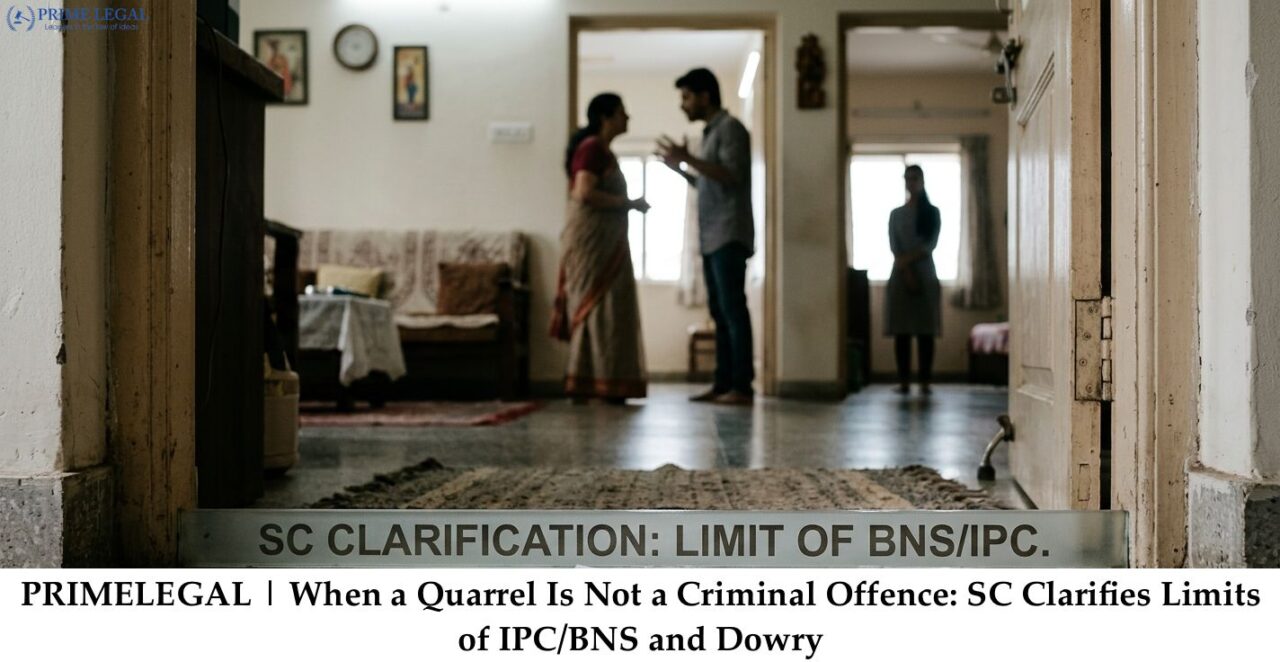
Dowry related cruelty and violence remain harsh realities of Indian marital life for which Parliament legislated strong provisions such as Section 498A IPC (Section 85 of BNS) and the Dowry Prohibition Act, 1961. At the same time, courts have repeatedly expressed concern one the misuse of these provisions, where FIR includes every member of the husband’s family, without clear or specific allegations. In the case Dr. Sushil Kumar Purbey & Anr. v. State of Bihar & Ors., the SC dealt with allegations of dowry harassment, where the husband’s parents and other relatives had been accused. The Court clarified the limits of criminal law by holding that a “quarrel” by itself is not an offense and cannot sustain cognizance under the IPC or the Dowry Prohibition Act.
THE SUPREME COURT’S RULING
The complainant alleged that she was subjected to harassment and cruelty, particularly due to demands for a BMW car and other expensive items as dowry after the marriage in 2019. Based on this, an FIR was lodged in 2022 under Sections 341, 323, 498A and 34 IPC (Section 126(2), 115(2), 85 and 3(5) of the Bharatiya Nyaya Sanhita respectively) and Sections 3 and 4 of the Dowry Prohibition Act, accusing the husband and his family. The SC examined the case and noted that the allegations against the sister‑in‑law and the parents‑in‑law were almost identical, and no specific apparent act was attributed. The only distinct accusation against the parents‑in‑law was that they would “quarrel” with the complainant.
On these facts, the Court held that quarreling, by itself, does not constitute a criminal offence and cannot sustain cognizance for offences under:
- Section 341 of IPC – wrongful restraint (Section 126(2) of BNS)
- Section 323 – voluntarily causing hurt (Section 115(2) of BNS)
- Section 498A – cruelty by husband or his relatives (Section 85 of BNS)
- Section 34 IPC (Section 3(5) of BNS),
- Sections 3 and 4 of the Dowry Prohibition Act.
Consequently, the criminal proceedings against the parents‑in‑law were quashed, with the Court emphasising that vague allegations without specific acts or dates cannot be the basis for dragging relatives into serious criminal cases.
EVERY QUARREL IS NOT CRUELTY OR DOWRY HARASSMENT
Section 498A IPC intents to punish cruelty by the husband or his relatives, of acts likely to induce a woman to suicide or cause grave injury and harassment for unlawful dowry demands. The Dowry Prohibition Act criminalizes giving, taking and demanding dowry, and prescribes penalties for it. The SC did not weaken these protections but reiterated that not every quarrel can be a crime. Marital relationships inevitably involve disagreements, raised voices and hurt feelings, especially in joint families.
The judgment draws a clear distinction between specific, sustained harassment linked to dowry or cruelty, which the law rightly condemns and ordinary quarrels or generalized grievances, which doesn’t amount to a criminal offence. There must be clear material showing what was said or done, when it occurred, and how it connects with unlawful demands or grave cruelty. A bare statement that “they used to quarrel with me” is simply too thin a basis for invoking Section 498A or the Dowry Prohibition Act.
CONCERNS OF THE COURT
The Court’s concern about vague or omnibus allegations against multiple family members is still a matter to ponder. In this case, the FIR named several relatives, but the narrative did not assign a concrete act or role to each accused. The parents‑in‑law were essentially alleged broadly of harassment, without dates, particulars or specific instances of cruelty or dowry demand. The Court observed that criminal law cannot rest on such generalities, especially in matters carrying social stigma and serious consequences. Naming a relative and adding that they “quarrelled” with the complainant is not sufficient, in that case almost any family disagreement could be converted into a non‑bailable criminal case, thus it must be grounded on clear, specific and credible allegations.
CONSEQUENCES OF THE JUDGEMENT
A general concern is whether such decisions would discourage genuine victims from coming forward or give in‑laws a defence. However, the Court’s reasoning does not say that parents‑in‑law can never be prosecuted or that quarrels are irrelevant, it says that the law demands more than a mere allegation, i.e., it must be substantiated with specific acts of cruelty, threats, assaults or persistent dowry demands with some detail. Through this the Court seeks to protect the credibility of dowry and cruelty prosecutions as a whole. If every domestic quarrel is treated as 498A, genuine grave cases would be considered trivial and it would also overburden the judiciary with weak cases.
CONCLUSION
The Supreme Court’s clarification that “mere quarrel” with a daughter‑in‑law is not, by itself, an offence under the IPC or the Dowry Prohibition Act, is both legally and socially significant. In Dr. Sushil Kumar Purbey & Anr. v. State of Bihar & Ors., 2026 INSC 212, the Court stressed that a concrete fact situation must be included and not vague and omnibus accusations. The judgment does not invalidate the protection that Section 498A and the Dowry Prohibition Act grants to women, but it tries to prevent the misuse. The SC’s ruling seeks to balance between protecting women from genuine abuse and preventing vague and false accusations against innocent relatives.
“PRIME LEGAL is a National Award-winning law firm with over two decades of experience across diverse legal sectors. We are dedicated to setting the standard for legal excellence in civil, criminal, and family law.”
WRITTEN BY: ABIA MOHAMMED KABEER

