
INTRODUCTION
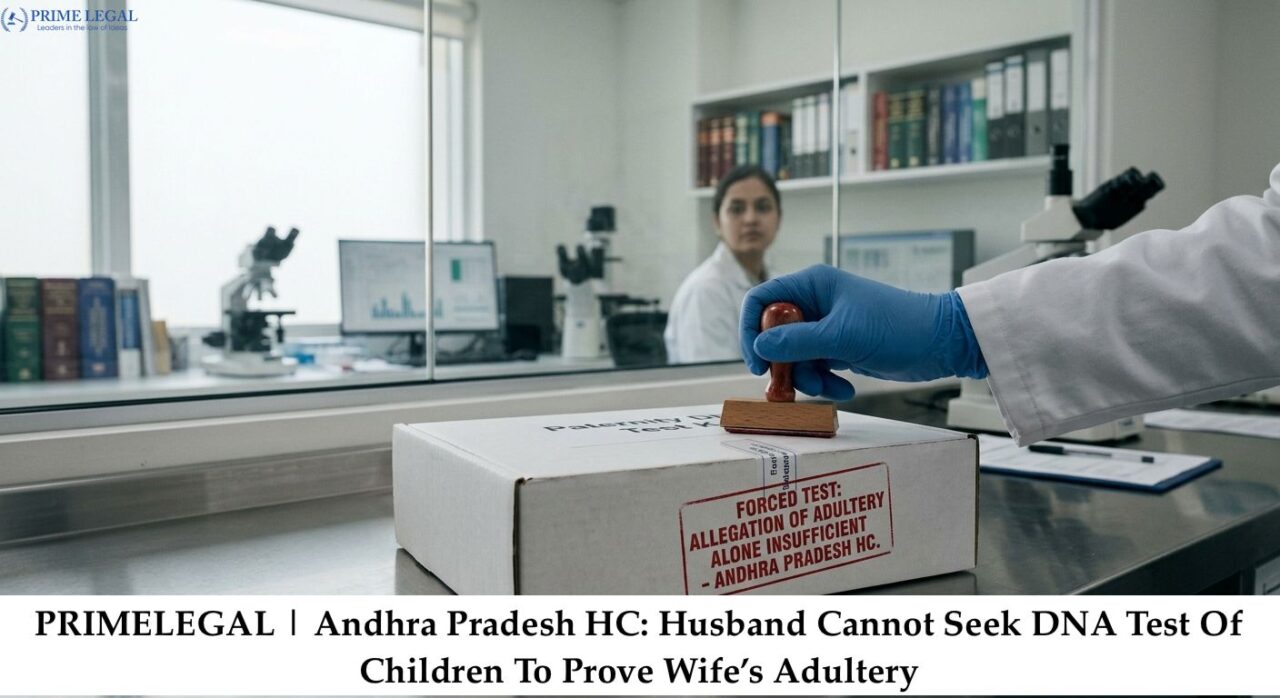
The Andhra Pradesh High Court has held that a husband cannot compel his children to undergo a DNA test merely to prove his allegations of adultery against his wife in a matrimonial dispute. Justice Tarlada Rajasekhar Rao refused a plea by a man requesting for DNA test on his 2 children to prove that they were not born from the wedlock, thereby establishing his wife’s infidelity. The Court observed that children must not be drawn into parents’ matrimonial dispute, particularly when they are neither parties to the case nor claiming maintenance from the father.
BACKGROUND
A husband filed a petition for divorce under Section 13(1)(ib) of the Hindu Marriage Act, 1955 on the ground that his wife had deserted him for a continuous period of more than two years. Further, he filed an interlocutory application under Section 45 of the Indian Evidence Act, 1872 (Section 39 of Bharatiya Sakshya Adhiniyam, 2023) requesting for DNA test on their 2 children to determine the paternity. The trial court declined the request, relying on Supreme Court precedents cautioning that blood or DNA tests should not be ordered as a matter of course in matrimonial litigation because such directions can stigmatize a child and permanently damage their social standing. Challenging that refusal, the husband approached the High Court arguing that a DNA report was “crucial” for a fair trial and without it he would be deprived of the best possible evidence to prove his wife’s alleged infidelity.
KEY POINTS
- The Andhra Pradesh HC held that even assuming the wife was committing adultery, the husband could not seek a DNA test of the children to prove it, he must rely on other evidence.
- Justice Rajasekhar Rao stressed that the children were not parties to the matrimonial case and were not claiming maintenance, so their rights and privacy could not be sacrificed to strengthen one parent’s case.
- Citing Section 112 of the Indian Evidence Act (Section 116 of Bharatiya Sakshya Adhiniyam, 2023), the Court reiterated that a child born during the subsistence of a valid marriage is presumed to be legitimate child, born out of the wedlock.
- The HC relied on the Supreme Court’s decision in Goutam Kundu v. State of West Bengal 1993 AIR 2295, wherein the courts were asked to not order blood tests and must protect a child’s reputation and society from any possible harm.
- The SC’s decision in Aparna Ajinkya Firodia v. Ajinkya Arun Firodia (2024) 7 SCC 773, was also referred, where the SC emphasized that decisions on DNA testing must be assessed based on the child’s welfare and that a child cannot be used as a “pawn” to prove the mother’s alleged adultery.
- The Court noted that the husband’s own divorce case was formally based on desertion, not on adultery, making the requested DNA test weakly connected to the actual pleadings.
RECENT DEVELOPMENTS
The Andhra Pradesh HC dismissed the revision petition of the husband’s plea for DNA test on the children, with costs of ₹3,000, to be paid to the District Legal Services Authority, with a warning that non‑payment could lead to civil recovery including imprisonment. This decision was delivered on March 12, 2026 adding to precedents set by High Court and Supreme Court, which prohibits the casual use of DNA tests on children in marital disputes.
CONCLUSION
The Andhra Pradesh HC’s decision to quash the husband’s plea to use his children’s DNA as a tool in a divorce case highlights that matrimonial disputes cannot override the welfare, dignity and privacy of minors. Heavy reliance on the Section 112 of the Evidence Act (Section 116 of Bharatiya Sakshya Adhiniyam, 2023) and Supreme Court precedents, the HC made a stern point that, proving adultery is a matter between spouses, and children are not collateral evidence to be tested and branded in the process. While modern science can help in fact finding, it cannot override the foundational principle of primacy of child’s welfare, even when a marriage is falling apart.
“PRIME LEGAL is a National Award-winning law firm with over two decades of experience across diverse legal sectors. We are dedicated to setting the standard for legal excellence in civil, criminal, and family law.”
WRITTEN BY: ABIA MOHAMMED KABEER

