
CASE NAME: The Commissioner, Bruhat Bangalore Mahanagara Palike v. K.K. Umesh Kumar & Ors.
CASE NUMBER: Civil Appeal No. of 2026 (Arising out of SLP (C.) No. 1039 of 2021)
COURT: In The Supreme Court of India
DATE: 11 June 2026
QUORUM: Hon’ble Mr. Justice Sanjay Karol and Hon’ble Mr. Justice Nongmeikapam Kotiswar Singh
FACTS
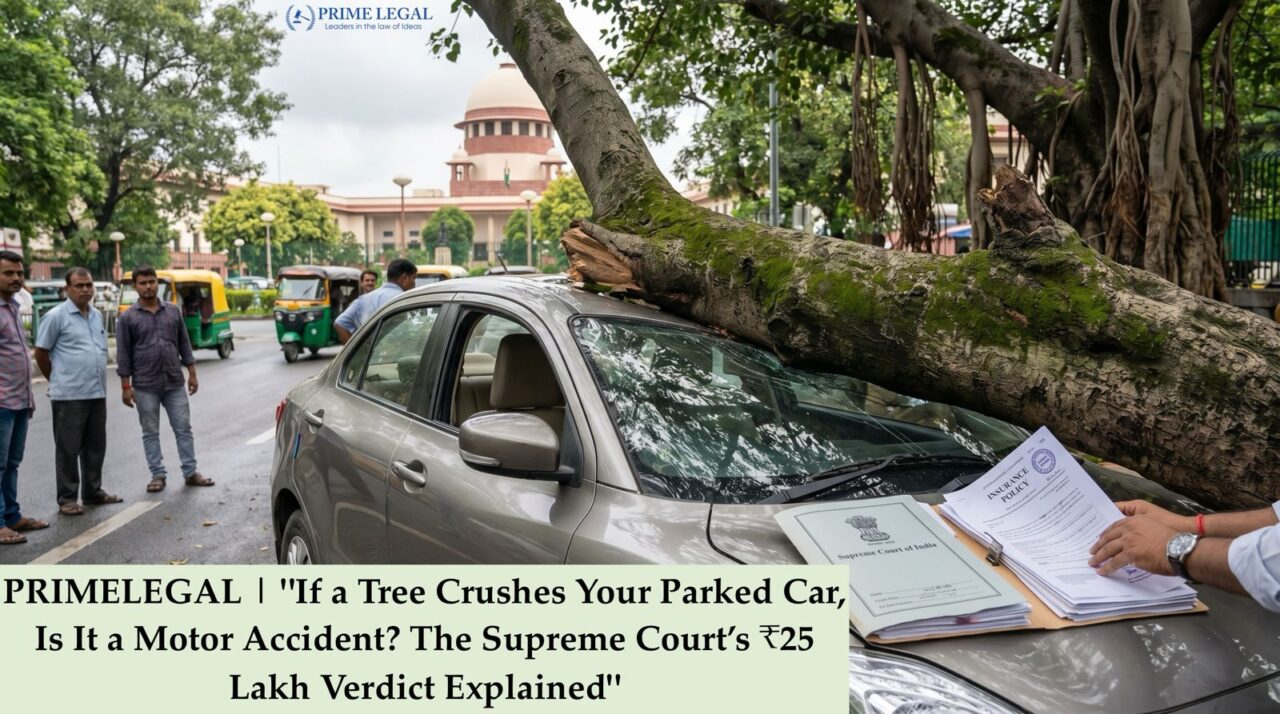
The Respondent no. 1 (the victim) was in an autorickshaw on his way from Queens Road to Chinnaswamy Stadium when heavy rain fell, and he asked the driver to stop the vehicle by the side of the road, under an old tree. Following this request, a branch of the tree fell on the autorickshaw while it was stationary, and this caused serious injuries to the victim. The victim was transferred to Mallya Hospital for treatment. A claim of Rs. 50 lakhs was filed in the Motor Accidents Claim Tribunal, Bangalore, which was dismissed on 10th April, 2013, because it was a natural disaster. After an initial dismissal by the High Court of Karnataka on grounds of delay, the Supreme Court remanded the matter. In the second round of proceedings, the High Court awarded awarded Rs. 17,10,500/- in compensation and apportioned liability of the same as follows: 25% for Bruhat Bangalore Mahanagara Palike (appellant), 50% for the insurer of the Autorickshaw, and 25% for the Horticulture Department of the Karnataka State Government. The Appellant appealed to the Supreme Court to challenge this aspect of liability.
ISSUES
- Whether the appellant can be held liable under the Motor Vehicles Act, 1988, for injuries sustained by a passenger when a roadside tree falls on a stationary vehicle sheltering from rain.
- Whether the falling of a tree branch on an autorickshaw qualifies as an accident arising out of the “use” of a motor vehicle for which a claim can be filed under the Motor Vehicles Act.
LEGAL PROVISIONS
- Motor Vehicles Act, 1988: Section 165(1) and Section 166- claims for compensation regarding accidents arising out of the use of motor vehicles.
- Constitution of India: Article 142 regarding the enforcement of decrees and orders of the Supreme Court to complete justice.
- Tort Law: The doctrine of strict liability and the ‘Act of God’ (Vis Major) defence.
ARGUMENTS
APPELLANT
Through the defence’s counsel, the Appellant claimed that they were not at fault for this unfortunate incident and argued that the tree that fell was simply a natural occurrence and also referred to as an “Act of God” over which the State authorities had absolutely no control.
RESPONDENTS
The Respondents wanted to uphold the claim for compensation due to the life-changing injuries sustained from a motor vehicle accident. Under the premise that the injuries were due to the use of the motor vehicle and that the damages sustained were the fault of the authorities, the Respondents wish to continue to seek compensation for the injuries suffered.
ANALYSIS
The Supreme Court outlined the ‘Acts of God’ doctrine, and in this case, while municipal corporations have a duty to maintain trees in municipal areas, it would be unreasonable to expect that all branches could be kept under constant observation. The Court stated that while it is reasonable to expect that people may seek shelter under trees that are being rained upon, it would not be reasonable to expect or contemplate that a branch would fall at the time of the accident. Therefore, it is not reasonable to hold the appellant liable for an Act of God under the MVA (Motor Vehicle Act), in this specific instance. The Court also looked at the word ‘use’ in relation to section 165(1) of the Act, and the Court held that the authority relying on precedent established that the meaning of ‘use’ within the MVA is quite broad, meaning that stationary vehicles also come under the definition. However, the Court noted that the motor vehicle was not actively involved in causing the accident and was not a proximate cause of the accident, thus making a claim under Section 166 of the MVA inappropriate from both a technical and legal perspective.
JUDGMENT
The Supreme Court has determined that even though applying strict statutory liability under The Motor Vehicles Act is unreasonable, a severely injured victim should not be left without any compensation and without going through further rounds of litigation. In finding that Respondent No. 1 had suffered a complete paraplegia, including bladder and bowel incontinence, the Court deemed the technical approach taken by the High Court and the resulting award of damages insufficient. In using its inherent powers under Article 142 of the Constitution to do complete justice, the Supreme Court ordered the total amount of compensation to be increased to Rs. 25,00,000/- with interest. The original allocation of liability – 25% by the Appellant, 50% by the Insurer and 25% by the Horticulture Department – shall not be disturbed. The appeal was resolved with a direction to pay the total amount directly into the Respondent’s bank account within four weeks of the date of this order, with no order as to costs.
CONCLUSION
The Supreme Court stated that an individual who has been injured due to a stationary motor vehicle being struck by a falling tree does not meet the direct cause-and-effect relationship required by law to make a claim for damages arising from a motor vehicle accident; however, using Article 142 of the Constitution to provide justice and fulfill its constitutional responsibility, the Court granted compensation in excess of the amount that would have been awarded to a plaintiff had the case been litigated through normal means, and also set out a procedure for resolving liability between the relevant parties (the State and the insurance company).
“PRIME LEGAL is a National Award-winning law firm with over two decades of experience across diverse legal sectors. We are dedicated to setting the standard for legal excellence in civil, criminal, and family law.”
WRITTEN BY: VINEET SEERVI
Read the judgment copy below:

