
INTRODUCTION:
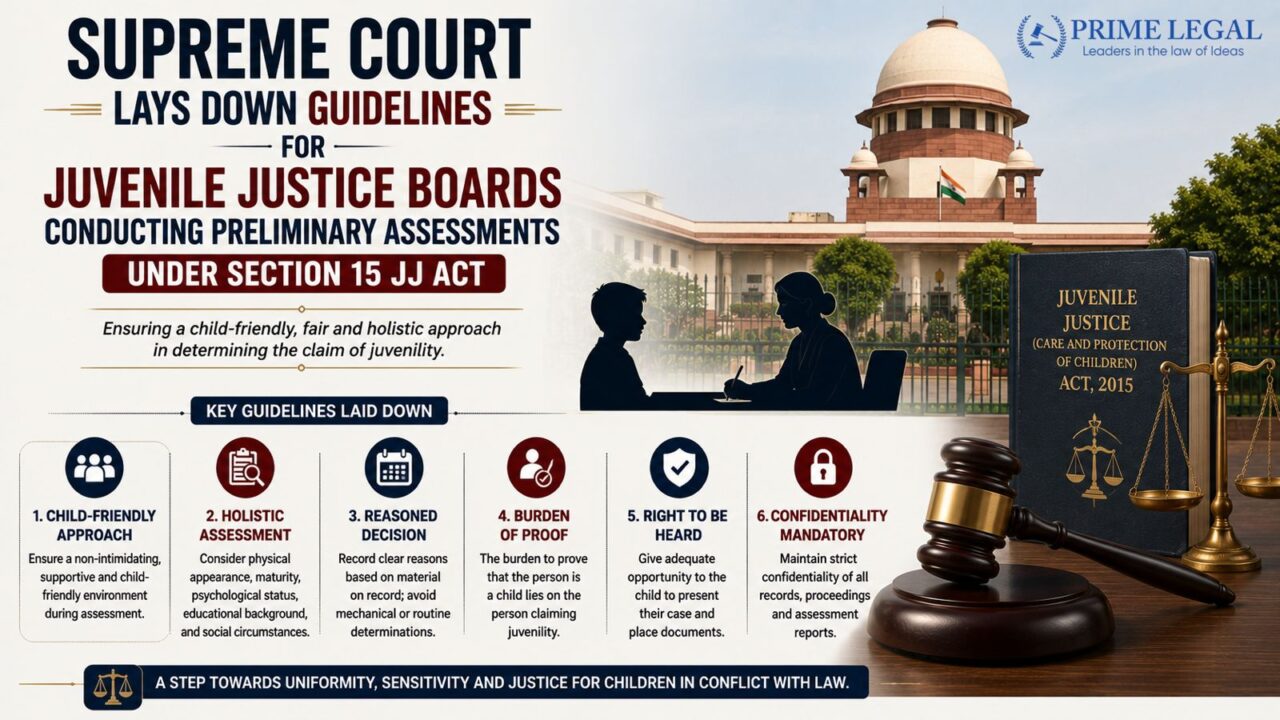
In a recent decision in the case of X vs State of Bihar, the Supreme Court has issued important guidelines for the Juvenile Justice Boards to conduct preliminary assessments under Section 15 of Juvenile Justice (Care and Protection of Children) Act, 2015 (JJ Act). The case involved an appeal against the earlier ruling for a 16-year-old accused in a murder case to be tried as an adult. A bench composed of Justice J.B. Pardiwala and Justice R. Mahadevan made it clear that a preliminary assessment cannot be conducted in the manner of a mini-trial but must be in nature of a statutory exercise to assess whether a child above 16, accused of a serious crime has the mental and physical ability to stand trial as an adult.
BACKGROUND:
The decision came in light in the aftermath of judicial proceedings concerning a minor of 16 years age who was accused of offences under Sections 302, 201 read with Section 34 of the Indian Penal Code, 1860. The Juvenile Justice Board, by a majority opinion, stated that the minor does not have the mental and physical capability to commit the crime and ordered him to be dealt with by the Juvenile Justice Board and not as an adult. However, the appellate court rejected the order passed and allowed the accused to be treated as an adult, which later was confirmed by the Patna High Court. The Supreme Court upheld the Patna High Court’s judgement.
KEY POINTS:
-
- A preliminary assessment cannot be conducted in the manner of a mini-trial but must be in the nature of a statutory exercise to assess whether a child above 16, accused of a serious crime has the mental and physical ability to stand trial as an adult.
- Expert evidence though of immense value cannot be considered as the sole determining factor under Section 15.
- The Board must examine the Social Background Report (SBR), the Social Investigation Report (SIR), statements from the witnesses, and other relevant materials before giving its decision.
- The “mental capacity” of a child is his ability to make social decisions and judgments, “a range of cognitive abilities, developmental disability, comprehension, decision-making and reasoning, more particularly, the child’s understanding of conflict and his understanding of the consequences of his actions.”
- The result of any preliminary assessment has to be a reasoned order that can be scrutinized by the judiciary.
ANALYSIS:
The SC while interpreting Sec 15 of the JJ Act, held that the sole purpose of preliminary assessment is to ascertain whether the child in conflict with law, who is aged more than 16 years, should be tried as an adult. Further, Rule 10A of the Juvenile Justice (Care and Protection of Children) Model Rules, 2016, provides for guidance to the Board on preliminary assessment. Sub-rule (4) of Rule 10A mandates that the Board must assign reasons while passing an order in furtherance of preliminary assessment. This requirement is not a mere procedural formality. It acts as a safeguard that ensures the decision of the Board is capable of judicial scrutiny. The assessment of “physical capacity” should not be restricted only to locomotor abilities of the child but must be assessed having regards to the nature of the act involved in the alleged offence. The assessment must constitute examination of whether the child, given his age, and physical development was physically and mentally capable of committing the offence in the manner alleged. Moreover, the court recorded that preliminary assessment is not a trial, but it is conducted to assess the capacity of such a child to commit and understand the consequences of the alleged offence. Therefore, before giving a decision, Social Background Report, Social Investigation Report and Statement of Witnesses must be examined.
CONCLUSION:
The SC while analysing Sec 15 of the JJ Act noted that, “the circumstances to be referred during an assessment of an offence are not merely the immediate circumstances of the offence itself, but also to other circumstances cumulative in nature to have led to the immediate circumstances related to a long period occurring in the child’s life, and finally the ability to understand the consequence of the offence”. The judgment sets a precedent for the various Juvenile Justice Boards present in the country, conveying to them that the decision on whether to treat children like adults has to be made based on a thorough, rational, and child-oriented inquiry rather than merely sticking to expert opinion.
“PRIME LEGAL is a National Award-winning law firm with over two decades of experience across diverse legal sectors. We are dedicated to setting the standard for legal excellence in civil, criminal, and family law.”
WRITTEN BY: SOMSUTA PAUL.

