
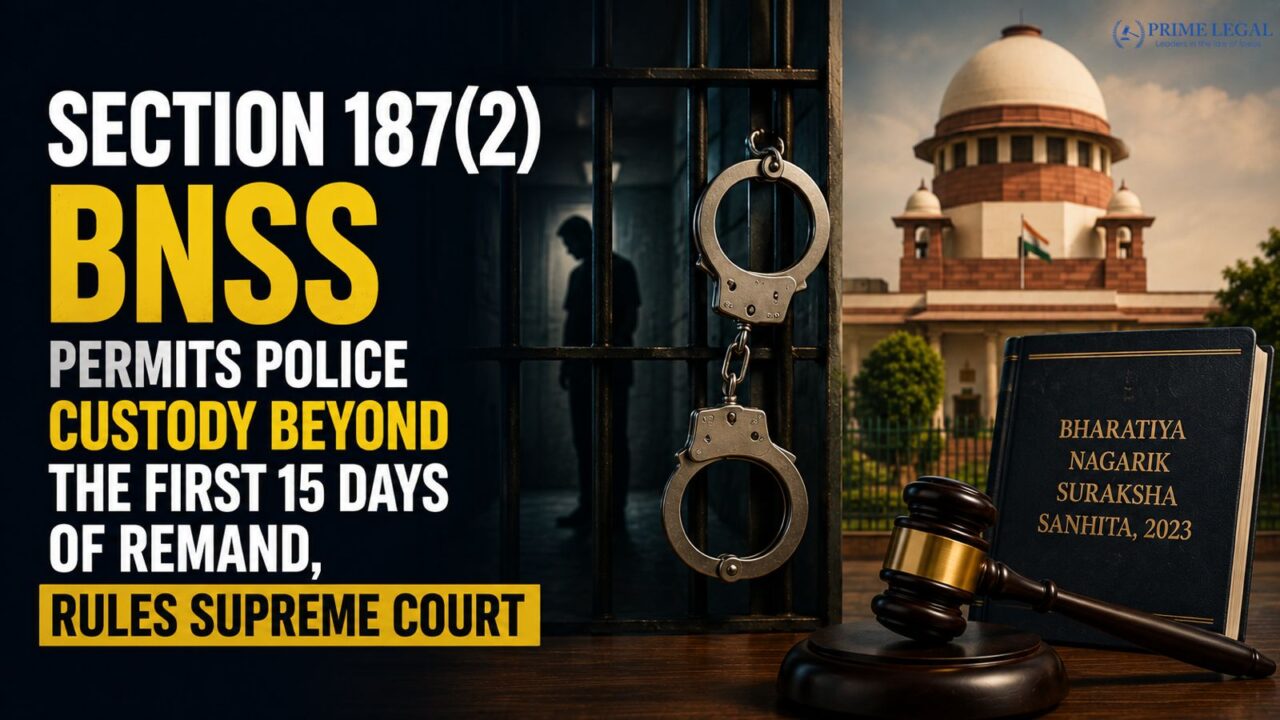
CASE NAME: The State of Andhra Pradesh v. Suda Suresh Veera Venkata Naga Raju
CITATION: 2026 INSC 744
CASE NUMBER: Criminal Appeal No(s). OF 2026 (Arising out of SLP(Crl.) No(s). 12344 of 2026)
COURT: The Supreme Court of India
DATE OF JUDGMENT: 27th July, 2026
QUORUM: Hon’ble Mr. Justice Vikram Nath and Hon’ble Mr. Justice Sandeep Mehta
FACTS
The State of Andhra Pradesh put in an appeal against the judgment dated 7th July, 2026 passed by the High Court of Andhra Pradesh in the present case. The High Court had partially set aside an order issued by II Additional Judicial Magistrate (JM) of First Class, Vijayawada, which had issued police custody for the respondent-accused with several stringent conditions.
The respondent-accused who is an Inspector of Police was involved in Crime No. 107 of 2026, registered at Krishna Lanka Police Station, Vijayawada, against the alleged custodial death of one Gade Sai Krishna. On 6th May 2026, the deceased-victim was seized and handed over to the respondent-accused, but missing CCTV footage was found during subsequent DVR seizures for the crucial time period. Pursuant to a Petition for Habeas Corpus filed by the victim’s mother and a case of ‘illegal detention and custodial torture leading to death’ a Special Investigation Team (SIT) was established and the respondent accused was arrested and remanded for judicial custody.
The Magistrate gave police custody but directed the interrogation be held only at the Central Prison, Rajamahendravaram and that it be conducted under the presence of the advocate at all times and videotaped continuously. The High Court allowed the SIT to take the accused to the crime spot but ordered for continuous video recording of each and every movement of the accused and his transfer from the jail to Vijayawada.
ISSUES
Whether the severe restrictions placed by the Magistrate and the High Court on the police in their custody infringed the powers of the investigating agency to interrogate effectively.
Whether the requirement to continuously record the accused’s movement and confine the interrogation to a particular prison had some legal basis and was feasible in practice.
If the defense advocate was present during all the interrogation sessions, did his presence violate the statutory rights under Section 38 of the BNSS?
LEGAL PROVISIONS
- The Bharatiya Nagarik Suraksha Sanhita, 2023 (BNSS) of sections 38, 187 and 528.
- Sections 103(1), 127(4), 127(6), and 238 of the Bharatiya Nyaya Sanhita, 2023 (BNS).
- Sections 23 and 63 of Bharatiya Sakshya Adhiniyam, 2023.
- Under Article 21, of the Constitution of India.
ARGUMENTS
APPELLANT
The Appellant-State’s counsel Mr Sidharth Luthra contended that the conditions by the lower courts amounted to a direct interference with the statutory right of the investigating agency to conduct proper investigations of the accused. The State argued that the interrogation of the accused in the Central Prison and the videography of all his movements (including during his travel) hampered the process of identification of the dead body and reconstruction of the crime scene. The Appellant also contended that the protection of the accused’s life and dignity under the constitutional safeguards had already been provided by the High Court, the enactment of other unrealistic conditions by the Magistrate made the police remand totally futile.
RESPONDENT
The Respondent-accused represented by Mr. L. Narasimha Reddy strongly resisted the State’s submissions. It was contended that the respondent-accused had personally arrested a number of criminals who are lodged in the prison in Vijayawada and his life was at a terribly great risk, if he is taken there. The respondent contended that the curbs imposed by the Magistrate and the High Court were in line with the Supreme Court rulings and were reiteration of the ordinary constitutional safeguards.
ANALYSIS
The Supreme Court examined the working and legality of the conditions imposed and found that the apprehensions of the investigating agency on the difficulties posed by the lower courts were realistic and reasonable. The Court noted that the interrogation was only happening at Rajamahendravaram and the body of the deceased had not been found and the crime scene was expected to be discovered in Vijayawada as per Section 23 of the BSA, the restriction was not justifiable or sustainable.
The Court also stated that Section 187 of the BNSS provides for a wider custody window for the specific purpose of addressing unforeseen new facts or newly discovered facts and that the Magistrate’s blanket rejection of the custody window did not reflect the legislative intent. With respect to Section 38 of the BNSS, the Court observed that the presence of an advocate during the interrogation is a right of an arrested person but the statute does not imply that the advocate must be physically present at all times during the interrogation sessions.
Regarding videography, the Court determined that the requirement of videoing the entire 160-kilometre journey was impractical for a number of reasons including signal failure, battery capacity and security and explained that only the audio-visual recording of the discovery session and interrogation was needed. The Court took cognisance of the respondent’s concern about the security and allowed him to be interrogated in a SIT centre that was identified as being safe instead of Vijayawada prison.
JUDGEMENT
The Supreme Court of India accepted the appeal and remanded the matter for reconsideration to the lower courts. The Court granted 7 days of police custody (which does not exceed 15 days) and gave the Investigating Officer unlimited access to the respondent-accused for interrogation. The situation of keeping custody in the Central Prison was dropped and the interrogation took place at SIT centre in Vijayawada. The Court said that such audio-visual recording would be required only in ‘actual interrogation and discovery process’ and had explicitly excluded ‘transit to and from the police station’ of the accused. The attorney was allowed to be in the room with the suspect during questioning but was explicitly forbidden from making any kind of “intervention.” In addition, the SIT was instructed to investigate the case in an objective and objective manner, without engaging in third degree.
CONCLUSION
The Supreme Court struck a balance between the rights guaranteed by the statute and the fundamental rights guaranteed by the Constitution by eliminating ‘logistically unworkable’ conditions set by lower courts. The judgment defines the meaning of critical provisions in the BNSS on police custody, the practical limitations of compulsory videotaping, and the restrictions on when an advocate can be present during police interrogation.
“PRIME LEGAL is a National Award-winning law firm with over two decades of experience across diverse legal sectors. We are dedicated to setting the standard for legal excellence in civil, criminal, and family law.”
WRITTEN BY: SHEEN
Read the Judgement copy below:
THE STATE OF ANDHRA PRADESH VERSUS SUDA SURESH VEERA VENKATA NAGA RAJU

