
INTRODUCTION:
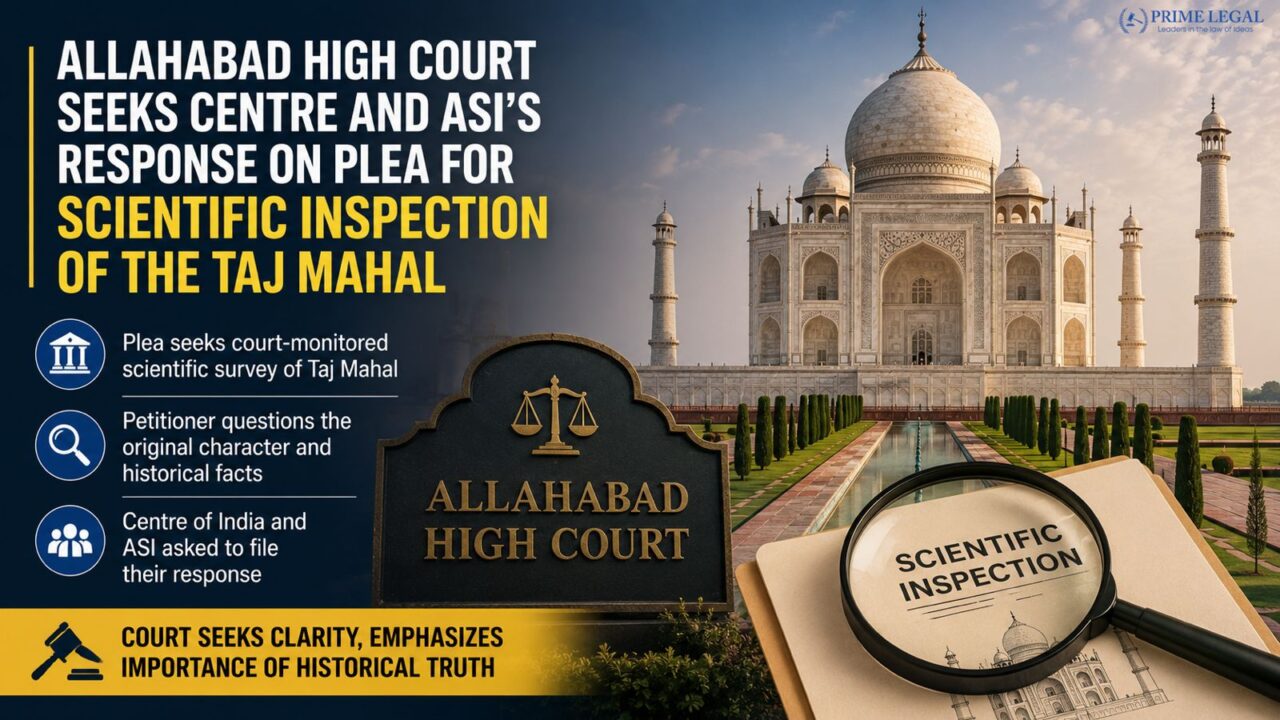
The Allahabad High Court has asked the Union Government (UOI) and Archaeological Survey of India (ASI) to submit counter-affidavits in the case of Lord Sri Agreshwar Mahadev Nagnatheswar Virajman and Others v. Union of India and Others. The petitioner claims that the Taj Mahal was first built as a Hindu temple named “Tejo Mahalaya”, dedicated to Lord Shiva. The petitioner’s prayer to the court was to direct that the Taj Mahal undergo a historical survey. The challenged the verdicts of the Agra trial and revisional courts that denied the appointment of a commissioner to visit, inspect and carry out photography and videography of the disputed historical site. This issue has reignited a historical debate and the High Court has to decide whether the lower courts have acted rightfully in refusing the appointment of a commissioner and whether there exists a need for a scientific inspection of the monument.
BACKGROUND:
The issue traces back to a suit initiated in the name of Lord Sri Agreshwar Mahadev Nagnatheswar Virajman in the year 2015 through a next friend Advocate Hari Shankar Jain, and other believers before the court of a Civil Judge in Agra. The petitioners sought a declaration that the Taj Mahal is the “Tejo Mahalaya” temple. Their intention was to highlight the fact that they have the right to worship inside the Taj Mahal as under Article 25 of the Constitution. While the case was heard in the lower court, a plea was filed by the petitioners for getting an Advocate Commissioner appointed to inspect the site, collecting photographs of the monument, and recording some features which included architectural structures that prove how it was a temple of Hindus. Such requests have been rejected by the trial court and the revision court respectively, which has given rise to the petition being filed in the Allahabad High Court.
The High Court has given notice to the Union Government and the ASI and asked them to file counter-affidavits.
KEY POINTS:
-
- Petitioners have challenged that the Taj Mahal is a historical, Hindu temple named “Tejo Mahalaya” dedicated to Lord Shiva.
- The lower courts’ decision prohibits appointment of Advocate Commissioner for the investigation of the Taj Mahal.
- Allahabad High Court has sought responses from the Union Government and ASI regarding appointment of a Commission but it has not sought any scientific investigation.
- The case involves constitutional rights and evidence about the role of the Commission in civil procedure.
ANALYSIS:
The controversy arises regarding a heritage site and involves constitutional rights and the civil procedure. The petitioners have taken recourse to Article 25 of the Constitution and argue that in case the disputed structure is eventually held to be a Hindu place of worship, then the worshippers are entitled to invoke the provisions of Article 25. But the civil court must first ascertain the factual position regarding the nature of the property in question, before any constitutional claims are to be entertained.
As far as the procedural aspect is concerned, the petition primarily relates to the ambit of the provisions under Order XXVI of the Code of Civil procedure, 1908, that empowers the court to appoint an Advocate Commissioner in cases where the local inspection is required for the effective adjudication of the matter. In this regard, the petitioners have contended that it would not be possible to prove the instrumentalities of the monument without a physical inspection of the monument and relevant pictures or video graphs. The High Court has to ascertain the respective legal principles regarding the scope of the authority under the Code of Civil Procedure, 1908.
The case also brings attention to the provisions of the Ancient Monuments and Archaeological Sites and Remains Act, 1958 as the ASI is established under this Act and is statutorily bound to preserve and maintain monuments of national importance. Although, Article 226 of the Constitution gives the High Courts an extremely wide range of powers to review administrative decisions, the courts can only intervene where the authorities have acted arbitrarily, illegally, or have failed to fulfil their obligations.
CONCLUSION:
The Allahabad High Court’s ruling does not confirm or deny the assertion that the Taj Mahal was a temple about 2,000 years ago. The question here is that, , whether or not sufficient legal grounds exist for appointing the Advocate Commissioner and carrying out scientific investigation as prayed by the petitioners. The ultimate outcome of this case may throw light on what will count as a valid order for investigative action against a protected monument and the extent to which constitutional rights can be invoked in long-term suits involving a place of historical significance. The case further reflects the need for the judiciary to balance different religious interests against evidence and legislation in order to preserve India’s cultural heritage through legal mechanisms.
“PRIME LEGAL is a National Award-winning law firm with over two decades of experience across diverse legal sectors. We are dedicated to setting the standard for legal excellence in civil, criminal, and family law.”
WRITTEN BY: SOMSUTA PAUL.

