
CASE NAME: Pooja Ramesh Singh v. Jammu and Kashmir Bank Ltd. & Anr.
CITATION: 2026 INSC 668
CASE NUMBER: Civil Appeal No. 11950 of 2025
COURT: The Supreme Court of India
DATE OF JUDGMENT: 2nd July, 2026
QUORUM: Hon’ble Mr. Justice Pamidighantam Sri Narasimha and Hon’ble Mr. Justice Alok Aradhe
FACTS
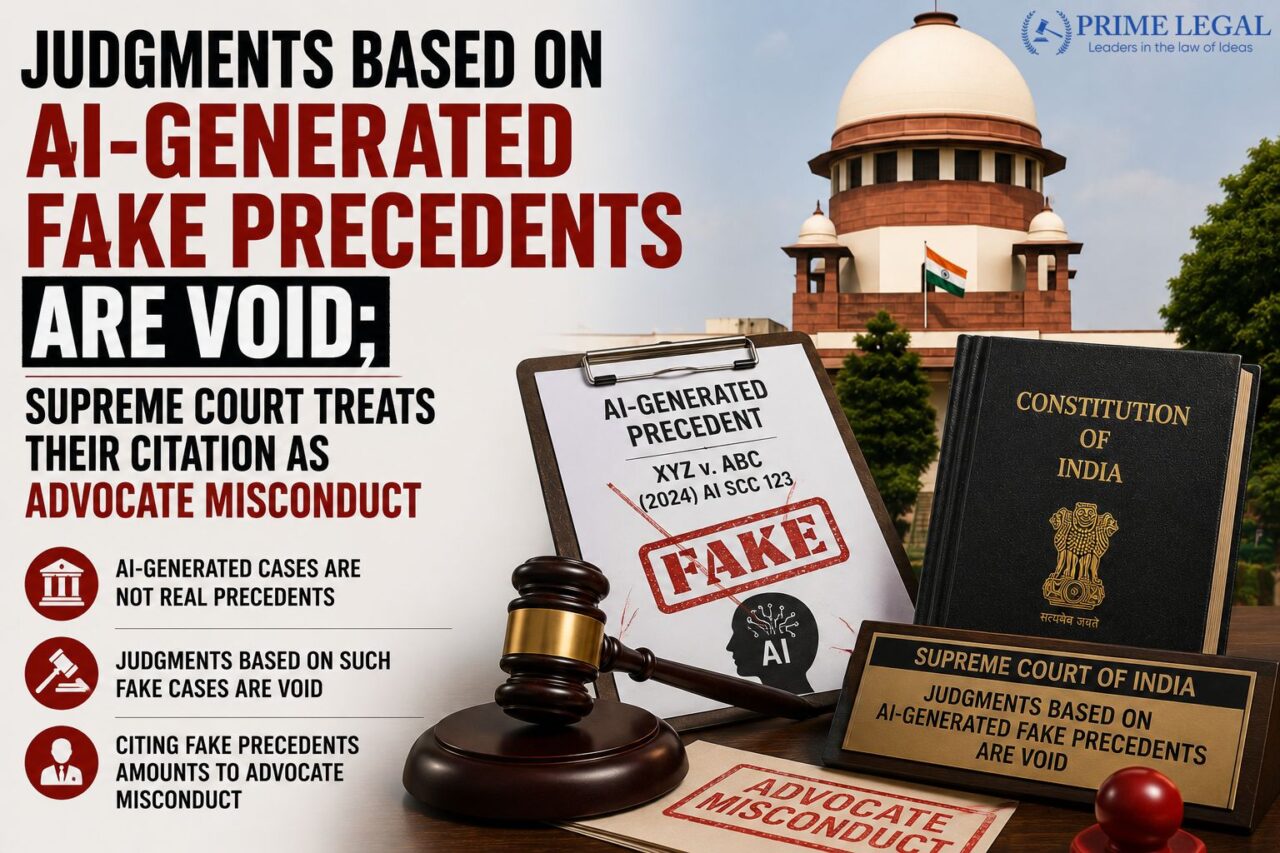
In the instant Civil Appeal, the Appellant who is a suspended director of Essel Infraprojects Ltd. (EIL), challenged the order of the National Company Law Tribunal (NCLT) and the National Company Law Appellate Tribunal (NCLAT) decided on the basis of artificial intelligence (AI) to create non-existent legal precedents.
The Appellant has challenged the order before the NCLAT claiming that the liabilities of EIL have been shifted through demerger and amalgamation and that the guarantee has become nullified as a result of the issuance of sanction letter. The NCLAT on 11th September, 2025 has affirmed the NCLT order relying on a series of Supreme Court precedents cited in para 12 of its order. The Appellant had taken an appeal before the Supreme Court on this score only to find that the precedents relied upon by the trial court to reject their arguments don’t exist.
ISSUES
- Whether a judicial or quasi-judicial decision based on non-existent, fake and AI-generated content can be upheld by the law, or whether it is a violation of the rule of law.
- Whether the corporate guarantee provided by EIL was dissolved or waived as a consequence of internal restructuring of the company (scheme of demerger and amalgamation).
- What parameters and regulatory obligations should be placed on the Bar and the Bench to ensure monitoring, verification and limitation of the use of AI in legal submissions and adjudication.
LEGAL PROVISIONS
- Section 7 and Section 14 of the Insolvency and Bankruptcy Code, 2016 (IBC).
- Statutory Disciplinary Framework and Norms of Professional Conduct of the Bar Council of India.
The AI generated cases were:
- State Bank of India v. M/s Shree Ram Urban Infrastructure Ltd.
- Everest Kento Cylinders Ltd. v. Union of India.
- ICICI Bank Ltd. v. Urban Infrastructure Real Estate Ltd.
- V.S. Dempo & Co. Ltd. v. Reliance Communications Ltd.
- Canara Bank v. N.G. Subbaraya Setty & Anr.
- Sarbjit Singh v. Union Bank of India.
ARGUMENTS
APPELLANT
The Appellant argued that both the NCLT and NCLAT erred significantly on the merits of the case by ignoring that the debt liabilities had shifted onto a separate entity through a corporate scheme of demerger and amalgamation. It was also argued that a new sanction letter dated 18.11.2017 did not expressly continue the guarantee, implying that this was abandoned.
We will highlight here that the Appellant’s counsel, in his own words, proved that the arguments of the Appellant and the paragraphs extracted by the NCLT for its systematic annulment were all fake, non-existent, and most parts were AI-generated.
What’s significant here is that the counsel for the Appellant and in his own words, established that the legal citations and the extracted paragraphs on which the NCLT relied to systematically strike down the arguments of the Appellant are all fake, all non-existent, and in fact, most of the citations and paragraphs were AI-generated.
RESPONDENT
The Respondents had rebutted the Appellant’s submissions on the fundamental insolvency issues of the proceedings. With regard to the fake case laws, Respondent No. 1 had taken a firm stand and had filed an official affidavit stating that the fabricated judgments used by the NCLT were never presented before its lawyers in court. The affidavit revealed that these precedents had been thoughtlessly created and imported by the adjudicating authority unaided and unthinkingly, based on their own research.
ANALYSIS
The Supreme Court, on an independent verification, came to a shocking realization that several judgments referred to by the NCLT were totally non-existent, and that true citations of the same contained fake paragraphs in the judgments.
The Court acknowledged that technology is a useful and powerful tool for improving efficiency, but that a reliance on AI without regulation poses a threat of transformation.
When the faculty of the mind is given over to the machine, it is the individual’s innate ability to distinguish right from wrong. The Court analysed how the introduction of hallucinated AI content as precedent in the realm of adjudication is the equivalent of the release of methyl isocyanate in the province of law and justice which is utterly devastating. The Court therefore pronounced an absolute zero-tolerance towards the Bar.
The Bench has determined that if there is a tinge of such invented material in any decision, it is deemed as no decision in the eyes of the law which is a violation of the fundamental sanctity of adjudication.
JUDGEMENT
The Supreme Court of India allowed the appeal, setting aside the orders of both the NCLT and NCLAT dated 28th August, 2024 and 11th September, 2025, respectively. The Court annulled the deleted Section 7 application and remanded it for fresh inspection by NCLT to pass appropriate orders on its own merits within two weeks of the order.
In the meantime, the Court directed that there be a status quo without any final decision on the merits. Furthermore, the Bar Council of India was directed to constitute a committee to look into the issue and prescribe disciplinary norms against submitting falsely created precedents generated by AI.
CONCLUSION
The court ruled that judicial rulings based on AI-generated precedents which are hallucinated are to be declared null and void, since it undermines the rule of law. It states that a human in the loop must be present at all points of legal adjudication and imposes strict accountability on the lawyers and judges to closely scrutinise the sources of the information.
PRIME LEGAL is a National Award-winning law firm with over two decades of experience across diverse legal sectors. We are dedicated to setting the standard for legal excellence in civil, criminal, and family law.
WRITTEN BY: SHEEN.
Read the judgment copy below:
POOJA RAMESH SINGH VERSUS JAMMU AND KASHMIR BANK LTD & ANR.

