
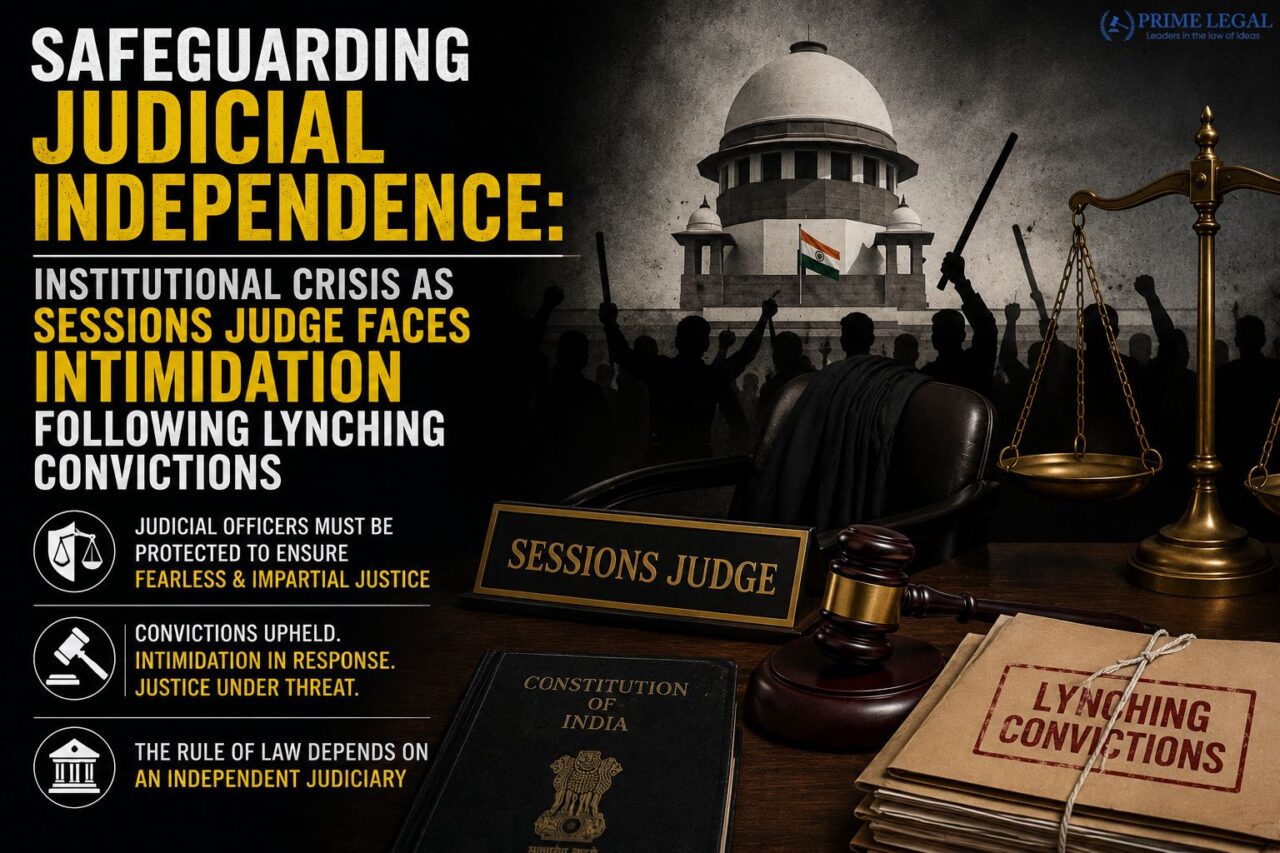
INTRODUCTION:
Judicial independence is one of the key features of a constitutional democracy. Judicial independence does not only separate judiciary as an organ from Executive and Legislative interference but also enables the administration of ‘Rule of Law’. In the landmark case of Kesavananda Bharati v. State of Kerala 1973 4 SCC 225. The Supreme Court clarified that Judicial Independence forms a basic structure of the Indian Constitution. Recent reports alleging that a sessions judge faced intimidation after delivering judgement in a sensitive mob-lynching case sparked nation-wide debate on safety of judges and its impact on judicial independence. The controversy has gained substantial attention among the legal fraternity regarding the need to strengthen institutional safety protocols for judicial officers. The debate highlights that public confidence in the administration of justice does not only depend on absence of executive or legislative interference but also on the ability of the judiciary to independently decide cases on their merits without facing any threat or intimidation.
BACKGROUND:
The controversy arose in Madhya Pradesh during the aftermath of a conviction judgement in a mob-lynching case. As reports suggest, on 12th June 2026, Additional District and Sessions Judge (ADJ) of Narmadapuram district, Tabassum Khan convicted 14 men for the mob lynching of Sheikh Lala Nazir Ahmed, a truck driver in August 2022, over suspicions of cattle smuggling and sentenced them to life imprisonment. Over the past few days, several videos by unidentified men and women threatening the judge have been circulating over various social media platforms. Some videos show men and women making communal remarks and using abusive language in order to intimidate the judge. Following the threats, a case has been registered against unidentified persons and help has been sought from state police’s cyber cell to track and identify the offenders. (Source: Indian Express) Further, the union cyber crime unit has also alerted the Madhya Pradesh authorities about the threatening videos. In a statement issued on July 1, The Supreme Court Advocates on Record Association (SCAORA) strongly condemned the threats and targeted social media campaigns against the sessions judge and remarked that, “judicial orders must be challenged only through legal remedies and not by intimidation or personal attacks against judges”.
KEY POINTS:
- Judicial Independence forms a basic structure of the Indian Constitution
- Article 50 of the Indian Constitution mandates the state to separate judiciary from executive organs.
- Additional District and Sessions Judge (ADJ) of Narmadapuram district, Madhya Pradesh, Tabassum Khan was allegedly threatened and intimidated by unknown persons over conviction of 14 men in a mob-lynching case related to suspicions of cattle smuggling.
- Videos uploaded on social media reveal communal remarks and threats made against the sessions judge.
- The legal fraternity across the nation has condemned the incident and emphasized that Judicial accountability must be administered through formal legal procedures, not perceived retaliation.
- The controversy has raised demands for strong institutional safeguards for judges and officials handling sensitive criminal cases.
ANALYSIS:
The current controversy transcends beyond a specific incident and strikes at the core of a constitutional democracy. Judicial independence being the cornerstone of rule of law is a basic structure of the Indian constitution. This position has been many a times reiterated by the Supreme court in several cases including the Supreme Court Advocates-on-Record Association v. Union of India, case 1993 (4) SCC 441. Further the constitution guarantees
There exists a critical balance between judicial independence and judicial accountability. Judges should undoubtedly remain accountable but only through formal legal mechanisms prescribed by the constitution. The criminal justice system operates on the principle that judicial discretion should be free from bias and should only depend on the evidence and law; any act that seeks to limit judicial discretion would not only affect individual cases but the entire justice process.
Judges must be protected from any threat of retaliation arising out of personal grievances. Public trust in judicial institutions can only be maintained if judicial officers are protected against external interference and intimidation. Institutional protection must be increased for district-level judges dealing with politically and socially sensitive cases.
CONCLUSION:
The case of threatening and intimidating a Sessions Judge serves as a critical reminder as to why judicial independence needs to be safeguarded at every step of the judicial process. While the charges are yet to be confirmed, the incident has brought light to the importance of ensuring adequate safeguards for the lower judiciary. As justice can only be done if judgements can be delivered without fear or favour.
“PRIME LEGAL is a National Award-winning law firm with over two decades of experience across diverse legal sectors. We are dedicated to setting the standard for legal excellence in civil, criminal, and family law.”
WRITTEN BY: SOMSUTA PAUL.

