
ABSTRACT
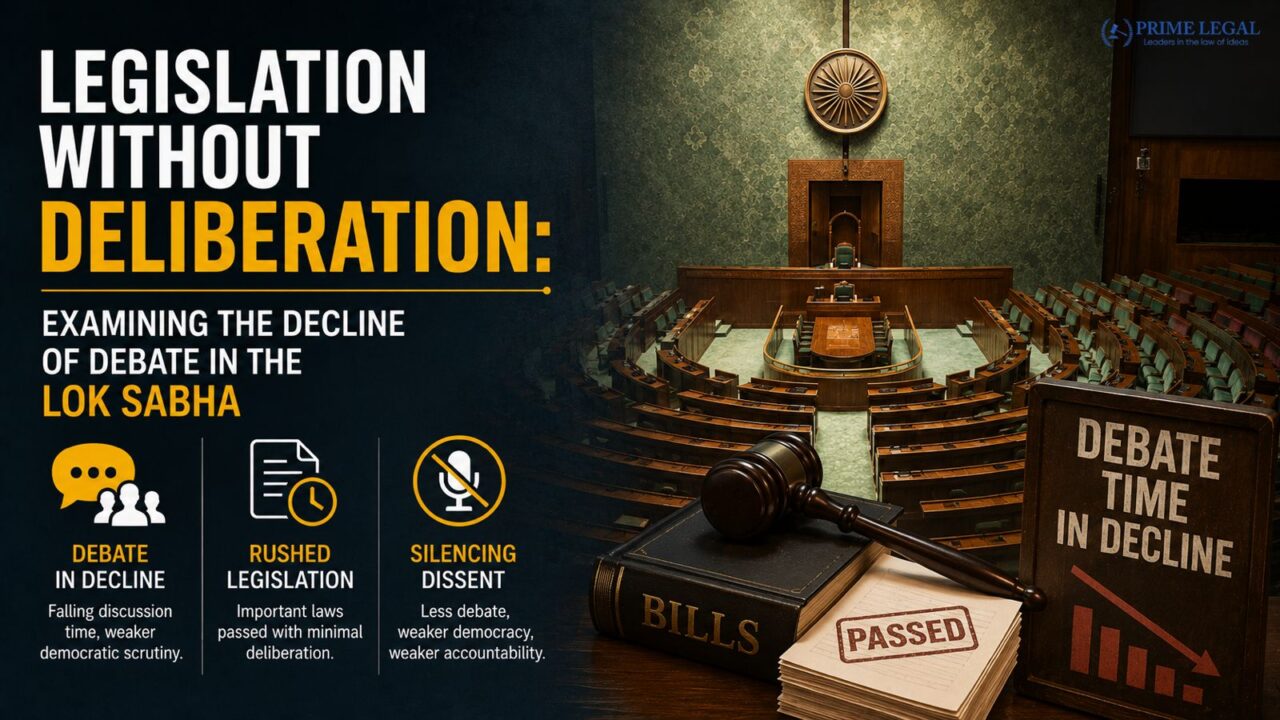
“Parliament exists, at its core, to deliberate to debate, question, and scrutinise laws before they bind an entire nation. Yet increasingly, bills in India are passing through the Lok Sabha in minutes rather than hours, often without meaningful discussion or committee scrutiny. This article examines the steady decline in parliamentary deliberation, tracing how sitting days, productivity levels, and the practice of referring bills to Standing Committees have all shrunk over successive Lok Sabhas. It looks at the constitutional expectations set out under Article 107 and Article 118, examines recent sessions where legislation was passed within minutes of introduction, and considers what this pattern means for the quality of India’s laws and the health of its democratic institutions.”
KEYWORDS: Lok Sabha, Parliamentary Deliberation, Article 107, Standing Committees, PRS Legislative Research, Legislative Scrutiny, Parliamentary Productivity.
INTRODUCTION
There’s a particular image most of us carry of how a law is supposed to come into being elected members standing up, making their case, being questioned. Somewhere in that back-and-forth, the theory goes, bad ideas get filtered out and good ones get sharpened. That is, after all, the entire point of having a Parliament rather than simply letting the executive issue decrees. But if you look closely at how bills are actually passed in the Lok Sabha today, that image doesn’t hold up particularly well. Bills are increasingly cleared within minutes, sometimes without a single amendment being discussed, sometimes without the opposition even present in the chamber. This isn’t a one-off aberration during a chaotic session, it’s become something close to a pattern. This article tries to trace how we got here, what the numbers actually show, and why legislation passed without deliberation is a problem worth taking seriously, not just a procedural footnote.
THE CONSTITUTIONAL EXPECTATION OF DEBATE
Parliament’s law-making power isn’t merely procedural; it comes wrapped in an assumption of deliberation. Article 107 of the Constitution lays down the process by which a bill becomes law, and Article 118 empowers each House to make its own rules of procedure, which in turn provide for readings, discussion, and clause-by-clause consideration before a bill is passed. None of this is decorative. The framers of the Constitution assumed, reasonably, that the numbers a majority commands in the House would be checked by the requirement to actually justify a law in open debate. Former Lok Sabha Secretary-General P.D.T. Achary has been fairly blunt about this, describing the passage of bills without debate as something close to a “mockery of legislative business” under Article 107 a formal box being ticked while the substance the provision was meant to protect simply falls away.
WHAT THE NUMBERS ACTUALLY SHOW
Numbers tend to make this argument better than adjectives do. PRS Legislative Research, which has tracked Parliament’s functioning for years, offers a fairly stark picture. The first Lok Sabha, sitting between 1952 and 1957, met on 677 days and passed 319 bills. The 14th Lok Sabha, roughly fifty years later, met for less than half as many sittings and passed 247 bills. The 17th Lok Sabha (2019–2024) recorded the fewest sittings of any full-term Lok Sabha since Independence in just 274 days, helped along by the pandemic, but reflecting a longer-term trend rather than a one-off disruption. Only 16% of bills introduced during that term were referred to Parliamentary Standing Committees for detailed scrutiny, a mechanism that exists precisely to catch drafting errors and unintended consequences before a bill becomes binding law.
More recent sessions haven’t reversed this. The 2026 Monsoon Session saw Lok Sabha productivity collapse to around 15 – 19%, the lowest since the 2016 Winter Session, itself dominated by disruption over demonetisation. Nineteen sittings produced twelve bills, and eleven of those went through without any real debate passed through voice votes amid protest rather than through considered discussion. Some of these took a matter of minutes: the Regulation of Online Gaming Bill, for instance, received roughly six minutes of discussion in the Lok Sabha before being cleared. This isn’t new to any one government, either under UPA-I, roughly 18% of bills passed in the 14th Lok Sabha were approved in under five minutes each, so it would be inaccurate to frame this purely as a recent or partisan phenomenon. What’s changed is the scale and consistency of it.
WHY THIS IS HAPPENING
A few threads run through most explanations for this decline. The first is disruption, walkouts, protests, and the suspension of members, increasingly concentrated on opposition benches, eating directly into the time available for debate. When a session is repeatedly adjourned, the government still has legislative business to clear, and the path of least resistance becomes pushing bills through during whatever brief window of order exists, rather than allowing extended debate to unfold. The second is a broader shift toward executive dominance, where the government of the day treats its parliamentary majority as sufficient justification in itself, without feeling particularly obliged to engage the opposition’s objections on the floor. The third, less discussed but arguably more structural, is the declining use of Standing Committees. These committees allow smaller groups of MPs, across party lines, to examine a bill’s technical detail away from the theatre of the main chamber and when fewer bills are referred to them, that layer of scrutiny simply disappears rather than being replaced by anything else.
THE PRACTICAL CONSEQUENCES OF UNDEBATED LAW
It would be easy to treat this as an abstract complaint about democratic culture, but the consequences are fairly concrete. Bills passed without adequate scrutiny tend to carry drafting problems that surface only after they’ve become law ambiguous provisions, unintended overlaps with existing statutes, or practical implementation gaps that a committee review would likely have caught. Litigators and courts frequently end up doing, after the fact, the interpretive work that a proper legislative debate was meant to do beforehand parsing intent from a Statement of Objects and Reasons rather than from any recorded parliamentary discussion, because none really took place. There’s also a quieter cost to public trust. When citizens see legislation affecting taxation, digital rights, or personal liberty pushed through in a matter of minutes, it reinforces a sense that Parliament functions more as a formality than as a genuine check on executive power which, over time, chips away at the legitimacy the institution depends on.
IS THERE A WAY BACK?
None of this is irreversible, and it’s worth being clear about that. The National Commission to Review the Working of the Constitution recommended, back in 2002, that Houses with more members should sit for at least 90 days a year, a benchmark that’s been missed fairly consistently since. Some MPs and commentators have pushed for a fixed, published sitting calendar, similar to what’s followed in the UK, Canada, and Australia, so that legislative business isn’t held hostage to shifting political convenience each session. Reviving the practice of routinely referring bills to Standing Committees, rather than treating it as optional, would also restore at least one layer of scrutiny without requiring any change to existing rules; it would simply mean using the mechanisms that already exist. None of these fixes require a constitutional amendment. They mostly require a willingness, across party lines, to treat deliberation as something worth protecting rather than something to be worked around whenever it’s inconvenient.
CONCLUSION
A bill that clears the Lok Sabha in six minutes has, technically, become law just as validly as one debated for six hours; the Constitution doesn’t grade the quality of the process once the vote is taken. But there’s a real difference between law that has been tested by argument and law that has simply been waved through, and that difference tends to show up later, in courtrooms and in implementation failures, long after the session that passed it has been forgotten. The decline in deliberation isn’t confined to one government or one party; it’s a structural drift that’s been building for decades, visible in sitting days, in Standing Committee referrals, and in the shrinking minutes recorded against each bill. Reversing it isn’t complicated in principle, even if it’s difficult in practice it mostly requires treating debate as a feature of law-making rather than an obstacle to it.
“PRIME LEGAL is a National Award-winning law firm with over two decades of experience across diverse legal sectors. We are dedicated to setting the standard for legal excellence in civil, criminal, and family law.”
WRITTEN BY: MAHFUZA FATHIMA

