
Abstract
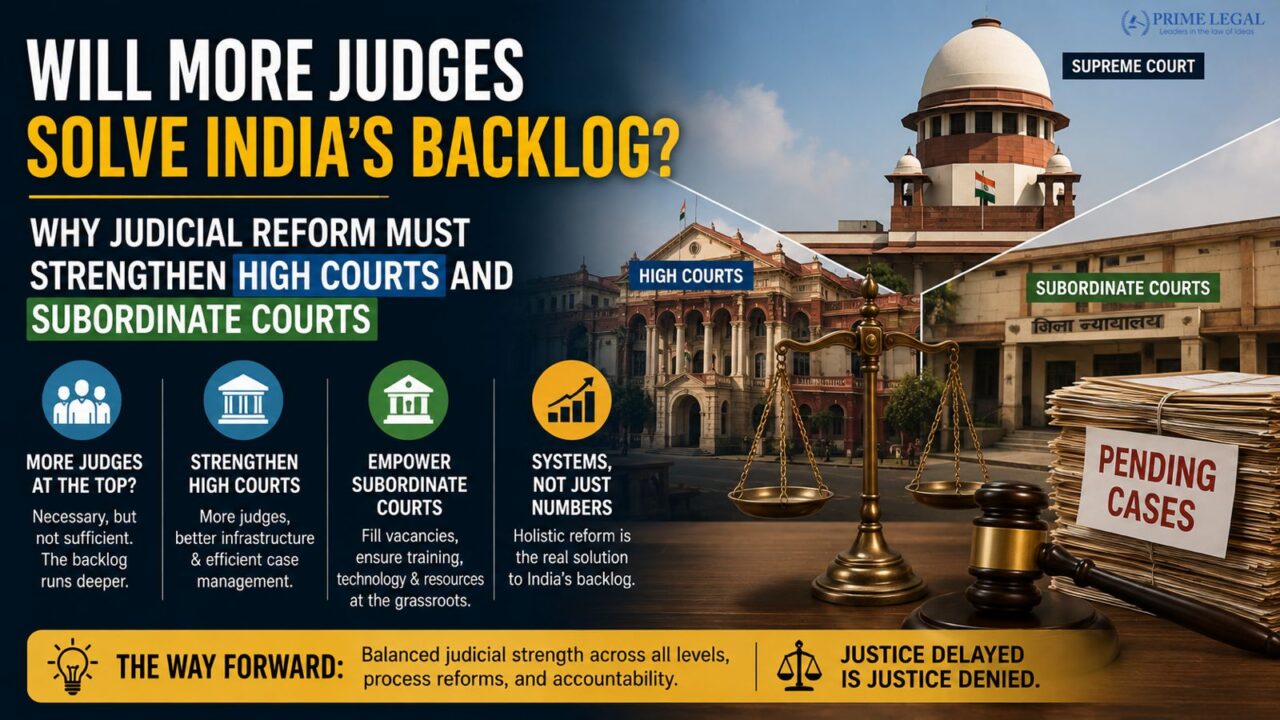
Sanctioning more judges is the default policy reflex whenever India’s case backlog makes headlines. But the numbers coming out of the National Judicial Data Grid (NJDG) in 2025–26 tell a more layered story: the Supreme Court, functioning at its full sanctioned strength of 34 judges, still recorded an all-time-high pendency of roughly 90,000 cases, while the High Courts and subordinate courts which together hold well over 99 percent of all pending cases continue to carry a combined vacancy of 20–33 percent. This gap points to where the real policy work lies. Judicial strength matters, but the backlog is overwhelmingly a High Court and subordinate court problem, and the solution has to be built at that level: filling posts, using the judges India already has more efficiently, and diverting cases away from full trial wherever possible.
KEYWORDS: Judicial Pendency, Judicial Vacancies, Case Management, Alternative Dispute Resolution (ADR) ,Judicial Infrastructure & Technology
Where the Backlog Actually Sits
Of India’s roughly 4.7 crore pending cases, the district and subordinate courts account for close to 90 percent, the High Courts for a further 13 percent or so, and the Supreme Court for a fraction of one percent. Any strategy that concentrates political and administrative attention on the apex court, or treats “judicial strength” as a single national number, is targeting the smallest part of the problem. While the pendency of the Supreme Court alone in 2025 reached its highest figure of about 88,400 cases, it must be remembered that it was functioning fully to its sanctioned strength of 34 judges. The pendency of the High Courts collectively stands at 62-63 lakh cases, despite a judge vacancy of about 30-33 percent. The pendency of the district and subordinate courts, where the majority of cases are heard, stands at about 4.4 to 4.7 crore cases, despite a judge vacancy of about 21 percent against sanctioned judicial strength. India’s judge-to-population ratio is about 21 judges per million against about 150 per million in the US, as noted by the Law Commission years ago.
The vacancy pattern reinforces the same point. High Courts are functioning with roughly a third of their sanctioned judgeships empty, and the subordinate judiciary despite its cadre having grown to over 25,000 sanctioned posts still runs at roughly one-fifth vacancy. Because subordinate courts are also where over 85 percent of all cases pending for more than 30 years sit, and where more than half of pending matters are over three years old, even a modest improvement in subordinate-court throughput moves the national backlog far more than any comparable change at the Supreme Court.
Filling the Posts that Already Exist
The single most direct lever is converting sanctioned vacancies into working judges, since a large share of the shortfall is not a shortage of posts but a shortage of people in them. This means fixed, enforced annual recruitment calendars for the subordinate judiciary – notification of vacancies, examinations and appointment letters completed on a predictable yearly cycle rather than an ad hoc one, so that High Courts and State Public Service Commissions cannot let a recruitment year lapse. For the High Courts, it means faster processing of collegium recommendations and consistent, time-bound responses from the Union government once names are cleared, since delay at the appointment stage is now as significant a source of High Court vacancy as delay in generating recommendations in the first place. A long-debated structural option is a pan-India entry-level judicial service, an All India Judicial Service that would let the subordinate judiciary recruit centrally against a national talent pool instead of forcing every State to run its own examination cycle; this remains contested on federalism grounds but is worth revisiting specifically for chronic-vacancy States.
Using Existing Judicial Capacity More Efficiently
Alongside recruitment, the existing judge-strength can be stretched further through better case management rather than simply adding numbers. Evening and weekend courts, dedicated “clearance weeks” for petty and compoundable matters, and short-term engagement of retired judges and judicial officers on contract to clear specific categories of backlog have all been piloted in various States with visible results on old and stagnant case files. Fast Track Courts, already used for cases under special statutes such as the POCSO Act and the NIA Act, are a proven model for ring-fencing high-priority categories so they do not get buried under routine civil filings. Commercial Courts, created under the Commercial Courts Act, 2015 with lowered pecuniary thresholds and mandated electronic case management, show that a purpose-built track with strict timelines can materially outperform the general civil docket for the same category of dispute. The lesson generalises: category-specific fast tracks, not only more judges, change disposal rates.
Diverting Cases Out of the Courtroom
A large share of subordinate-court filings never needed a full trial in the first place, and India’s Lok Adalat system already demonstrates the scale of what pre-trial and out-of-court settlement can absorb: national Lok Adalats have resolved crores of cases in a single day of sittings, and cumulative disposals since 2021 run into the tens of crores. The Mediation Act, 2023 institutionalises pre-litigation mediation for a wider band of civil and commercial disputes, and arbitration under the Arbitration and Conciliation Act is designed to resolve commercial matters in twelve to eighteen months rather than the multi-year timelines typical of ordinary civil suits. Scaling these mechanisms mandatory pre-litigation mediation for defined categories of civil and matrimonial disputes, a trained and certified national pool of mediators, and online dispute resolution for small-value and consumer claims keeps disputes out of the subordinate court docket altogether rather than merely speeding up their passage through it.
Reducing Government Litigation
Central and State government departments and public sector entities are estimated to generate close to half of all pending litigation, much of it appeals against routine service, pension, land and contractual matters that could be resolved through internal departmental review or a national litigation policy with binding thresholds on when the government may appeal. Empowering departmental legal cells to settle or withdraw weak appeals, and requiring a documented cost-benefit assessment before a government appeal is filed, would remove a large and entirely controllable share of both High Court and subordinate court filings without touching judge strength at all.
Infrastructure and Technology at the High Court and District Level
Even a fully staffed subordinate judiciary cannot function without courtrooms, residential quarters for judges, support staff and digital systems, and this is precisely where the Centrally Sponsored Scheme for Development of Infrastructure for the Judiciary and the e-Courts Mission Mode Project are targeted. E-Courts Phase III is extending e-filing, video-conferencing, virtual courts for traffic and petty offences, and the Virtual Justice Clock down to the district level, while tools such as the Supreme Court’s FASTER system for electronic transmission of bail orders and AI-assisted research tools like SUPACE point toward what case-management technology can do for High Courts and district courts once it is scaled beyond pilot use. Because subordinate courts, not the Supreme Court, are where the bulk of the country’s courtroom and staffing shortage is concentrated, infrastructure spending directed at the district level produces a disproportionately larger reduction in national pendency than the same spending directed upward.
A Hierarchy-Wide, District-First Approach
Put together, the evidence points to a layered strategy rather than a single fix. At the subordinate court level where nearly 90 percent of the backlog sits, priority should go to enforced recruitment calendars, courtroom and staffing infrastructure, Lok Adalats and mandatory pre-litigation mediation, and category-specific fast tracks for high-volume matters such as cheque-bounce, traffic and petty criminal cases. At the High Court level, priority should go to faster collegium-to-appointment turnaround, digitised and better-managed case listing, and continued expansion of Commercial Courts and other specialised benches. At the level of government as a litigant, priority should go to a binding litigation policy that filters out weak appeals before they reach either tier. Judicial strength remains part of this picture filling existing vacancies is still the fastest available lever but the record of the past several years, particularly the Supreme Court’s own experience of record pendency at full strength, shows that strength unaccompanied by recruitment discipline, infrastructure, technology and dispute diversion at the High Court and subordinate court level will not by itself bring the backlog down.
Conclusion
India’s judicial backlog is not one problem but a stack of them, and it is concentrated almost entirely below the Supreme Court. Increasing judicial strength helps only to the extent that the posts created are actually filled, supported with courtrooms and staff, and paired with case-management and dispute-diversion tools that reduce what reaches trial in the first place. The most realistic path to a smaller backlog is not a single number for judges per million people, but a combination of enforced recruitment timelines, expanded infrastructure and technology at the district and High Court level, wider use of Lok Adalats, mediation and arbitration, category-specific fast tracks, and a disciplined reduction in government litigation applied where the cases actually are: the High Courts and, above all, the subordinate courts.
“PRIME LEGAL is a National Award-winning law firm with over two decades of experience across diverse legal sectors. We are dedicated to setting the standard for legal excellence in civil, criminal, and family law.”
WRITTEN BY: DRISHTITA BANIK

